NI Labour Market Cools After Record July Growth as Median Monthly Pay Reaches £2,498
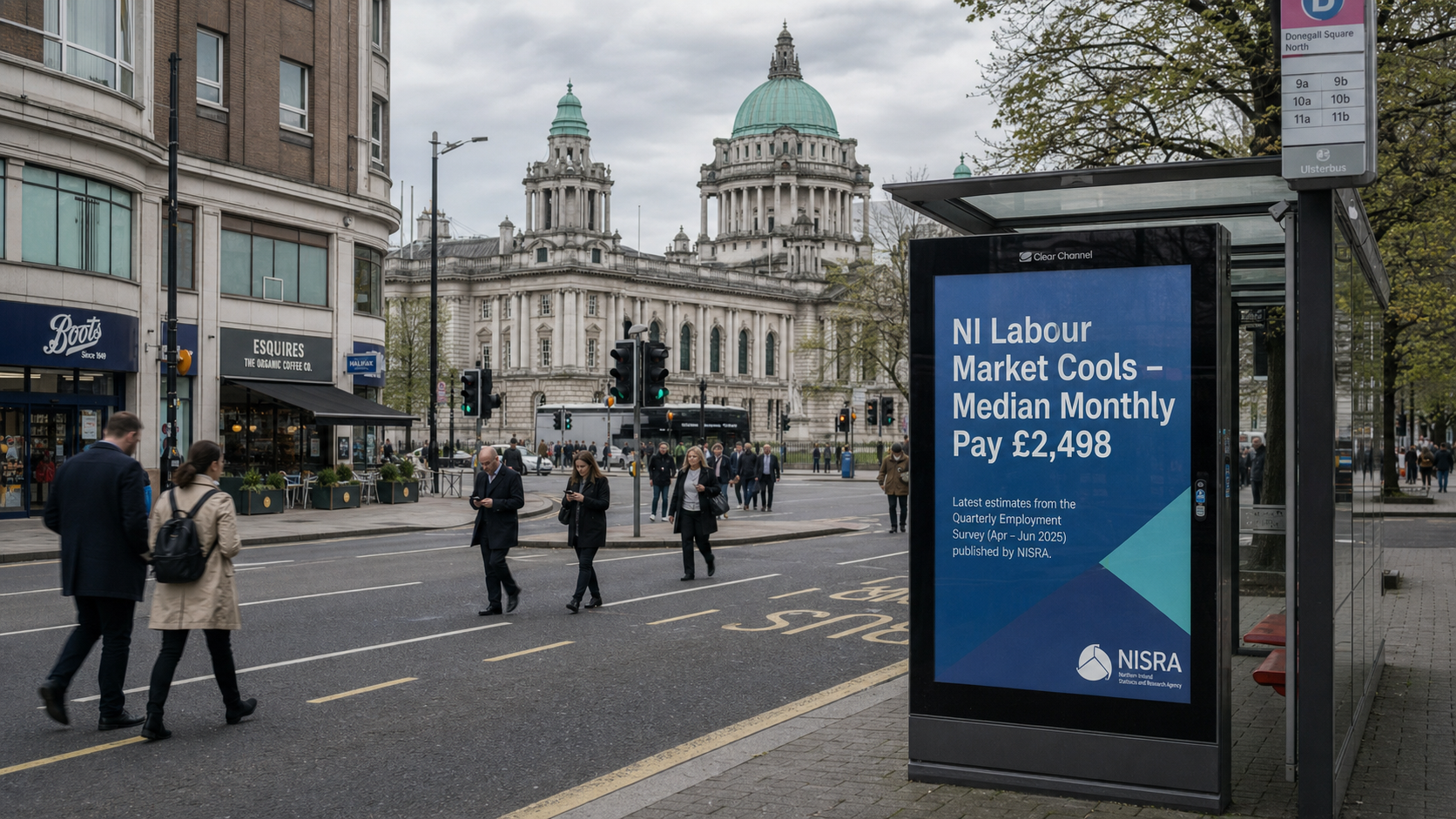
Northern Ireland's labour market is showing signs of cooling after a period of record-breaking growth, according to the latest statistics from the Northern Ireland Statistics and Research Agency, with payrolled employees reaching 819,900 in July 2026 — a 1.1 per cent annual increase — while median monthly pay rose 5.4 per cent to £2,498, though analysts warn that the Stormont budget deadlock and energy price pressures are creating significant headwinds for the local economy.
Background
Northern Ireland's labour market has been one of the more resilient in the United Kingdom over the past several years, with employment levels recovering strongly from the pandemic and wages growing at a pace that has, in many sectors, outstripped inflation. The unemployment rate has remained low by historical standards, and the claimant count — the number of people claiming unemployment-related benefits — has been significantly below the levels seen during previous economic downturns.
However, the Northern Ireland economy faces a distinctive set of challenges that distinguish it from other UK regions. The ongoing budget deadlock at Stormont, which has left departments operating on contingency funds and unable to make the capital investments needed to support economic growth, is a significant constraint on the public sector, which accounts for a larger share of employment in Northern Ireland than in most other parts of the UK. The energy price increases announced by Share Energy and other suppliers for October 2026 will add to the cost pressures facing households and businesses.
The Northern Ireland Statistics and Research Agency published the Labour Market Statistics for September 2026 on 15 September, providing the most recent comprehensive picture of employment, unemployment, earnings, and economic inactivity in the region. The statistics are derived from multiple sources, including the Labour Force Survey and HMRC's Pay As You Earn Real Time Information system.
Key Developments
The September 2026 statistics show that payrolled employees in Northern Ireland reached 819,900 in July 2026, representing a 1.1 per cent increase over the year. This figure is slightly below the peak of 820,800 recorded in February 2026, suggesting that the labour market is beginning to plateau after a period of sustained growth. Median monthly pay reached £2,498 in July 2026, an annual increase of 5.4 per cent — a figure that represents real wage growth for most workers, given that inflation has been running below this level for much of the year.
The unemployment rate for the April to June 2026 period was estimated at 2.0 per cent, one of the lowest rates recorded in Northern Ireland in recent decades. The claimant count stood at 33,300, a figure that has remained relatively stable over the past several months. Economic inactivity — the proportion of the working-age population that is neither employed nor actively seeking work — remains a concern, with Northern Ireland continuing to have a higher inactivity rate than most other UK regions, driven in part by long-term health conditions and caring responsibilities.
The cooling of the labour market is consistent with broader trends across the UK economy, where the combination of higher interest rates, reduced consumer spending, and global economic uncertainty has begun to dampen employment growth. In Northern Ireland, the specific pressures of the budget deadlock and the energy price increases are expected to add to these headwinds in the coming months.
Why It Matters
The labour market statistics provide an important barometer of the health of the Northern Ireland economy, and the signs of cooling are a reminder that the strong performance of recent years cannot be taken for granted. The budget deadlock at Stormont is particularly concerning from an economic perspective: the inability to make capital investment decisions is holding back infrastructure projects that would support private sector growth, and the uncertainty about public sector funding is affecting confidence among businesses that depend on public contracts. The energy price increases coming in October will reduce household disposable income and business profitability, adding further pressure to an economy that is already navigating a difficult environment. The resolution of the budget deadlock is therefore not merely a political priority but an economic necessity.
Local Impact
The labour market statistics have different implications for different parts of Northern Ireland. In Belfast, where the economy is more diversified and the private sector is stronger, the cooling of the labour market is less immediately concerning than in areas like Derry/Londonderry, Strabane, and Newry, where public sector employment accounts for a higher proportion of the workforce and where the budget deadlock has more direct consequences. In rural areas of Fermanagh, Tyrone, and Armagh, the agri-food sector — which is a major employer — is facing its own pressures from input cost inflation and market uncertainty. The overall picture is of an economy that has performed well in recent years but that is now facing a more challenging environment, and that needs the stability of a settled Stormont budget to maintain its momentum.
What's Next
The next Labour Market Statistics release from NISRA is expected in October 2026, providing data for August 2026. The Department for the Economy is expected to publish its economic outlook for Northern Ireland before the end of the year, providing a more comprehensive assessment of the challenges and opportunities facing the local economy. The resolution of the Stormont budget deadlock, which is expected before the UK government's own budget announcement on 28 October, will be a critical factor in determining the economic trajectory of Northern Ireland in the coming months.