Meta Confirms 8,000 Global Job Cuts as Ireland Fears for 1,800 Local Employees
Meta Platforms has confirmed it will cut approximately 8,000 jobs globally — 10% of its worldwide workforce — as it redirects an unprecedented $135 billion towards artificial intelligence in 2026, with Ireland's government yet to be formally notified about the impact on the company's 1,800 Irish employees and hundreds of additional contractor roles already under threat.
CEO Mark Zuckerberg communicated the layoffs to employees via memo on Thursday, 23 April, with the cuts expected to take effect on 20 May. The company also plans not to fill around 6,000 open positions. The announcement represents the largest single reduction at Meta since its "year of efficiency" in 2023, and marks a decisive shift from human capital to machine capital as the company bets its future on artificial intelligence.
Background
The 2026 layoffs are not an isolated event but the latest phase in a multi-year restructuring at Meta. The company eliminated over 21,000 roles during its 2022-23 "year of efficiency" — 11,000 in November 2022 and a further 10,000 in March 2023 — as it corrected for overhiring during the pandemic-era tech boom, when its headcount peaked at over 87,000. Smaller cuts followed in early 2026, affecting its Reality Labs metaverse unit. In total, since late 2022, Meta has reduced its workforce by approximately 25,000 employees.
Where earlier rounds were defensive corrections, the 2026 layoffs are more offensive in nature — a strategic reallocation of resources from human labour to AI infrastructure. Zuckerberg has stated that 2026 is "the year that AI starts to dramatically change the way that we work," noting that AI tools are enabling smaller, highly talented teams to accomplish tasks that previously required much larger groups. The company's planned AI spend of $115-135 billion in 2026 alone is roughly double its 2025 expenditure and equivalent to its total AI spending over the previous three years combined.
Key Developments
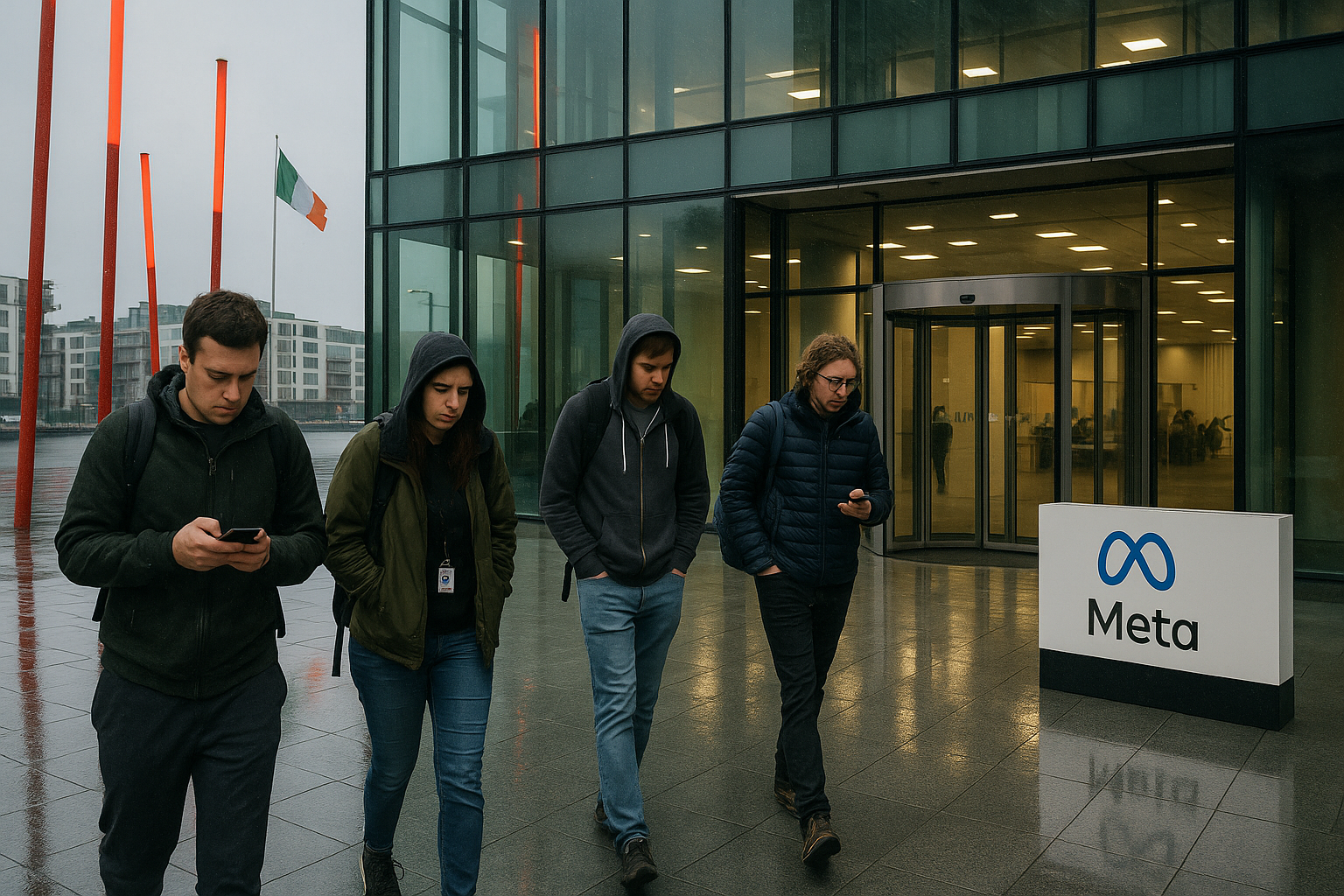
As of Friday, Meta had not yet formally notified the Department of Enterprise in Ireland about the specific impact on its Irish operations, which employ approximately 1,800 people — already down 40% from a peak of 3,000 in 2022. A proportional 10% reduction would affect around 180 direct employees. But the more immediate impact is being felt among contractors: Covalen, a firm providing staff for Meta projects, announced that over 700 roles in Dublin were at risk, with more than 500 of those in AI annotation — a field directly threatened by the development of more advanced AI systems.
Taoiseach Micheál Martin warned of "significant upheaval" in the job market driven by AI, stating that industry leaders have been candid about using AI to reduce headcount. Tánaiste Simon Harris acknowledged the "stressful and anxious" time for workers and affirmed that government agencies would engage with Meta. The Communications Workers' Union criticised the "mind-boggling AI spending" at the expense of "living breathing workers" and called for government intervention to ensure fair redundancy packages.
As The Irish Times reported, Meta's cuts are part of a sweeping trend across the technology sector. Oracle has initiated layoffs of between 20,000 and 30,000 employees, Snap eliminated 1,000 jobs in mid-April — 16% of its staff — and Amazon cut approximately 16,000 corporate roles globally in 2026. As of late April, over 104,000 tech employees have been laid off globally this year, with AI-driven efficiencies cited as the recurring justification.
Why It Matters
Meta's pivot illustrates a structural shift in the technology industry that has profound implications for workers, governments, and economies across the UK and Ireland. Companies are not cutting staff due to poor financial performance — Meta remains enormously profitable — but are making a calculated choice to convert operating expenses in the form of salaries into capital expenditure for AI systems, hardware, and data centres. The pattern is being replicated across the sector, from Microsoft offering voluntary retirement packages to 8,000 US employees, to Block cutting nearly 40% of its workforce.
For the UK, the impact has been more nuanced than in Ireland. While around 1,050 UK tech layoffs have been recorded in 2026, the hiring market is becoming more "measured and strategic" rather than collapsing outright. Demand remains robust for specialists in AI, cybersecurity, data engineering, and cloud architecture, with companies increasingly favouring project-based contractors over permanent hires. The challenge is for workers in roles most susceptible to automation — data annotation, content moderation, and routine software tasks — who face the most immediate displacement.
Local Impact
For Northern Ireland, the Meta layoffs are a reminder of the region's exposure to decisions made in Silicon Valley boardrooms. The tech sector has been a significant driver of employment growth in Belfast and beyond, with companies like Cloudsmith, Kainos, and Allstate providing thousands of well-paid jobs. The broader AI-driven restructuring of the global tech industry raises questions about the long-term sustainability of Northern Ireland's tech employment base, particularly in roles that are most susceptible to automation. Invest NI and the Department for the Economy will be watching developments closely as they seek to attract and retain tech investment in the region.
What's Next
The Irish government is exploring proposals to understand the implications of AI on the world of work, with the Taoiseach indicating he anticipates significant upheaval in the jobs market over the next decade. BBC News has reported that trade unions are calling for emergency meetings with Meta management and the government. For the 8,000 employees facing redundancy globally, the cuts take effect on 20 May — a date that will mark a significant moment in the ongoing transformation of the technology industry by artificial intelligence.