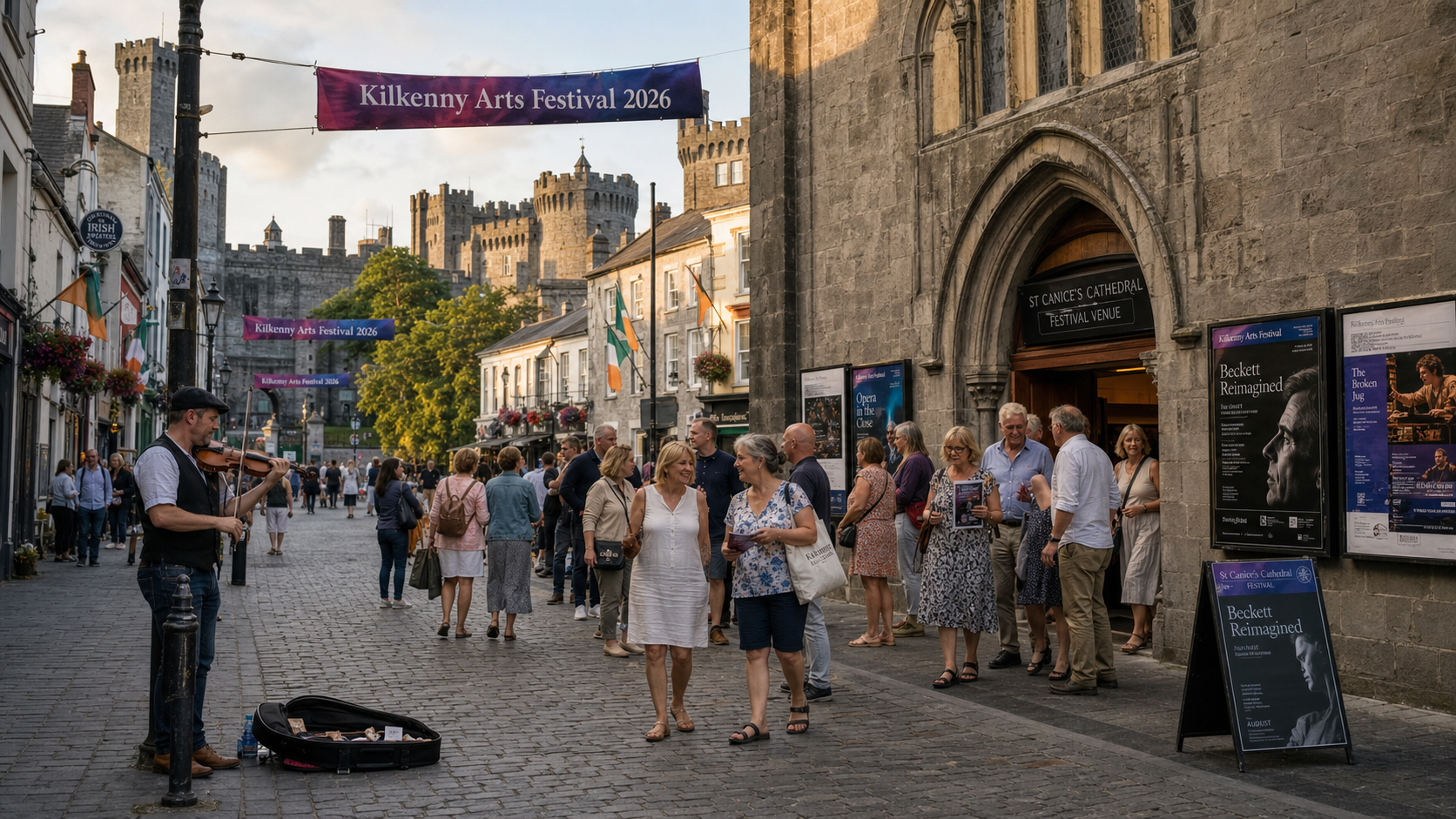
Kilkenny Arts Festival Marks 53rd Year with World Premieres and Beckett Reimagined in Medieval City
The 53rd Kilkenny Arts Festival has concluded its 2026 programme with a series of world premieres, a reimagined Samuel Beckett, and a diverse programme spanning opera, new music, visual arts, and theatre that drew audiences from across Ireland and internationally — with critics describing this year's edition as one of the most ambitious and successful in the festival's half-century history.
Background
The Kilkenny Arts Festival has been a fixture of the Irish cultural calendar since 1974, when it was established as a small chamber music festival in the medieval city's historic buildings. Over five decades, it has grown into one of Ireland's most prestigious multidisciplinary arts festivals, attracting world-class performers and artists across music, theatre, visual arts, literature, and film, and using the extraordinary architectural backdrop of Kilkenny — its Norman castle, its medieval churches, its narrow streets and hidden courtyards — as an integral part of the artistic experience.
The festival's reputation rests on its commitment to presenting work of genuine artistic ambition alongside more accessible programming, and on its ability to attract Irish and international artists who see Kilkenny as a destination of choice rather than a compromise. The 2026 programme, curated by artistic director Olga Barry, was built around the theme of "transformation" — the ways in which art can change how we see the world and ourselves — and this theme was reflected in a programme that included several world premieres and a number of ambitious reimaginings of classic works.
The festival's economic impact on Kilkenny city and county is substantial. The ten-day event attracts tens of thousands of visitors, many of them staying overnight in the city's hotels and guesthouses, and generates significant revenue for local restaurants, bars, and retailers. Kilkenny County Council has been a consistent supporter of the festival, recognising its value both as a cultural asset and as an economic driver for the region.
Key Developments
The 2026 festival's most talked-about production was the world premiere of Michael Gallen's The Curing Line, a new opera that drew on the tradition of Irish folk medicine and the figure of the "fairy doctor" to explore themes of healing, belief, and the relationship between the human and the natural world. The production, which featured a cast of Irish singers and a score that blended contemporary classical music with traditional Irish melodic material, received standing ovations at all four of its performances and is expected to transfer to other venues in Ireland and internationally.
Equally acclaimed was a new interpretation of Samuel Beckett's Krapp's Last Tape, directed by Garry Hynes of Druid Theatre and performed by veteran Irish actor Niall Buggy. Hynes's production stripped the play back to its essentials, using the intimate setting of St Canice's Cathedral to create an experience of extraordinary emotional intensity. Critics described it as one of the finest Beckett productions seen in Ireland in a generation.
The visual arts programme included a major retrospective of the work of Cork-born sculptor Kathy Prendergast, whose intricate and emotionally resonant works have been exhibited in galleries across Europe and North America. The retrospective, which was mounted in the Butler Gallery, attracted significant critical attention and is expected to travel to several other venues in the coming year.
Why It Matters
The Kilkenny Arts Festival matters because it demonstrates what Irish arts festivals can achieve when they combine artistic ambition with strong curatorial vision and adequate resources. In an era when many arts organisations are struggling with funding cuts and the aftermath of the pandemic, Kilkenny has maintained its commitment to presenting work of genuine quality and has continued to attract the artists and audiences that make it one of the most important events in the Irish cultural calendar.
The festival's success also reflects the broader health of the Irish arts sector, which has shown remarkable resilience in recent years despite the challenges of the pandemic and the cost-of-living crisis. Audiences for live arts events in Ireland have recovered strongly since 2022, and the appetite for high-quality cultural programming — particularly in regional centres like Kilkenny — appears to be growing rather than declining.
Local Impact
For Kilkenny city, the arts festival is a defining event that shapes the city's identity and its reputation as a cultural destination. The festival's use of the city's historic buildings — the castle, the cathedral, the medieval churches and alleyways — creates an experience that is unique to Kilkenny and that cannot be replicated elsewhere. Local businesses report that the festival period is consistently their busiest of the year, and the city's hotels and guesthouses are typically fully booked for the duration of the event.
What's Next
The 2027 Kilkenny Arts Festival will take place from 5 to 15 August, with the theme and programme to be announced in early 2027. Artistic director Olga Barry has indicated that she is already in discussions with a number of major artists about commissions and productions for next year's festival, and has expressed confidence that the 2027 edition will build on the success of 2026. Applications for the festival's artist residency programme, which provides Irish artists with time and space to develop new work in Kilkenny, will open in October 2026.