Irish Whiskey Industry Pivots to Asia and Europe as US Tariffs Create 'Tariff Border' Within Island of Ireland
Ireland's whiskey industry is engaged in an aggressive pivot towards Asian and European markets following the introduction of a 15% US import tariff on spirits from the Republic of Ireland in mid-2025, a measure that has not only disrupted the sector's most important export market but has created an unprecedented 'tariff border' within the island of Ireland — with Northern Irish whiskey entering the US at a lower 10% rate, creating a competitive distortion that the Irish Whiskey Association has described as one of the most significant challenges the industry has ever faced.
Background
Irish whiskey has been one of the great success stories of Irish food and drink exports over the past two decades. From a low base in the 1990s, when the category was dominated by a handful of brands and production was concentrated in a small number of distilleries, the industry has grown into a global phenomenon, with more than forty distilleries now operating across the island of Ireland and export values reaching nearly €1 billion annually at their peak.
The United States has been the engine of that growth. American consumers' appetite for premium spirits, combined with the cultural resonance of Irish heritage in the US market, made the country the most important destination for Irish whiskey exports. The 'zero-for-zero' tariff arrangement between the EU and the US, which had been in place since 1997, provided the frictionless market access that allowed Irish whiskey to compete on equal terms with Scotch whisky and American bourbon in the world's largest spirits market.
The introduction of a 15% US tariff on spirits from the Republic of Ireland in mid-2025 — part of a broader trade dispute between the US and the EU — ended that arrangement and created an immediate competitive challenge for Irish producers. The tariff has increased the landed cost of Irish whiskey in the US by approximately 5-6% at the retail level, a significant disadvantage in a market where price sensitivity is high and competition from domestic American spirits is intense.
Key Developments
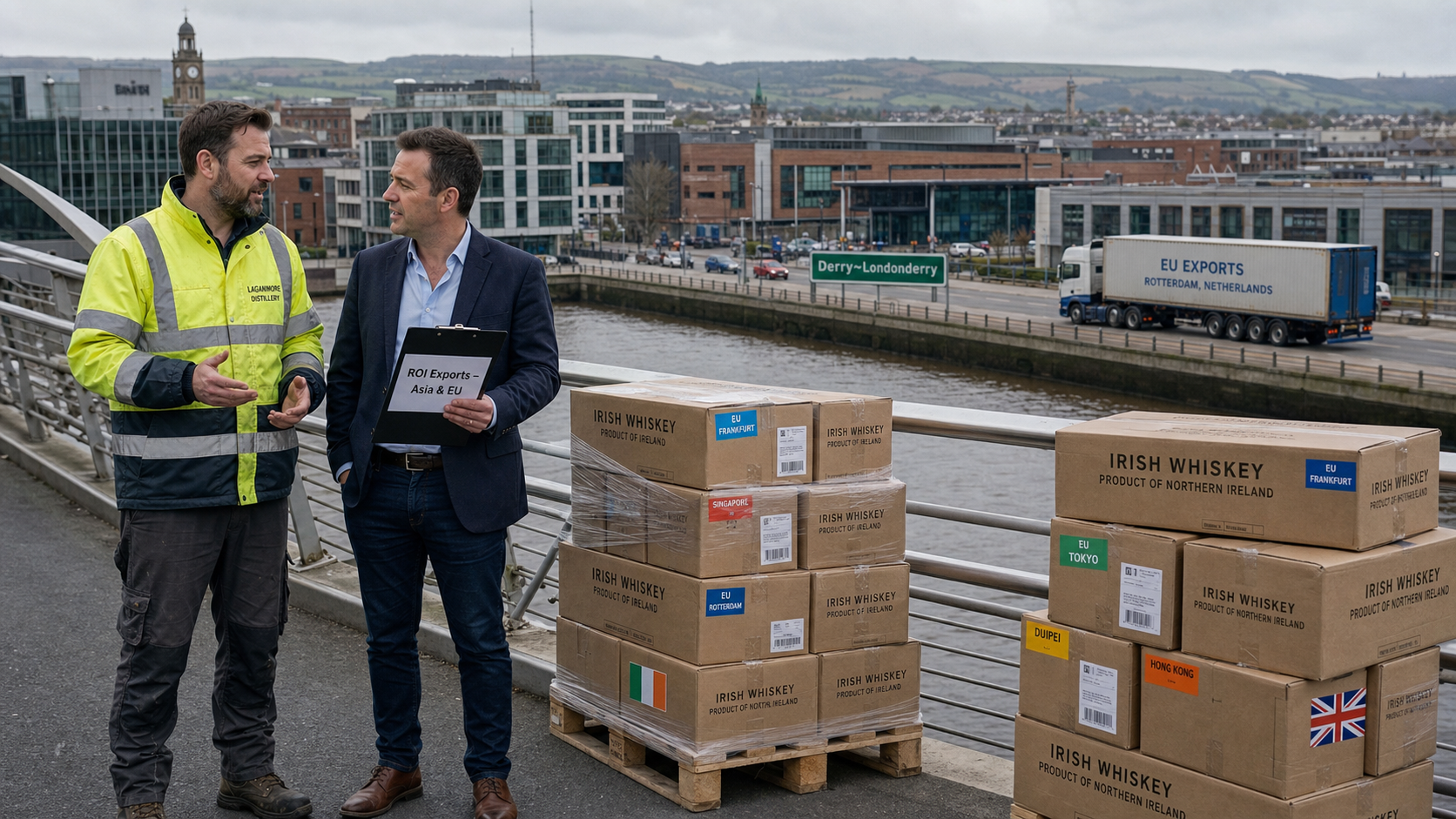
The most unusual aspect of the current tariff situation is the disparity between the rates applied to whiskey from the Republic of Ireland (15%) and Northern Ireland (10%). Because Irish whiskey is legally defined as a product of the entire island of Ireland, the post-Brexit trade landscape has created a situation in which the same category of spirit faces different tariff rates depending on which side of the border it is produced. This 'tariff border' within the island has created competitive distortions that the Irish Whiskey Association has been lobbying intensively to address.
The industry's response to the US tariff challenge has been to accelerate its diversification into other markets. Japan, which has a mature and high-margin market for Irish whiskey, has been a particular focus, with brands like The Busker benefiting from the 'Highball' consumption trend. China is also being targeted, with Great Northern Distillery signing a cooperation agreement with Tsingtao Brewery in July 2026. The EU-India free trade agreement, signed in January 2026, is expected to slash tariffs on Irish whiskey in India from 150% to 75% in 2027, presenting a major growth opportunity.
Export volumes to EU26 countries have risen by 21.5% over the last four years, with significant growth in Germany, Poland, France, Greece, and Italy. Emerging markets in Africa — particularly Nigeria (+40%) and South Africa (+30%) — are also providing a partial offset to the US market decline. Total export value fell approximately 5% in 2025 to around €930 million, but the industry is cautiously optimistic that the diversification strategy will stabilise the sector.
Why It Matters
The Irish whiskey industry's response to the US tariff challenge is a case study in how a sector can adapt to external shocks through market diversification and product innovation. The industry's ability to pivot to new markets — and to do so at speed — reflects the quality of the brands involved and the strength of the 'Irish whiskey' category as a global proposition. The challenge is to maintain that momentum while continuing to lobby for the restoration of the zero-for-zero trading arrangement that would level the playing field with Scotch whisky and American bourbon.
The tariff border within the island of Ireland is a particularly troubling development from a political as well as an economic perspective. The Good Friday Agreement was premised on the idea that the border between Northern Ireland and the Republic would become increasingly irrelevant in economic terms. The emergence of a tariff differential that creates a competitive advantage for Northern Irish producers over their counterparts in the Republic is a reminder that the post-Brexit trade landscape has created new forms of economic divergence that were not anticipated when the Agreement was signed.
For the broader Irish economy, the whiskey industry's challenges are a reminder of the risks associated with dependence on a single export market. The sector's experience with the US tariff is a lesson that applies across Irish food and drink exports, many of which are heavily dependent on the UK and US markets.
Local Impact
The impact of the US tariff has been felt most acutely by smaller distilleries that lack the financial resources to absorb the increased costs or to invest in new market development. The closure of the Killarney Brewing and Distilling Company, which cited trade uncertainties and inflation among its reasons for ceasing operations, is a cautionary example of what can happen when a small producer is caught between rising costs and falling revenues. Larger producers like Jameson, which has the resources to maintain its US market presence through strategic investments including a partnership with the NFL, are better placed to weather the storm.
In County Cork, which is home to several significant whiskey producers including the Midleton Distillery, the tariff situation has prompted discussions about the future of the sector and the need for government support. The Irish Whiskey Association has been in regular contact with the Department of Enterprise, Trade and Employment, and the issue is expected to feature in the pre-Budget 2027 submissions from the food and drink sector.
What's Next
The Irish Whiskey Association will continue to lobby for the restoration of the zero-for-zero trading arrangement between the EU and the US, a process that is expected to be part of broader EU-US trade negotiations in the coming months. The EU-India free trade agreement, which is expected to come into force in 2027, will be a significant milestone for the industry's Asian expansion strategy. The industry's annual report, expected in the autumn, will provide a comprehensive assessment of the impact of the US tariff and the progress of the diversification strategy.