Irish Whiskey Distilleries Welcome Tariff Removal But Urge Caution Over Trump's Unpredictability
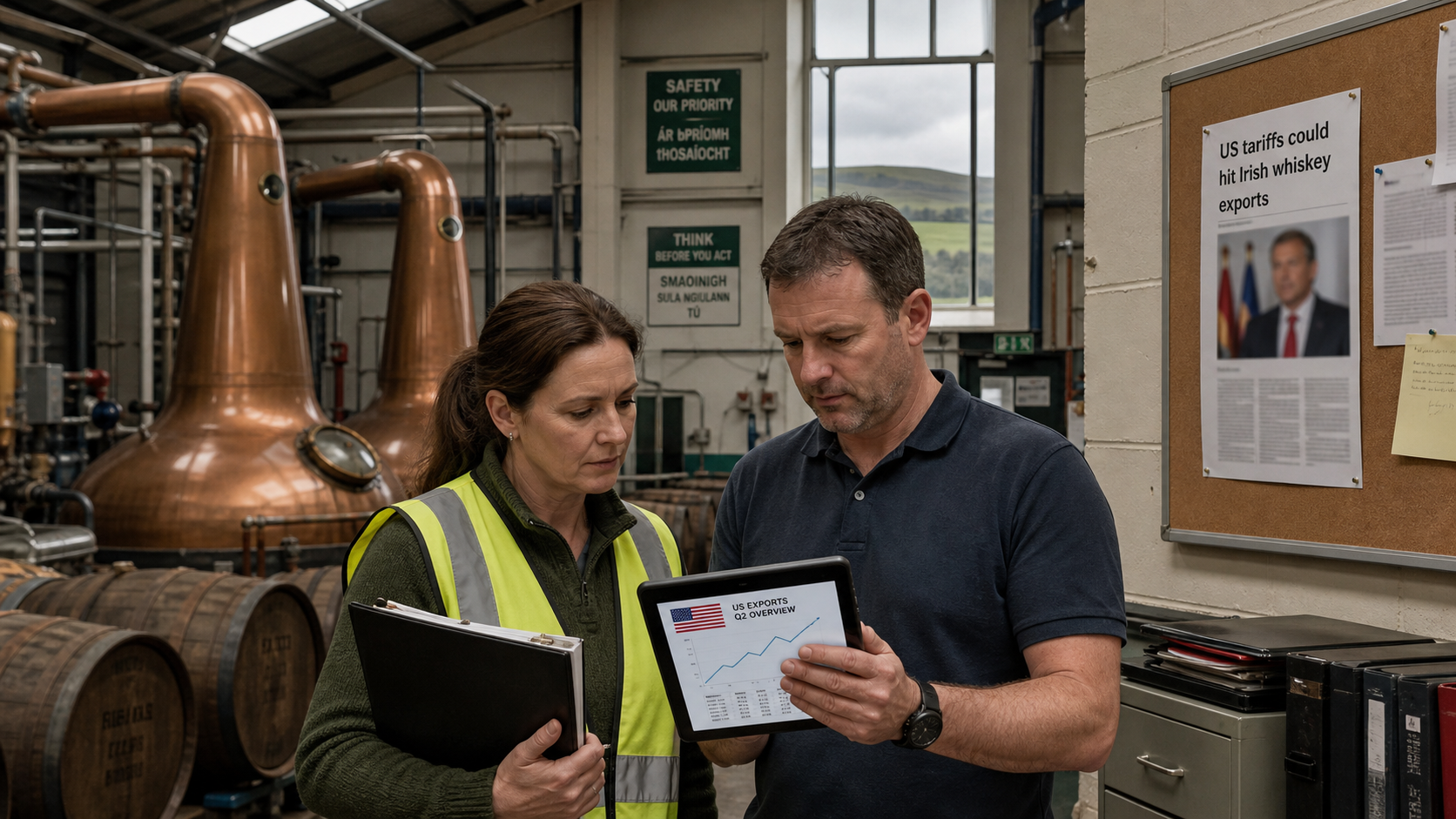
Ireland's whiskey distilleries have responded to Donald Trump's announcement removing the 10 per cent tariff on Irish whiskey imports to the United States with a mixture of genuine relief and cautious scepticism, welcoming the commercial benefit of a decision that restores their competitive position in a market worth €450 million annually while privately acknowledging that a policy made on a golf course in County Clare could be reversed with equal informality.
Background
The Irish whiskey industry has been one of the great success stories of Irish food and drink exports over the past two decades. From a low base of just two operational distilleries in the early 2000s, the sector has grown to more than 40 distilleries across the island of Ireland, producing a range of single malts, single pot stills, blends, and grain whiskeys that have found enthusiastic audiences in markets from the United States to Japan. The industry's global exports were valued at approximately €1.1 billion in 2025, with the United States accounting for the largest single market at around €450 million.
The 10 per cent tariff imposed by the Trump administration on Irish whiskey imports — part of a broader set of tariffs on European goods — had placed Irish producers at a competitive disadvantage relative to American bourbon and Tennessee whiskey, which face no equivalent tariff in the Irish market. The tariff had also created uncertainty for distributors and retailers in the US, who were reluctant to commit to large orders of Irish whiskey while the trade environment remained unstable.
Trump's announcement at the Irish Open trophy ceremony at Doonbeg — where he declared that he was removing the tariff on Irish whiskey, crediting lobbying by Taoiseach Micheál Martin and Shane Lowry — was characteristically theatrical. The Irish Whiskey Association had been lobbying for the removal of the tariff for more than a year, and the announcement, while welcome, came in a form that reflected the personal and transactional nature of Trump's approach to trade policy.
Key Developments
The Irish Whiskey Association welcomed the announcement on Monday, describing it as "a major commercial win for an industry that has worked hard to build its position in the American market." Chief executive Miriam Mooney said the removal of the tariff would allow Irish distilleries to compete on a level playing field with their Scottish and American counterparts and would provide a significant boost to export revenues in the short term.
However, Mooney also struck a note of caution, noting that the announcement had been made informally and that the industry would need to see the formal regulatory changes before it could fully plan around the new tariff environment. "We welcome this very much," she said. "But we are also realistic about the nature of the current US trade environment. We will be watching closely to ensure that the announcement translates into concrete policy change."
Individual distilleries have responded with similar caution. Jameson owner Irish Distillers, which accounts for the largest share of Irish whiskey exports to the US, said it was "encouraged" by the announcement but would await formal confirmation before adjusting its commercial strategy. Smaller craft distilleries, for whom the US market is a critical growth opportunity, were more openly enthusiastic, with several announcing plans to increase their US marketing budgets in anticipation of improved market conditions.
Why It Matters
The tariff removal matters for the Irish whiskey industry not just in terms of its immediate commercial impact but as a signal about the future of Irish-American trade relations. The Trump administration's approach to trade has been characterised by unpredictability and a willingness to use tariffs as a political tool, and the Irish whiskey industry's experience — of having a tariff imposed and then removed in the space of a few years — illustrates the vulnerability of export-dependent industries to political decisions made in Washington.
The broader lesson for Irish exporters is that diversification of markets is essential. The Irish Whiskey Association has been actively developing markets in Asia, particularly Japan and South Korea, and in emerging markets in Africa and Latin America. The US remains the most important single market, but the industry's long-term resilience depends on not being overly dependent on any one market or any one political relationship.
The announcement also has implications for the Scotch whisky industry, which has been competing with Irish whiskey for market share in the US. The removal of the tariff on Irish whiskey — while Scotch continues to face its own tariff challenges — could shift the competitive balance in Ireland's favour, at least in the short term.
Local Impact
For distilleries across Ireland — from the Dingle Peninsula in Kerry to the Boann Distillery in County Meath, from Waterford Distillery to the Slane Distillery in County Meath — the tariff removal is a welcome development that will improve the economics of exporting to the US. Many of these distilleries are significant employers in rural areas where alternative employment opportunities are limited, and the health of the export market directly affects their ability to maintain and grow their workforces.
What's Next
The Irish Whiskey Association has requested a formal meeting with the US Trade Representative's office to confirm the details of the tariff removal and to discuss the timeline for implementation. The Department of Enterprise, Trade and Employment has indicated that it will monitor the situation closely and will engage with the industry to ensure that the commercial benefits of the announcement are maximised. The next major industry event is the Irish Whiskey Awards, which take place in Dublin in November 2026.