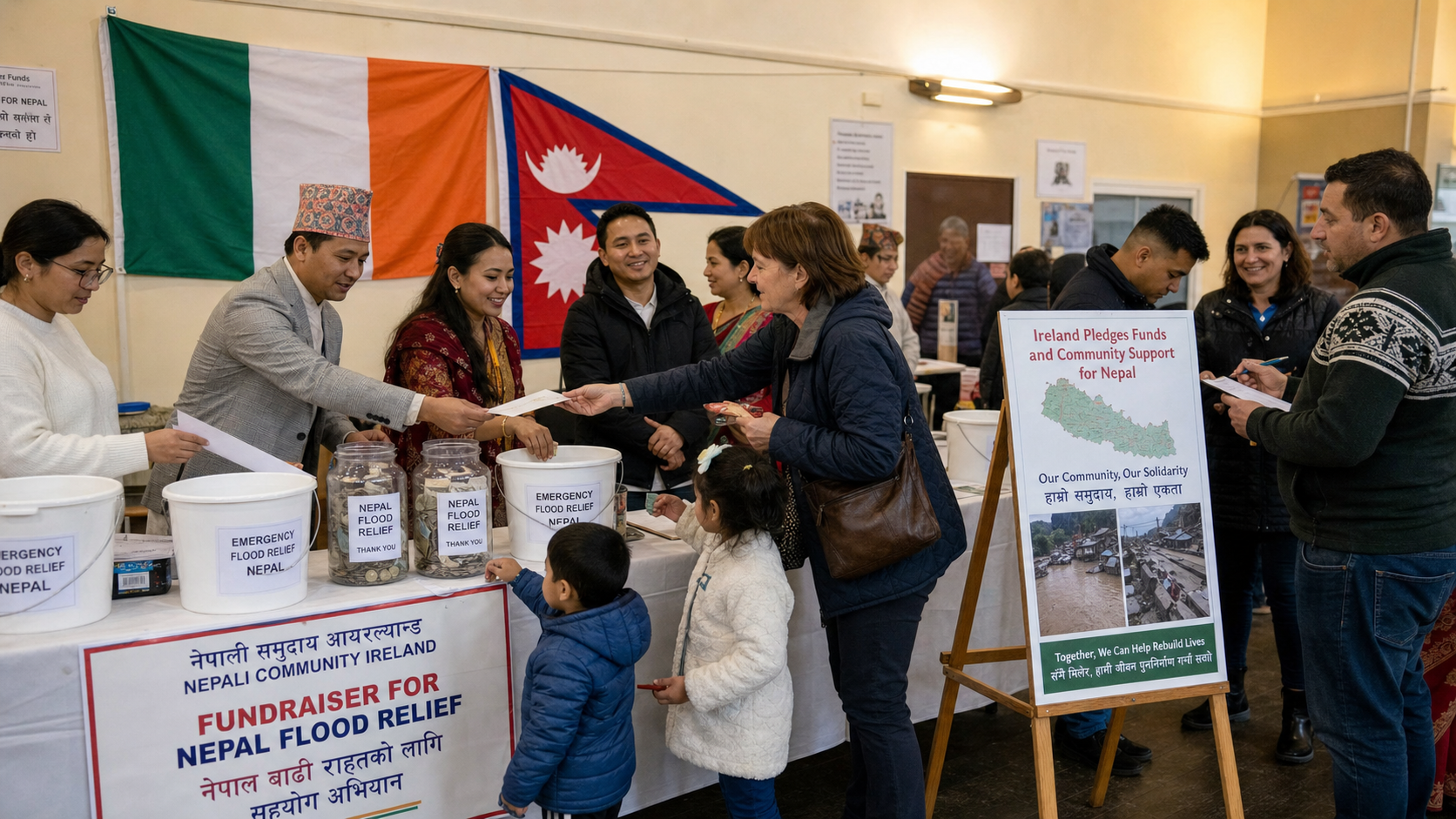
Irish-Nepalese Community Mobilises for Flood Relief as Ireland Pledges €500,000 in Emergency Aid to Stricken Nepal
Ireland's Irish-Nepalese community has launched an urgent fundraising campaign for victims of the catastrophic floods that have devastated Nepal, killing hundreds of people and displacing tens of thousands more, as the Irish government pledges €500,000 in emergency humanitarian aid to support relief efforts in a country where rescue teams are still pulling survivors from floodwaters more than ten days after the initial disaster — a response that reflects both Ireland's commitment to international humanitarian action and the deep ties between the two countries forged through decades of Irish missionary and development work in Nepal.
Background
Nepal is one of the world's most disaster-prone countries, situated in a seismically active region and subject to annual monsoon flooding that regularly causes significant loss of life and destruction of infrastructure. The country's mountainous terrain, which makes it one of the most spectacular landscapes on earth, also makes it extraordinarily vulnerable to landslides, flash floods, and glacial lake outburst floods — events that can devastate communities in minutes and that are becoming more frequent and more severe as climate change alters precipitation patterns in the Himalayas.
The current floods, which began in late August 2026, have been described by Nepalese authorities as among the worst in the country's recent history. The combination of exceptionally heavy monsoon rainfall and the failure of several glacial lakes has caused flooding across multiple provinces, with the Terai lowlands and the river valleys of the middle hills particularly severely affected. The death toll has risen steadily as rescue teams reach communities that were cut off by floodwaters and landslides, and the full extent of the damage to homes, agricultural land, and infrastructure is still being assessed.
Ireland has a long history of engagement with Nepal, dating back to the work of Irish missionaries and development organisations in the country from the 1960s onwards. Organisations including Concern Worldwide, Trócaire, and Goal have all worked in Nepal at various points, and the Irish-Nepalese community in Ireland — which has grown significantly in recent years as Nepalese workers have come to Ireland in the healthcare, hospitality, and retail sectors — has maintained strong connections with the country of origin.
Key Developments
The Irish-Nepalese community in Ireland has launched a fundraising campaign through a combination of social media, community events, and direct appeals to Irish businesses and organisations with connections to Nepal. The campaign, which is being coordinated by the Irish-Nepalese Association, has already raised a significant sum in its first week, with donations coming from across the Irish-Nepalese community and from Irish people who have visited Nepal or who have been moved by the scale of the disaster.
The Irish government has pledged €500,000 in emergency humanitarian aid to Nepal, channelled through established humanitarian organisations with experience of working in the country. The Minister for International Development has described the floods as "a humanitarian catastrophe" and has indicated that Ireland is prepared to provide additional support if the situation deteriorates further. Irish Aid, the government's overseas development programme, has been in contact with its partners in Nepal to assess the most effective use of the emergency funding.
Rescue teams in Nepal have been working around the clock to reach communities cut off by floodwaters and landslides. International media have reported dramatic rescues, including the extraction of survivors from partially submerged homes more than ten days after the initial flooding — a reminder of the extraordinary resilience of the Nepalese people in the face of repeated natural disasters. The UN has described the situation as requiring an urgent international response and has called on donor countries to increase their contributions to the relief effort.
Why It Matters
Ireland's response to the Nepal floods matters because it reflects the country's commitment to international humanitarian action — a commitment that is embedded in Irish Aid's mandate and that draws on Ireland's own historical experience of famine and emigration. The €500,000 pledge is a meaningful contribution to the relief effort, and the fundraising activity of the Irish-Nepalese community demonstrates the depth of the connections between Ireland and Nepal that have been built over decades of engagement.
The floods also matter as a reminder of the human consequences of climate change. Nepal is among the countries most vulnerable to the effects of a warming climate, with glacial retreat, changing precipitation patterns, and more frequent extreme weather events all contributing to an increasing frequency of disasters. Ireland, as a country that has committed to ambitious climate targets, has a particular responsibility to support the countries that are bearing the greatest burden of a crisis they did not create.
Local Impact
In Dublin, where the largest concentration of the Irish-Nepalese community is based, the fundraising campaign has generated significant activity. Community events have been organised in Parnell Street — the heart of Dublin's Asian community — and in several other locations across the city, with restaurants, shops, and community organisations all contributing to the effort. The Nepalese Embassy in Dublin has been coordinating with the Irish-Nepalese Association to ensure that funds raised in Ireland are directed to the most effective relief organisations operating in Nepal. In Cork, Galway, and Limerick, smaller Irish-Nepalese communities have also been active in fundraising, reflecting the spread of the community across Ireland in recent years.
What's Next
The Irish-Nepalese Association's fundraising campaign will continue for the coming weeks, with a target of raising €100,000 from the Irish-Nepalese community and its supporters. The Irish government's €500,000 pledge will be disbursed through established humanitarian organisations in the coming days, with a focus on immediate relief needs including food, shelter, and clean water. Irish Aid has indicated that it will monitor the situation in Nepal closely and is prepared to provide additional funding if the scale of the disaster requires it. A longer-term reconstruction programme, which will address the damage to homes, infrastructure, and agricultural land, is expected to be developed in the coming months with input from the Nepalese government and international partners.