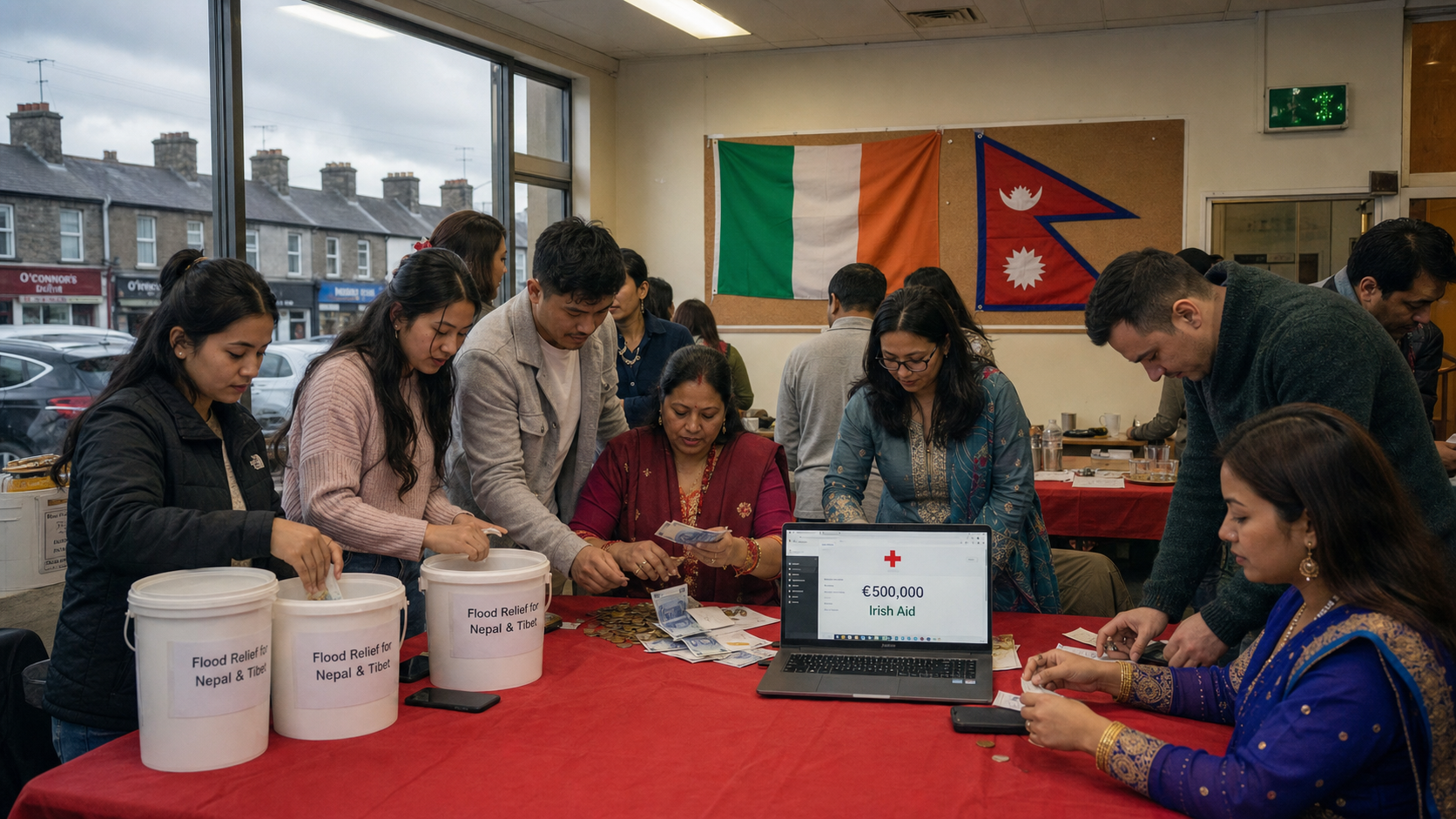
Irish-Nepalese Community Raises Funds for Flood Victims as Ireland Pledges €500,000 in Emergency Aid
Ireland's Nepalese community has launched fundraising efforts for victims of the devastating floods that have killed more than 1,100 people in Nepal and Tibet, as the Irish government pledges €500,000 in emergency aid through the International Federation of the Red Cross — with two Irish citizens among those reported missing following the glacial lake outburst that triggered the catastrophe.
Background
On 26 August 2026, a glacial lake outburst flood occurred near the Nepal-China border, causing widespread destruction across northern Nepal, particularly in the Rasuwa and Nuwakot districts. The disaster was triggered by the sudden release of water from a glacial lake that had been swollen by unusually high temperatures — a phenomenon that climate scientists have been warning about for years as global warming accelerates the melting of Himalayan glaciers.
The scale of the destruction has been catastrophic. More than 1,100 people have been confirmed dead, with thousands more missing and presumed dead. Infrastructure across the affected regions has been devastated, with roads, bridges, and hydropower facilities destroyed, leaving many communities isolated and difficult to reach by emergency services. The disaster has been described by Nepal's foreign minister as a "climate warning signal" that demands urgent global action on greenhouse gas emissions.
Ireland's Nepalese community, which numbers more than 3,000 people, has been deeply affected by the disaster. Many community members have family and friends in the affected regions, and the Non-Resident Nepalese Association Ireland has been coordinating fundraising and support efforts since the disaster struck. Among those reported missing are two Irish citizens — Santosh Sahu, 46, and his 18-year-old son Spandan Sahu — who were in Nepal at the time of the floods.
Key Developments
The Irish government announced a €500,000 emergency funding package on 28 August 2026, with Minister for Foreign Affairs Helen McEntee and Minister of State for International Development and Diaspora Neale Richmond confirming that the contribution would be channelled through the International Federation of the Red Cross Nepal Floods Appeal and the Nepalese Red Cross. The funding is designated for essential resources including emergency shelter, clean water, healthcare, and basic relief supplies.
The government's contribution complements existing Irish Aid projects in the region, including a two-year, €200,000 initiative focused on climate resilience and livelihood security. Ireland has a long-standing relationship with Nepal through its development aid programme, and the emergency funding reflects the government's commitment to supporting communities affected by climate-related disasters.
The Non-Resident Nepalese Association Ireland has been running an online fundraising appeal since the disaster struck, with General Secretary Pravin Baral noting that community members in Ireland have been personally affected, with some losing relatives in the floods. The Irish Red Cross has also launched an emergency appeal, leveraging its long-standing partnership with the Nepal Red Cross Society that was developed during the 2015 earthquake response.
Why It Matters
The Nepal floods are a stark illustration of the human cost of climate change. The glacial lake outburst that triggered the disaster is directly linked to the accelerated melting of Himalayan glaciers caused by rising global temperatures. Nepal, which contributes less than 0.1 per cent of global greenhouse gas emissions, is among the countries most vulnerable to the consequences of climate change — a profound injustice that has been highlighted by the country's foreign minister and by international climate advocates.
For Ireland, the disaster has a personal dimension through the missing Irish citizens and the presence of a significant Nepalese community in the country. The government's rapid response — pledging €500,000 within two days of the disaster — reflects both the scale of the humanitarian need and Ireland's commitment to its international development obligations. Ireland's overseas development aid budget, which is targeted at 0.7 per cent of gross national income, has been a source of national pride and international recognition.
The fundraising efforts of the Irish-Nepalese community also demonstrate the role that diaspora communities play in connecting Ireland to the wider world and in mobilising support for humanitarian causes. The community's response to the Nepal floods is a reminder that Ireland's connections to other countries are not merely diplomatic or economic — they are human and personal.
Local Impact
In Dublin, where the majority of Ireland's Nepalese community is based, the disaster has prompted an outpouring of support. Community events have been organised to raise funds and to provide a space for community members to come together and support one another. The Nepalese community has a significant presence in areas including Blanchardstown, Tallaght, and the city centre, and local community organisations have been involved in supporting the fundraising efforts. The Irish Red Cross has been accepting donations at its offices and online, and has indicated that the response from the Irish public has been generous. The Department of Foreign Affairs has confirmed that consular assistance is being provided to the families of the two missing Irish citizens.
What's Next
The search for missing persons in Nepal is ongoing, with emergency services and volunteers continuing to work in the affected areas despite difficult conditions. The Irish government has indicated it will consider additional aid contributions if the humanitarian situation deteriorates further. The Irish Red Cross appeal will remain open for the coming weeks, with funds being directed to the most urgent needs on the ground. The families of the two missing Irish citizens are being supported by the Department of Foreign Affairs and are in contact with Irish consular officials in Kathmandu.