Irish Housing Market Affordability Crisis Deepens as New Homes Output Projected to Hit 40,000 Units in 2026
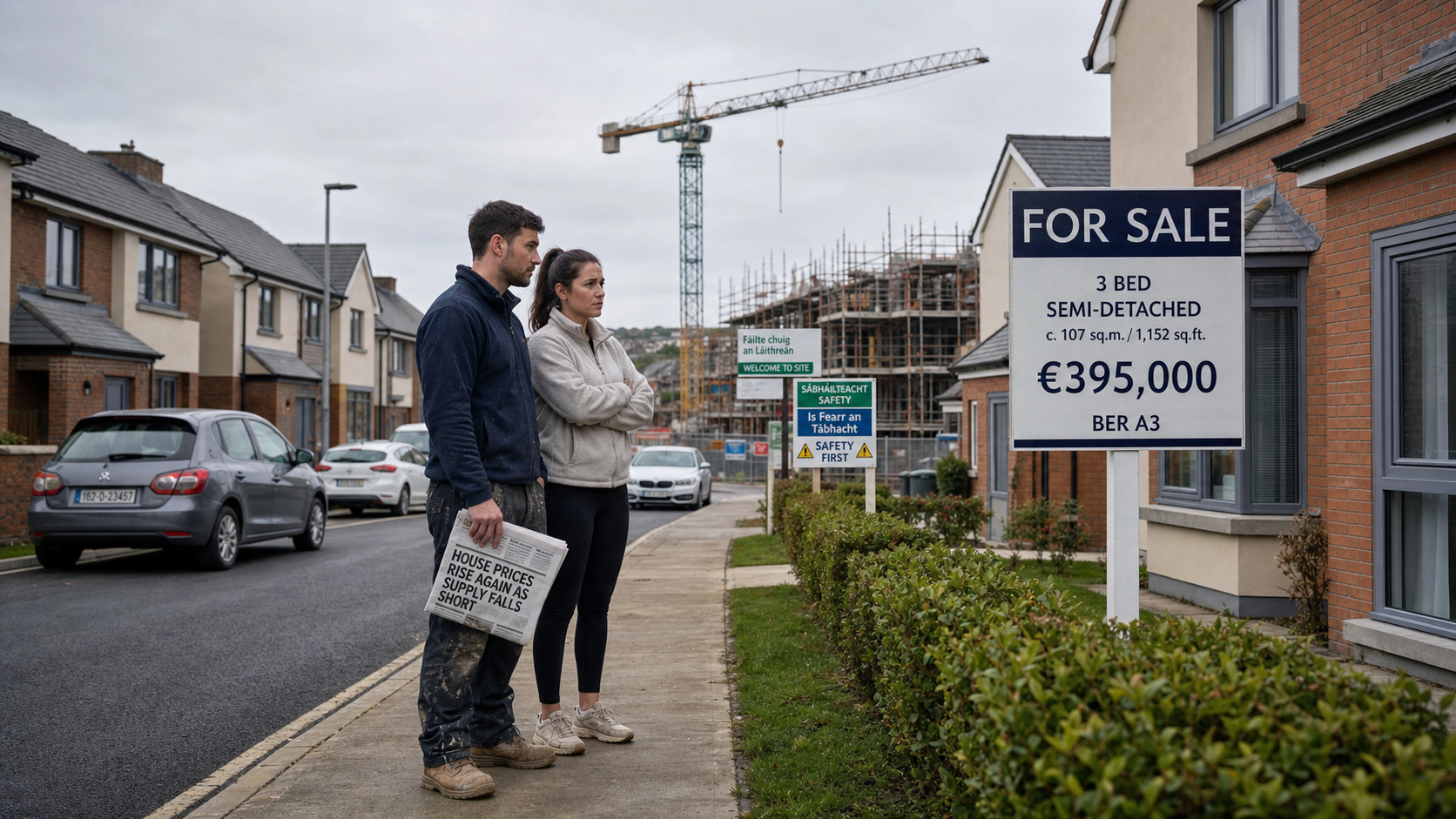
New home construction in Ireland is projected to reach 40,000 units in 2026, exceeding government targets for the first time in the history of the Housing for All plan — yet the housing affordability crisis shows no sign of abating, with the national median home price standing at €395,000, the average Dublin three-bedroom semi-detached house costing €580,000, and medium-sized developers warning that planning uncertainty and financing constraints are preventing the further scaling of output needed to make a meaningful dent in the shortage.
Background
Ireland's housing crisis has been the most persistent and politically damaging domestic policy failure of the past decade. The roots of the crisis lie in the collapse of construction activity following the 2008 financial crash, which left the country with a severe structural deficit in housing supply that has proved extraordinarily difficult to address. Despite successive government plans — from Rebuilding Ireland to Housing for All — the gap between supply and demand has remained stubbornly wide, driving prices and rents to levels that are unaffordable for a growing proportion of the population.
The Housing for All plan, launched in 2021, set ambitious targets for new home construction, aiming to deliver 33,000 new homes per year by 2030. The plan included a range of measures to stimulate supply, including planning reforms, increased State investment in social and affordable housing, and new financing mechanisms for developers. Progress has been slow and uneven, with output consistently falling short of targets in the early years of the plan.
The projected output of 40,000 units in 2026 represents a significant milestone, suggesting that the supply-side measures introduced under Housing for All are beginning to have an effect. However, housing economists and advocacy organisations have cautioned that even this level of output is insufficient to address the accumulated deficit in housing supply and that the affordability crisis will persist for years even if construction targets are consistently met.
Key Developments
The projected 40,000 new homes in 2026 represents a significant increase on the approximately 32,000 units completed in 2025 and would be the highest annual output since the peak of the Celtic Tiger era. The increase is being driven by a combination of factors: the activation of large development sites in Dublin and other urban centres, the impact of planning reforms that have streamlined the approval process for large residential developments, and increased investment by both domestic and international developers in the Irish market.
However, medium-sized developers — those building between 50 and 500 homes per year — have warned that planning uncertainty and a lack of finance for land acquisition are preventing them from scaling up output further. These developers, who account for a significant proportion of new home construction in regional towns and cities, report that the economics of development outside the major urban centres remain challenging, with construction costs, planning delays, and financing costs all squeezing margins to the point where many projects are not viable.
The Oireachtas housing committee has identified the housing crisis as a 'key catalyst' for rising anti-immigrant sentiment in Ireland, a finding that has added a new urgency to the political debate about housing policy. The committee's report noted that the perception — often inaccurate — that immigrants are receiving preferential access to social housing is fuelling resentment in communities where housing pressure is most acute. In Dublin, councillors have rejected remarks by Tánaiste Simon Harris about the rights of homeless individuals, accusing the government of scapegoating vulnerable people rather than addressing the structural causes of the crisis.
Why It Matters
The housing crisis matters because it is affecting the life choices and opportunities of hundreds of thousands of people across Ireland. Young people are delaying or abandoning plans to start families because they cannot afford a home. Essential workers — nurses, teachers, gardaí — are unable to live in the communities where they work. Businesses are struggling to recruit and retain staff because of the cost of housing. The social consequences of the crisis — including rising homelessness, increased mental health pressures, and the erosion of community cohesion — are becoming increasingly visible and increasingly severe. The political consequences are also significant: the housing crisis has been a major driver of electoral volatility in recent years, and its continued failure to be resolved is a source of deep public frustration with the political establishment.
Local Impact
The housing crisis is playing out differently in different parts of Ireland, but its effects are felt everywhere. In Dublin, the combination of high prices and limited supply is forcing many first-time buyers to look to the commuter counties of Kildare, Meath, Wicklow, and Louth, adding to pressure on transport infrastructure and increasing commuting times. In Cork, Galway, and Limerick, the shortage of affordable homes is a major concern for city councils struggling to attract and retain workers in key public services. In rural areas, the arrival of remote workers with Dublin salaries has transformed local property markets, pricing out local buyers and changing the social character of communities. For the thousands of people currently living in emergency accommodation or on social housing waiting lists, the projected increase in new home construction offers some hope — but the scale of the backlog means that relief is still years away for many.
What's Next
The government's Housing for All plan will be reviewed in the autumn, with the two-speed market dynamics and the projected 40,000-unit output likely to prompt a reassessment of some of its key measures. The Help to Buy scheme, the Land Value Sharing levy, and the planning system reforms introduced under the plan will all be evaluated for their effectiveness and adjusted where necessary. The government is also expected to announce additional capital funding for social and affordable housing in the context of the autumn budget, with the housing crisis providing a powerful political impetus for increased State investment. The CSO will publish its next residential property price index in August, providing an updated picture of market trends as the summer selling season concludes.