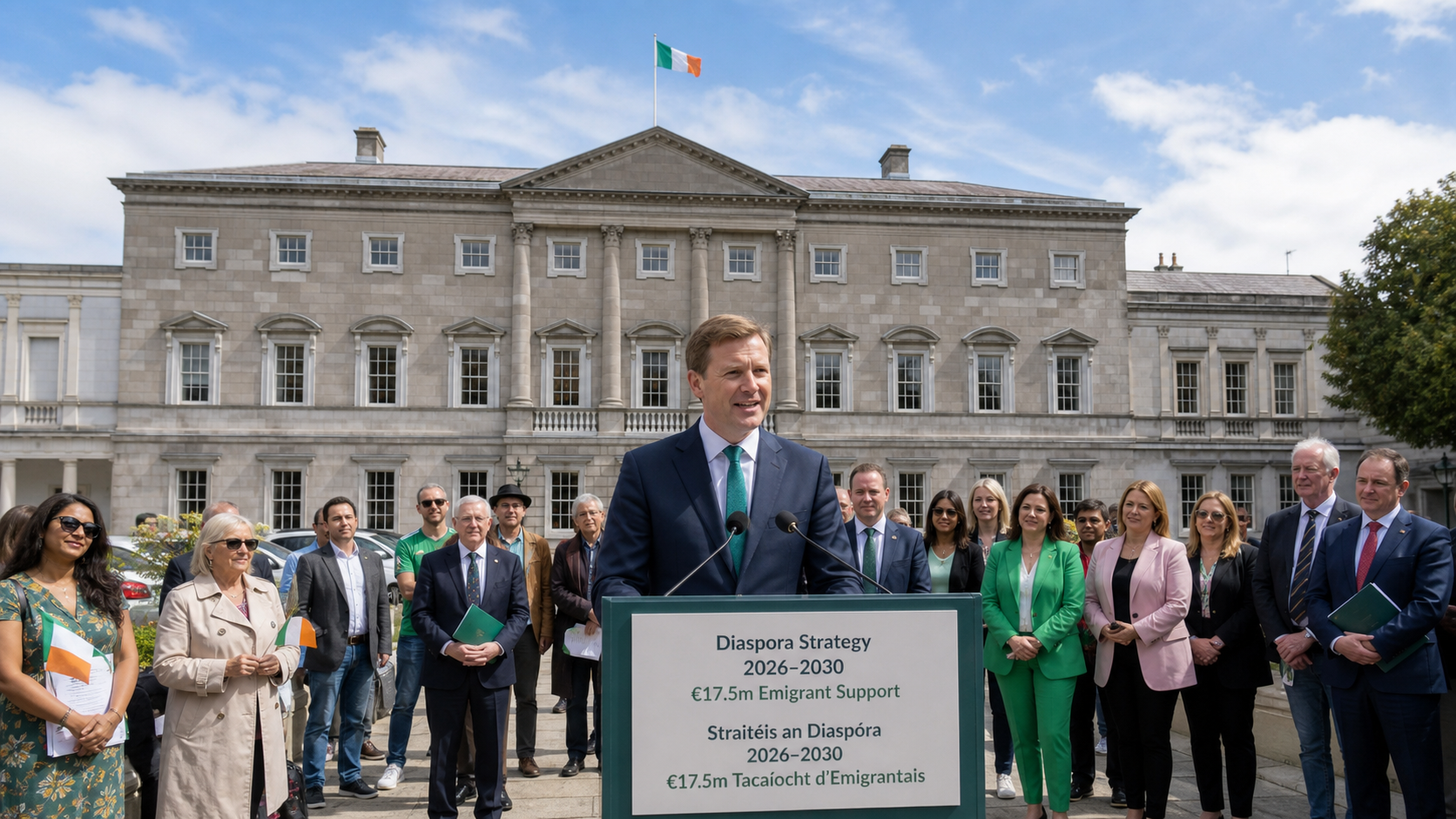
Irish Government Launches Record €17.5 Million Diaspora Support Fund as Strategy Targets 70 Million Worldwide
The Irish government has committed a record €17.5 million to diaspora support in 2026 as part of its newly launched Diaspora Strategy 2026-2030, the most ambitious programme of engagement with the global Irish community ever undertaken by the state, targeting an estimated 70 million people of Irish heritage worldwide through 23 specific commitments across five thematic areas — a programme that reflects both the scale of the Irish diaspora and the government's recognition that maintaining connections with Irish communities abroad is a strategic national interest.
Background
Ireland has one of the most extensive diasporas of any country in the world, relative to its population. The combination of centuries of emigration — driven by famine, poverty, political upheaval, and more recently by economic opportunity — has created Irish communities in virtually every country on earth. The United States alone is home to an estimated 35 million people of Irish descent, while significant communities exist in the United Kingdom, Australia, Canada, Argentina, and across continental Europe.
The Irish government's engagement with the diaspora has evolved significantly over the past three decades. The establishment of the Emigrant Support Programme in 2004, which has provided more than €265 million in grants to over 900 organisations across 53 countries since its inception, represented the first systematic attempt to support Irish communities abroad. Subsequent diaspora strategies — in 2015 and 2020 — built on this foundation, expanding the scope of engagement and developing new mechanisms for connecting the diaspora with Ireland.
The 2026-2030 strategy, which was developed following an extensive consultation process that included 27 in-person meetings across 17 countries and the first-ever online Global Irish Survey, represents a further evolution in the government's approach. It adopts a broader and more inclusive definition of the diaspora, encompassing not just those with Irish ancestry but also the 'affinity diaspora' — people who have studied or worked in Ireland and maintain a deep connection to the country.
Key Developments
The strategy, led by Minister of State for the Diaspora Neale Richmond, is built around five thematic threads: Wellbeing and Advocacy, Identity and Culture, Connection and Contribution, Departure and Return, and Sharing Our Experience. The 23 commitments within these themes range from enhanced support for elderly and vulnerable Irish people abroad to new initiatives to leverage the expertise and networks of the diaspora for Ireland's trade and diplomatic interests.
The record €17.5 million allocation for 2026 represents a significant increase on previous years and reflects the government's commitment to backing the strategy with real resources. The Emigrant Support Programme, which is the primary mechanism for funding community organisations abroad, will receive the largest share of this funding, with grants available to Irish community organisations in countries across the world.
A particularly significant element of the strategy is the commitment to develop proposals for voting rights for Irish emigrants in national parliamentary elections. A 12-month Task Force has been established to examine the options, and its recommendations are expected to be published before the end of 2026. The question of diaspora voting rights has been debated in Ireland for decades, and the establishment of the Task Force represents the most concrete step yet towards a resolution.
Why It Matters
The Diaspora Strategy matters because the Irish diaspora is not merely a sentimental connection to the past — it is a living network of people, organisations, and relationships that has real value for Ireland in the present. Irish communities abroad have historically been among the most effective advocates for Ireland's interests in their host countries, from the Irish-American community's influence on US policy towards Northern Ireland to the Irish communities in Europe that have supported Ireland's position in EU negotiations.
The economic dimension of the diaspora is also significant. Irish people abroad are disproportionately represented in senior positions in business, finance, technology, and the professions in many countries, and their connections to Ireland — through investment, trade, and talent flows — contribute meaningfully to the Irish economy. The strategy's commitment to leveraging the expertise and networks of the diaspora for Ireland's trade and diplomatic interests reflects a recognition of this economic potential.
The inclusion of the 'affinity diaspora' in the strategy's definition is a significant conceptual development. Ireland's position as a hub for international students and workers has created a new category of people with strong connections to the country who do not have Irish ancestry. Recognising and engaging with this group expands the potential reach of Irish diaspora policy significantly.
Local Impact
In Irish communities across the world, the announcement of the new strategy and the record funding allocation has been welcomed. In the United States, where the Irish-American community has been navigating the challenges of maintaining cultural identity across multiple generations, the strategy's focus on identity and culture is seen as particularly relevant. In the United Kingdom, where the Irish community has faced particular challenges in the post-Brexit environment, the enhanced support for community organisations is a practical response to real needs.
In Australia, which has become the primary destination for Irish emigrants in recent years — with approximately 13,500 people moving there in the year ending April 2025 — the strategy's focus on departure and return is especially pertinent. Many Irish people in Australia maintain strong connections with home and are potential returnees if the conditions in Ireland — particularly around housing and cost of living — improve sufficiently to make return viable.
What's Next
The Diaspora Strategy 2026-2030 will be implemented over the coming four years, with annual progress reports to be published by the Department of Foreign Affairs. The Task Force on diaspora voting rights is expected to report before the end of 2026, and its recommendations will be considered by the government in the context of any necessary constitutional or legislative changes. The Emigrant Support Programme will continue to accept applications from Irish community organisations abroad, with the next funding round expected to open in the autumn. Minister Richmond has indicated that he will undertake a series of visits to Irish communities abroad in the coming months to engage directly with diaspora members and to promote the new strategy.