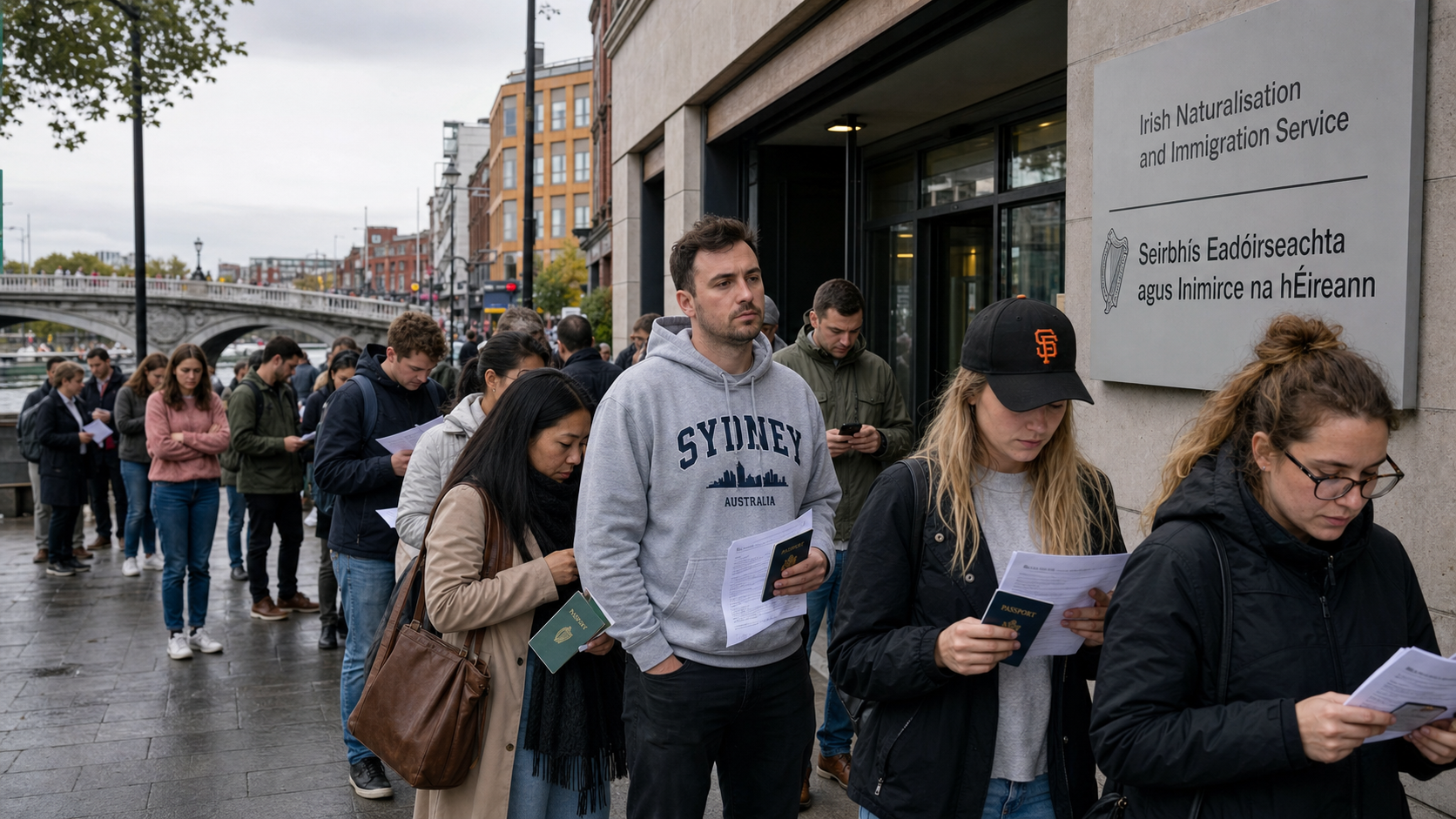
Irish Emigrants Face Longer Wait for Citizenship as Eight-Year Rule Hits Diaspora Planning Across Australia and US
The Irish government's decision to increase the residency requirement for naturalisation from five years to eight years is generating significant concern among diaspora communities and immigration advocates, with the retrospective application of the new rules affecting thousands of foreign nationals who had been planning their lives around the existing five-year threshold — while the growing "reverse diaspora" of US and British nationals seeking Irish citizenship through the foreign birth register faces new uncertainty.
Background
Ireland's relationship with its diaspora is one of the most complex and emotionally charged aspects of the country's national identity. The experience of emigration — voluntary and involuntary — has shaped Irish culture, politics, and society for centuries, and the Irish state has historically maintained a relatively open approach to citizenship and to the recognition of Irish heritage as a basis for connection to the country.
The diaspora strategy launched in May 2026, covering the period to 2030, reflected a sophisticated understanding of the changing nature of the Irish diaspora. The strategy acknowledged that Australia has overtaken the United States as the primary destination for Irish emigrants, that the "affinity diaspora" — people without hereditary Irish links who maintain deep connections to the country — is growing in importance, and that the traditional concept of the Irish emigrant is evolving in ways that require new policy responses.
The "reverse diaspora" phenomenon — the growing number of US, British, and other nationals seeking Irish citizenship through the foreign birth register — has been a significant trend since Brexit and the election of Donald Trump in 2016. The number of applications through the foreign birth register has increased dramatically in recent years, reflecting both the practical value of an EU passport and a genuine desire among people of Irish heritage to formalise their connection to Ireland.
Key Developments
The Irish Nationality and Citizenship (Amendment) Bill 2026, approved by Cabinet on Wednesday, will increase the residency requirement for naturalisation from five years to eight years, with the new rules applied retrospectively to those who have not yet submitted their applications. For foreign nationals living in Ireland who are approaching the existing five-year threshold, the change means an additional three-year wait — a significant disruption to their life planning.
The impact on the diaspora is multifaceted. For Irish emigrants who have returned home after years abroad, the question of whether their time overseas counts toward the residency requirement is a source of anxiety. The legislation is understood to apply to continuous residency in Ireland, meaning that time spent abroad — even for work or family reasons — may not count toward the eight-year threshold.
For the growing community of US nationals seeking Irish citizenship through the foreign birth register — a process that does not require residency in Ireland — the new legislation does not directly apply. However, the broader tightening of citizenship rules has created uncertainty about the future direction of Irish citizenship policy and has prompted some applicants to accelerate their applications.
The Emigrant Support Programme, which received a record €17.5 million allocation in 2026, provides support to Irish communities abroad through a network of organisations in the UK, the US, Australia, and other countries. The programme's focus on the most vulnerable members of the diaspora — older emigrants, those experiencing homelessness or mental health difficulties, and those facing legal challenges — will continue regardless of the changes to the naturalisation rules.
Why It Matters
The citizenship changes represent a significant shift in Ireland's approach to immigration and integration, and their impact on the diaspora — both the traditional Irish emigrant community and the growing reverse diaspora — deserves careful attention. The retrospective application of the eight-year rule is particularly concerning for those who have made life decisions based on the existing five-year threshold, and the absence of a transitional arrangement is a source of genuine hardship for many individuals and families.
The broader question of Ireland's relationship with its diaspora is also relevant. The country has benefited enormously from the contributions of its diaspora — in terms of remittances, investment, cultural exchange, and political advocacy — and the signal sent by the tightening of citizenship rules may affect the willingness of diaspora communities to maintain their connections to Ireland.
The task force on voting rights for Irish emigrants in national parliamentary elections, which has been established as part of the diaspora strategy, is a positive development that reflects the government's recognition of the diaspora's stake in Irish democracy. However, the contrast between the extension of voting rights and the tightening of citizenship rules creates a tension that will need to be addressed in the government's broader diaspora policy.
Local Impact
In Irish communities in Sydney, Melbourne, New York, London, and Boston — the major centres of the Irish diaspora — the citizenship changes have generated significant discussion and concern. Community organisations that provide support to Irish emigrants have reported an increase in inquiries from members seeking to understand the implications of the new rules for their own situations.
In Ireland itself, the changes will affect the plans of thousands of foreign nationals who have built their lives in the country and who had been looking forward to applying for citizenship after five years. For many of these individuals — who work in healthcare, technology, construction, and other essential sectors — the additional three-year wait is a source of genuine frustration and uncertainty.
What's Next
The Irish Nationality and Citizenship (Amendment) Bill 2026 will proceed through the Oireachtas in October, with opposition parties expected to seek amendments to remove the retrospective application of the eight-year rule. The diaspora task force on voting rights is expected to publish its recommendations before the end of 2026. The Emigrant Support Programme will continue to provide funding to diaspora organisations in the 2027 budget cycle.