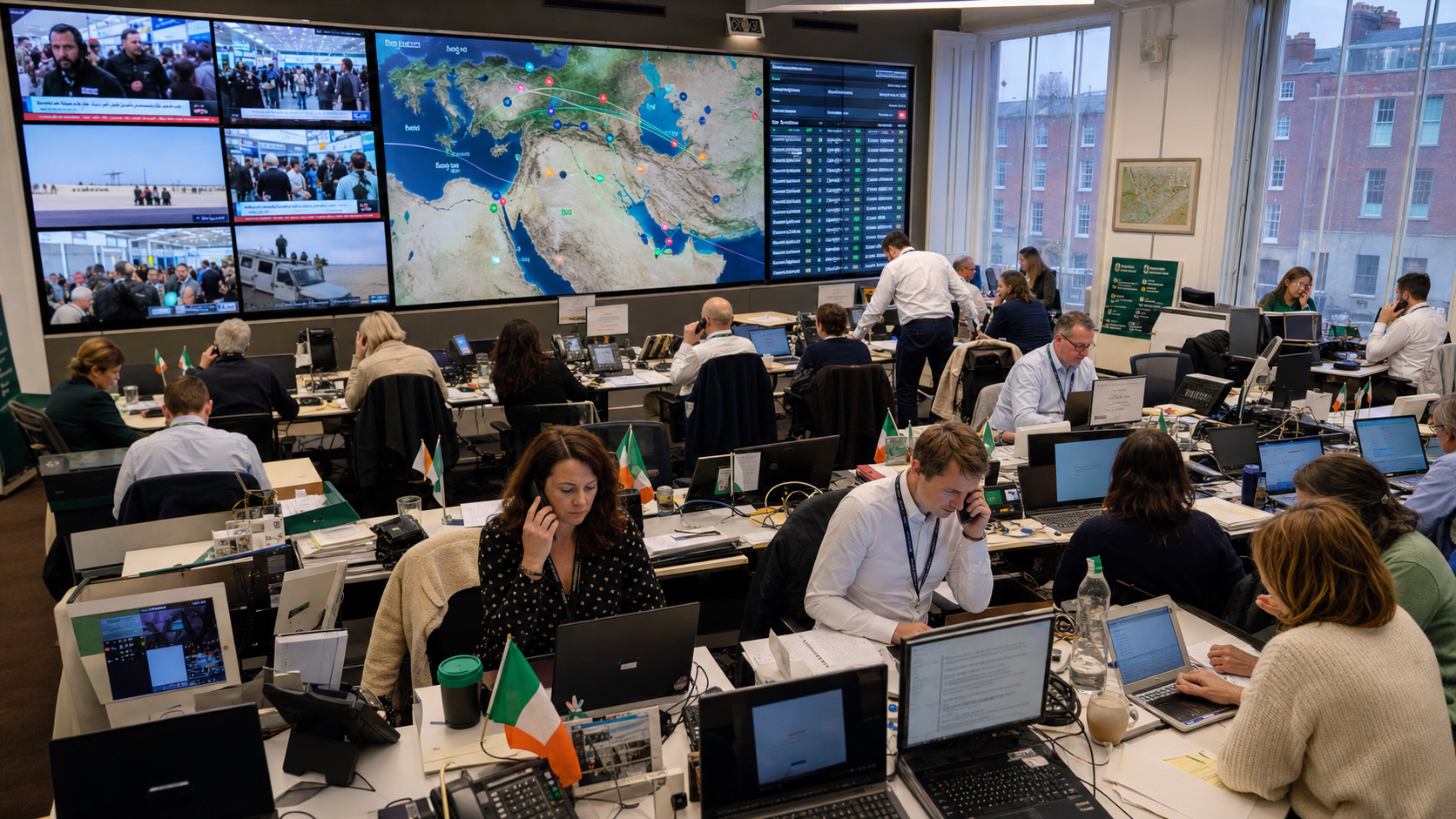
Irish Consular Service Mounts Largest Response Since COVID as Citizens Caught in Middle East Crisis
The Department of Foreign Affairs has mounted its largest consular response since the COVID-19 pandemic, mobilising its network of embassies, consulates, and honorary consuls across the Middle East to assist Irish citizens caught in the regional crisis that has dominated international headlines in the first half of 2026. The operation, which has involved the evacuation of hundreds of Irish nationals and the provision of emergency consular assistance to thousands more, has highlighted both the extraordinary reach of the Irish diaspora and the capacity of the State's consular network to respond effectively to major international emergencies.
Background
The Irish diaspora's presence in the Middle East has grown substantially over the past two decades, driven by the expansion of Irish companies into the region, the growth of the Gulf states as major employers of skilled workers, and the increasing internationalisation of Irish professional life. Tens of thousands of Irish citizens now live and work in countries including the United Arab Emirates, Saudi Arabia, Qatar, Bahrain, Kuwait, and Oman, as well as in Lebanon, Jordan, and Israel. Many more are present in the region as tourists, business travellers, or participants in international organisations and NGOs.
The Department of Foreign Affairs maintains a network of embassies and consulates across the Middle East, supplemented by a network of honorary consuls who provide a first point of contact for Irish citizens in countries where Ireland does not maintain a full diplomatic mission. This network has been tested repeatedly in recent years by the various crises that have affected the region, from the conflict in Yemen to the instability in Lebanon and the ongoing tensions between Israel and its neighbours.
The current crisis, which escalated significantly in the spring of 2026, has presented the consular network with its most demanding challenge since the COVID-19 pandemic, when the Department coordinated the repatriation of thousands of Irish citizens stranded abroad by the sudden closure of international borders. The scale and complexity of the current operation — involving multiple countries, rapidly changing security situations, and a large and geographically dispersed Irish population — has required the mobilisation of resources from across the Department's global network.
Key Developments
The Department of Foreign Affairs confirmed this week that it has provided consular assistance to over 3,000 Irish citizens in the Middle East since the crisis escalated in March 2026. This assistance has ranged from the provision of emergency travel documents to citizens whose passports were lost or damaged, to the coordination of evacuation flights for Irish nationals in areas directly affected by the conflict, to the provision of welfare support and financial assistance to citizens who found themselves stranded without access to their normal financial resources.
The Department's Crisis Centre, which operates on a 24-hour basis during major international emergencies, has been at the heart of the response, coordinating the work of Irish embassies and consulates across the region and maintaining contact with Irish citizens through the Department's Citizens' Emergency Consular Assistance (CECA) service. The CECA service, which allows Irish citizens abroad to register their presence in a country and to receive emergency alerts and assistance, has been used by a record number of Irish nationals in the Middle East during the current crisis.
Minister for Foreign Affairs Micheál Martin has praised the work of the Department's consular staff, describing their response as "a testament to the professionalism and dedication of Ireland's diplomatic service." He confirmed that the Department has been in close contact with the governments of the countries affected by the crisis, and has been working with its EU partners to coordinate a collective European response to the consular challenges posed by the situation.
Why It Matters
The scale of the consular response to the Middle East crisis is a reminder of the extraordinary reach of the Irish diaspora and of the obligations that this reach places on the Irish State. Ireland is a small country with a disproportionately large global footprint, and the presence of tens of thousands of Irish citizens in one of the world's most volatile regions creates a significant and ongoing consular challenge. The Department of Foreign Affairs' ability to respond effectively to this challenge — to locate, assist, and where necessary evacuate Irish citizens in dangerous situations — is a measure of the State's capacity and its commitment to its citizens abroad. The current crisis has also highlighted the importance of the Citizens' Emergency Consular Assistance service, which has proved its value as a tool for maintaining contact with Irish citizens in emergency situations. The Department has indicated that it will review the service's performance during the current crisis and will consider enhancements to its functionality in the light of the lessons learned.
Local Impact
The impact of the Middle East crisis on Irish families has been felt across the country, as relatives of Irish citizens in the region have anxiously monitored the situation and sought information about the welfare of their loved ones. The Department of Foreign Affairs' public communications during the crisis — including regular updates on its website and social media channels, and the operation of a dedicated helpline for families seeking information — have been widely praised for their clarity and responsiveness. In Dublin, Cork, and other cities with significant Irish-Middle East connections, community organisations and diaspora networks have been providing support to families affected by the crisis, and have been working with the Department to ensure that information reaches those who need it most.
What's Next
The Department of Foreign Affairs has indicated that it will maintain its enhanced consular presence in the Middle East for as long as the crisis continues to pose a risk to Irish citizens in the region. The Crisis Centre will remain on an elevated state of readiness, and the network of embassies and consulates across the region will continue to provide assistance to Irish nationals who require it. The Department has also indicated that it will publish a full review of its consular response to the crisis once the immediate emergency has passed, with a view to identifying lessons that can be applied to future operations. The review is expected to be completed by the end of the year.