Irish-Colombian Community Welcomes Garda Pact as Sign of Deepening Ties Between Ireland and Latin America
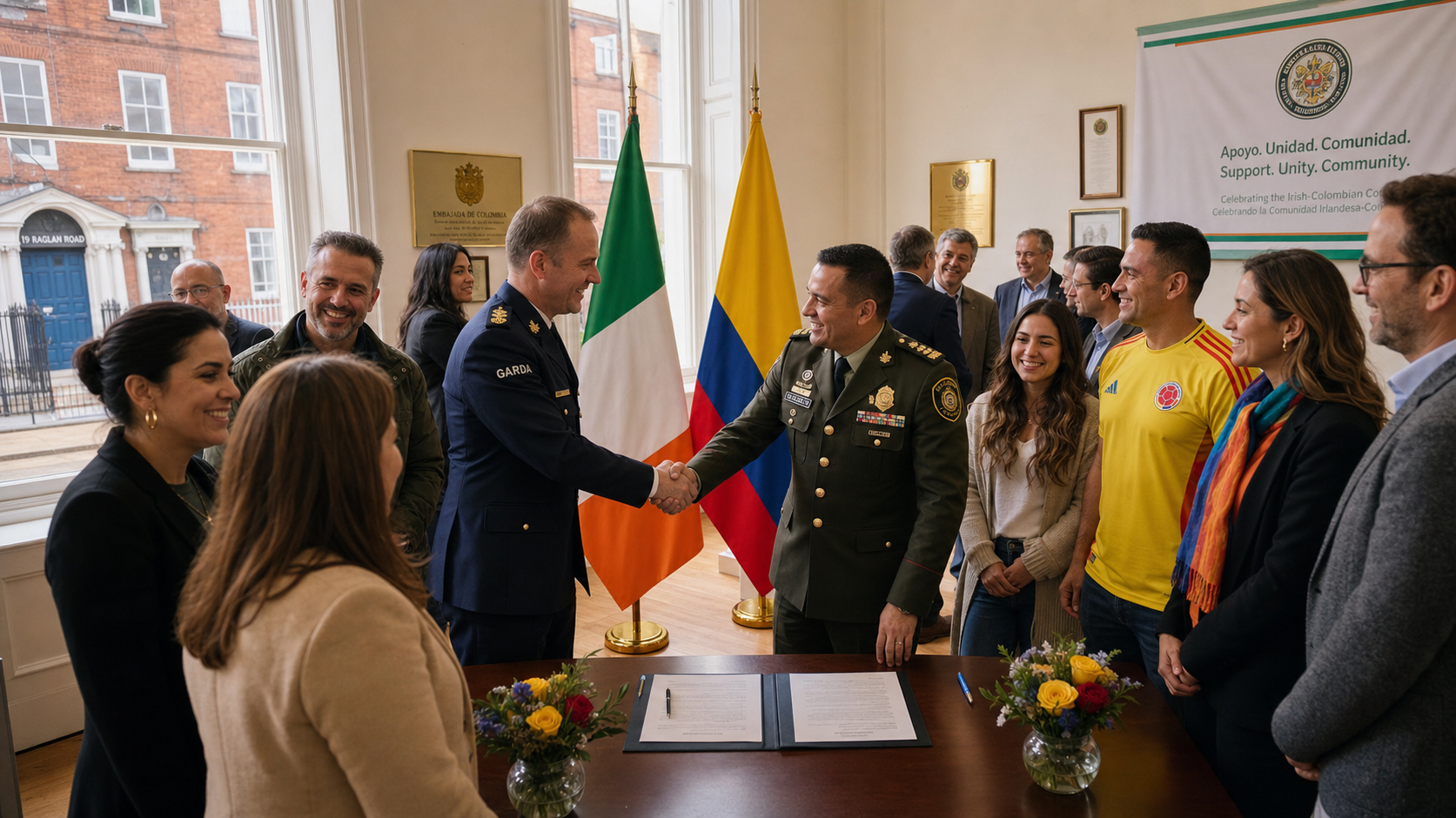
The signing of a formal co-operation pact between An Garda Síochána and the Colombian National Police has been welcomed by Ireland's small but growing Irish-Colombian community, who see it as a sign of deepening ties between the two countries and as an opportunity to raise the profile of the long and often overlooked history of Irish engagement with Latin America. The pact has also prompted renewed interest in the story of the Wild Geese — Irish soldiers and emigrants who played significant roles in the independence movements of several South American countries in the 19th century.
Background
Ireland's connection with Latin America is older and deeper than many people realise. The Wild Geese — Irish soldiers who left Ireland following the Flight of the Earls and the Williamite Wars — served in the armies of Spain and its colonies, and their descendants played significant roles in the independence movements that swept Latin America in the early 19th century. In Colombia, the Irish connection is particularly strong: Bernardo O'Higgins, who is celebrated as the liberator of Chile, was the son of an Irish immigrant, and the Irish Brigade that fought under Simón Bolívar in the Colombian independence war included hundreds of Irish soldiers who had come to South America seeking adventure and a cause.
The contemporary Irish-Colombian community in Ireland is small but growing, reflecting the broader diversification of Ireland's immigrant population over the past two decades. Colombian nationals living in Ireland are estimated to number in the thousands, concentrated primarily in Dublin and the other major cities. The community has established a number of cultural and social organisations, and it maintains strong connections with Colombia through family ties, cultural events, and business relationships. The signing of the Garda-Colombian National Police pact has been welcomed by community leaders as a sign that the Irish government is taking its relationship with Colombia seriously.
The context for the pact is, of course, primarily one of law enforcement — the growing cocaine trade that links Colombia and Ireland through a complex international supply chain. But the community has been careful to distinguish between the criminal networks that are the target of the pact and the vast majority of Colombian nationals in Ireland who are law-abiding, contributing members of Irish society. Community leaders have emphasised that the pact should be seen as a partnership between two countries that share a commitment to the rule of law, rather than as a statement about the Colombian community in Ireland.
Key Developments
The signing of the pact in Bogotá was attended by senior representatives of An Garda Síochána and the Colombian National Police, as well as by representatives of the Irish Embassy in Colombia. The Irish Ambassador to Colombia, who has been working to develop the bilateral relationship between the two countries, welcomed the pact as a significant step forward in Ireland-Colombia relations and expressed hope that it would be the foundation for a broader partnership that extends beyond law enforcement to encompass trade, culture, and development.
The Irish-Colombian community in Dublin has responded to the pact with a mixture of welcome and caution. Community leaders have welcomed the deepening of ties between the two countries, but have also emphasised the importance of ensuring that the pact does not lead to increased scrutiny of the Colombian community in Ireland. "We are proud of our Colombian heritage and of our contribution to Irish society," said one community leader. "We want to see a relationship between Ireland and Colombia that is based on mutual respect and partnership, not on suspicion."
The pact has also prompted renewed interest in the history of Irish engagement with Latin America. The story of the Wild Geese in South America — and particularly the role of Irish soldiers in the Colombian independence war — is not well known in Ireland, and community organisations have been working to raise awareness of this history through cultural events, educational programmes, and publications. The signing of the Garda pact has provided an opportunity to bring this history to a wider audience.
Why It Matters
The Garda-Colombian National Police pact is significant not just as a law enforcement measure but as a symbol of the deepening relationship between Ireland and Colombia. The two countries have more in common than many people realise — a shared history of colonialism, a strong Catholic tradition, a vibrant cultural life, and a diaspora that has spread across the world. The development of a formal law enforcement partnership is a step toward a broader bilateral relationship that could encompass trade, investment, cultural exchange, and development co-operation.
For the Irish-Colombian community in Ireland, the pact is a reminder of the complex and sometimes contradictory nature of the relationship between their two countries. On one hand, the pact is a response to the cocaine trade that has caused enormous harm in both Colombia and Ireland. On the other hand, it is an opportunity to deepen the ties between two countries that have a long and often overlooked history of connection. The community's response — welcoming the pact while emphasising the importance of mutual respect and partnership — reflects a sophisticated understanding of the complexity of the relationship.
The broader context of Ireland's engagement with Latin America is also significant. Ireland has traditionally focused its international relationships on Europe, the United States, and the English-speaking world, and its engagement with Latin America has been relatively limited. The Garda pact with Colombia is a sign that this is beginning to change, and it may open doors to a broader engagement with a region that is increasingly important in global politics and economics.
Local Impact
In Dublin, where the Irish-Colombian community is most concentrated, the pact has generated significant interest and discussion. Community organisations have been hosting events to discuss the implications of the pact and to explore the history of Irish-Colombian connections. The Colombian Embassy in Dublin has welcomed the pact and has indicated that it sees it as an opportunity to deepen the bilateral relationship between the two countries. In Cork, Galway, and Limerick, where smaller Colombian communities are established, similar discussions are taking place. The Irish language community has also expressed interest in the history of Irish engagement with Latin America, noting that several of the Wild Geese who served in South American independence movements were Irish speakers from the west of Ireland.
What's Next
The implementation of the Garda-Colombian National Police pact will be overseen by a joint working group that will meet regularly to review progress and to identify new opportunities for collaboration. The Irish Embassy in Colombia is expected to play a central role in facilitating the relationship between the two forces. The Department of Foreign Affairs has indicated that it is exploring opportunities to develop the broader bilateral relationship between Ireland and Colombia, including in the areas of trade, investment, and cultural exchange. A cultural event celebrating the history of Irish-Colombian connections is being planned for later this year, with the support of the Irish-Colombian community in Dublin and the Colombian Embassy. The event will include presentations on the history of the Wild Geese in South America and on the contemporary Irish-Colombian community in Ireland.