Ireland's Record 12.1% GDP Contraction Drags Eurozone into Reverse but Domestic Economy Remains Resilient
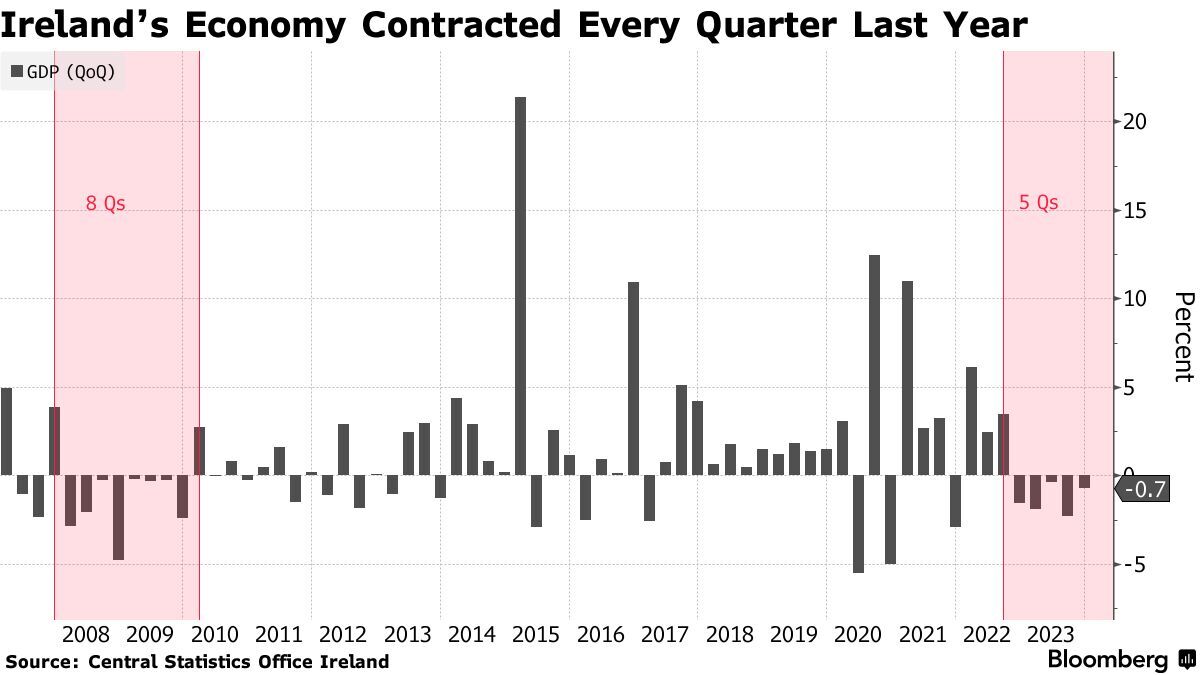
Ireland's economy recorded its sharpest quarterly contraction in history in the first quarter of 2026, with GDP falling by a staggering 12.1% — a decline so significant that it single-handedly pushed the entire 21-country eurozone into a 0.2% contraction, yet one that economists have been quick to contextualise, pointing to Modified Domestic Demand growth of 0.6% as evidence that the underlying Irish economy remains fundamentally sound.
Background
Ireland's GDP figures have long been regarded with a degree of scepticism by economists, policymakers, and international observers. The country's status as the European headquarters for many of the world's largest multinational corporations — particularly in the pharmaceutical, technology, and financial services sectors — means that its GDP figures are heavily influenced by the accounting decisions of those companies, which can shift enormous volumes of intellectual property, profits, and exports across borders in ways that have little to do with the actual economic activity occurring in Ireland.
This phenomenon became dramatically apparent in 2015, when Ireland's GDP grew by 26% in a single year — a figure so extraordinary that it prompted the Nobel Prize-winning economist Paul Krugman to coin the term "leprechaun economics." The growth was almost entirely attributable to the relocation of intellectual property assets by a small number of multinational companies, and it bore no relationship to the lived experience of Irish workers, businesses, or households.
In response to this problem, the Central Statistics Office developed the Modified Domestic Demand (MDD) metric, which strips out the most volatile multinational-related components of GDP and provides a more accurate picture of the health of the domestic economy. MDD has become the preferred measure for most serious economic analysis of Ireland's performance, though the headline GDP figure continues to attract international attention.
Key Developments
The 12.1% GDP contraction in the first quarter of 2026 was driven primarily by a sharp decline in multinational exports, particularly in the pharmaceutical sector. Economists attribute the decline to a "unwinding" effect: in 2025, pharmaceutical companies significantly accelerated their exports from Ireland in anticipation of potential US tariffs, creating an artificial surge in GDP. When that surge reversed in the first quarter of 2026, the statistical effect was a dramatic contraction.
The scale of the Irish contraction was sufficient to push the entire eurozone into negative territory, with the 21-country bloc recording a 0.2% contraction for the quarter. This is a remarkable illustration of the outsized statistical impact that Ireland's multinational sector can have on European economic data — an impact that bears no relationship to the actual economic conditions in the eurozone.
Against this backdrop, the MDD figures tell a very different story. Modified Domestic Demand rose by 0.6% in the first quarter, reflecting continued growth in consumer spending (up 0.6%) and domestic sector output (up 0.4%). These figures suggest that the Irish economy, as experienced by Irish workers and businesses, remains in reasonable health despite the headline GDP contraction.
Why It Matters
The GDP contraction matters for several reasons, even if the headline figure is misleading. It is a reminder of Ireland's profound dependence on a small number of large multinational companies, whose accounting decisions can have enormous statistical consequences for the country's economic data. This dependence creates a structural vulnerability: if a significant number of multinationals were to relocate their operations or their intellectual property out of Ireland, the impact on tax revenues and employment could be severe.
The episode also illustrates the limitations of GDP as a measure of economic wellbeing. A country whose GDP can fall by 12% in a single quarter without any corresponding deterioration in the living standards of its citizens is a country for which GDP is a particularly poor guide to economic reality. The development of alternative metrics like MDD is a step in the right direction, but there is a broader need for a more sophisticated public understanding of what economic statistics do and do not tell us.
For Ireland's international reputation, the GDP contraction creates a communications challenge. The headline figure — Ireland dragging the eurozone into recession — is the kind of story that travels internationally and can affect investor confidence, even when the underlying reality is more benign. The government and the Central Statistics Office have been active in contextualising the figures, but the task of explaining the nuances of Irish economic statistics to an international audience is a perennial challenge.
Local Impact
For Irish workers and businesses, the GDP contraction has had no direct impact on their day-to-day economic experience. Consumer spending is growing, employment remains high, and the domestic economy is performing reasonably well. However, the figures do have indirect implications: if the multinational sector's volatility leads to a sustained reduction in corporation tax revenues, the government's capacity to fund public services and infrastructure will be affected. The Department of Finance has been building up a sovereign wealth fund — the Future Ireland Fund — precisely to provide a buffer against this kind of revenue volatility, and the first quarter figures will reinforce the importance of that strategy.
What's Next
The second quarter GDP figures, due in September, will be closely watched for signs of whether the first quarter contraction was a one-off statistical anomaly or the beginning of a more sustained trend. The Department of Finance is expected to publish its mid-year economic review in July, which will include updated projections for the full year. The European Commission has indicated it will take the Irish figures into account in its assessment of eurozone economic performance, and the episode is likely to prompt renewed discussion about the adequacy of EU economic statistics in capturing the reality of member states with large multinational sectors.