Ireland's Dark Sky Tourism Boom Ahead of August 12 Solar Eclipse as Kerry and Donegal Prepare for Stargazers
Ireland's rapidly growing dark sky tourism sector is preparing for its most significant moment in a generation as the country readies for a deep partial solar eclipse on Wednesday, August 12 — an event that will see up to 97% of the sun obscured in Kerry and Cork, and which is expected to draw tens of thousands of visitors to the country's designated dark sky reserves and observatories.
Background
Ireland has quietly become one of Europe's most compelling destinations for astronomical tourism. The country's western seaboard, with its low population density, minimal light pollution, and dramatic coastal landscapes, provides some of the finest stargazing conditions on the continent. The Kerry International Dark Sky Reserve on the Iveragh Peninsula — the first International Dark Sky Reserve in the Northern Hemisphere — has been a pioneer in the development of astro-tourism, attracting visitors from across Europe and beyond who come to experience the extraordinary clarity of the night sky above Waterville and Cahersiveen.
The Mayo Dark Sky Park in Wild Nephin National Park, the OM Dark Sky Park and Observatory in Davagh Forest in County Tyrone, and a network of informal stargazing sites in Donegal, Connemara, and west Cork have all contributed to the growth of a sector that is now generating significant economic activity in some of Ireland's most rural and economically marginal communities. Dark sky tourism is particularly valuable because it is a year-round activity — unlike beach tourism, which is concentrated in the summer months, stargazing is often best in the autumn and winter when the nights are longest and the skies are clearest.
The August 12 eclipse is the most significant astronomical event to be visible from Ireland since the total solar eclipse of August 1999, which was visible as a partial eclipse across the country. The 2026 event will not reach totality in Ireland — the path of totality passes through Iceland and northern Spain — but the degree of obscuration will be extraordinary, particularly in the south and west of the country.
Key Developments
The eclipse will begin at approximately 6:10pm on Wednesday, August 12, with the maximum obscuration occurring around 7:10pm and the event concluding by approximately 8:05pm. The degree of coverage will vary across the country: Kerry and Cork will experience up to 96-97% obscuration, Dublin approximately 94%, and Belfast around 93%. The sun will be relatively low in the western sky at the time of maximum eclipse, meaning that a clear view of the west-south-west horizon will be essential for the best viewing experience.
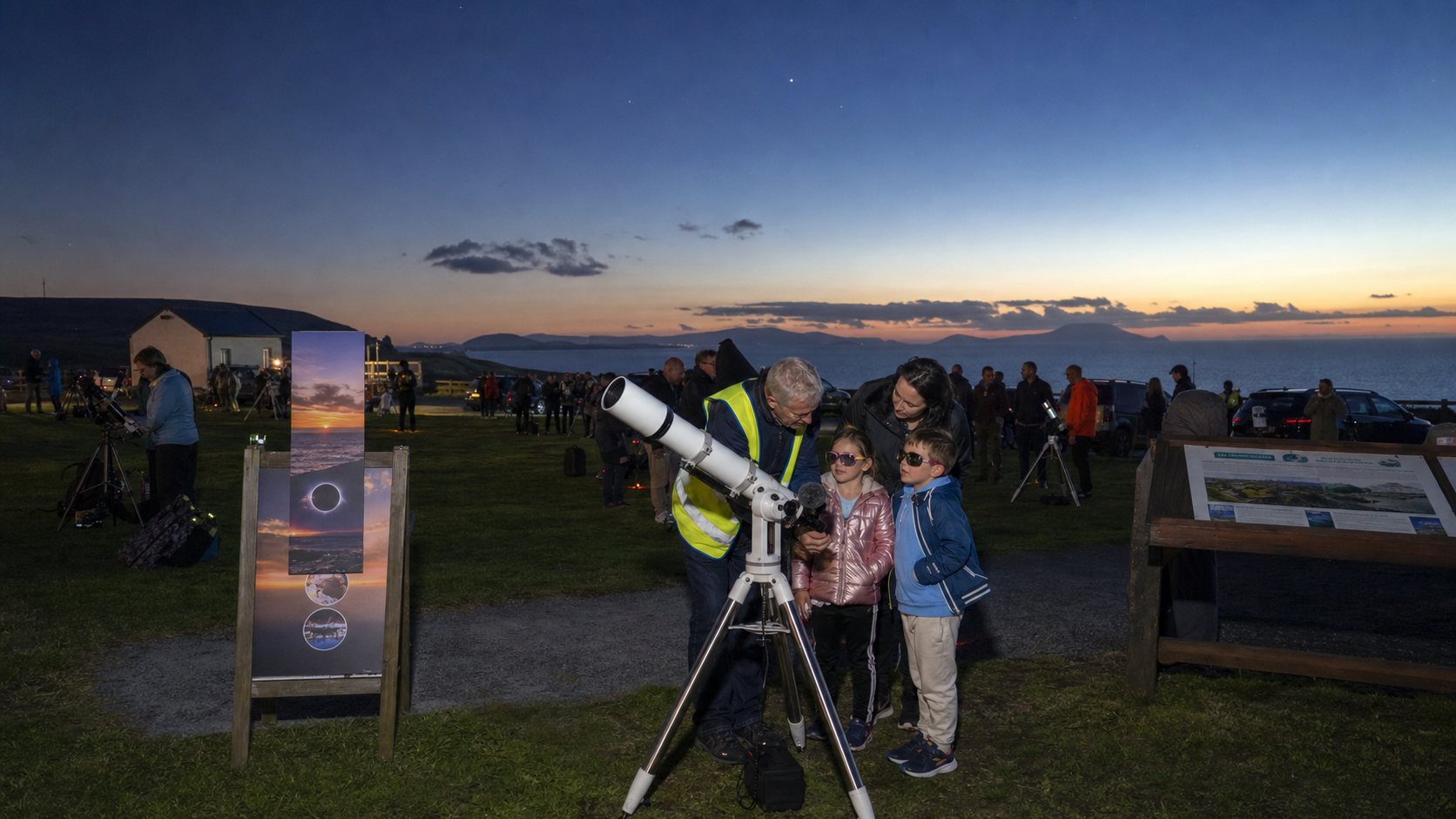
Blackrock Castle Observatory in Cork, Dunsink Observatory in Dublin, Armagh Observatory in Northern Ireland, and the Irish Astronomical Society are all planning public viewing events. The Kerry International Dark Sky Reserve has organised a series of events across the Iveragh Peninsula, with guided viewing sessions at Waterville and Cahersiveen. In Donegal, local astronomy clubs are hosting events at several locations along the Wild Atlantic Way, taking advantage of the county's exceptional dark sky conditions.
Safety guidance has been issued by all the major astronomy organisations: the eclipse is partial throughout Ireland, meaning the sun will never be fully obscured, and looking directly at the sun without certified eclipse glasses — conforming to the ISO 12312-2 international standard — can cause permanent eye damage. Sunglasses, 3D glasses, and multiple layers of eyewear do not provide adequate protection.
Why It Matters
The August 12 eclipse is a rare opportunity for Ireland's dark sky tourism sector to showcase itself to a national and international audience. Events of this magnitude — a near-total partial eclipse visible across the entire island — occur only once or twice in a generation, and the tourism and cultural value of the occasion is significant. For communities in Kerry, Donegal, Mayo, and Tyrone that have invested in dark sky infrastructure and programming, the eclipse is a chance to demonstrate the quality of their offering and to attract visitors who might not otherwise have considered astronomical tourism.
The eclipse also coincides with the peak of the Perseid meteor shower, which reaches its maximum on the night of August 12. With the moon below the horizon, conditions for viewing the meteor shower later that evening will be excellent — a bonus for those who travel to dark sky locations for the eclipse and choose to stay for the night.
Local Impact
In Kerry, the eclipse is expected to generate significant visitor numbers across the Iveragh Peninsula, with accommodation in Waterville, Cahersiveen, and Kenmare already heavily booked for the night of August 12. Local businesses — from hotels and B&Bs to restaurants and craft shops — are anticipating a significant boost in trade. In Donegal, the eclipse has been embraced by the county's tourism operators as an opportunity to extend the summer season and to attract visitors to areas that are not typically on the main tourist trail. The OM Dark Sky Park in Davagh Forest, County Tyrone, is hosting a major public event that is expected to draw visitors from across Northern Ireland and the border counties.
What's Next
The eclipse will take place on Wednesday, August 12, weather permitting. Met Éireann has indicated that conditions are expected to be favourable across much of the country, though cloud cover cannot be ruled out in some areas. Those planning to view the eclipse are advised to check the weather forecast in the days leading up to the event and to have a backup location in mind if their primary viewing site is affected by cloud. A lunar eclipse is scheduled for August 28, 2026, providing a further astronomical event for those who miss the solar eclipse or who are inspired by it to explore the night sky further.