Ireland's 2026-2030 Diaspora Strategy Reaches Out to 70 Million Strong Global Irish Community
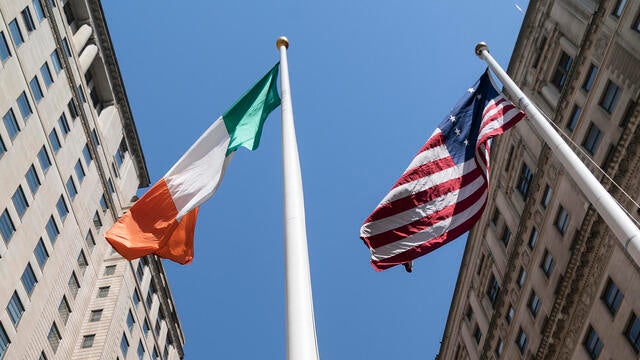
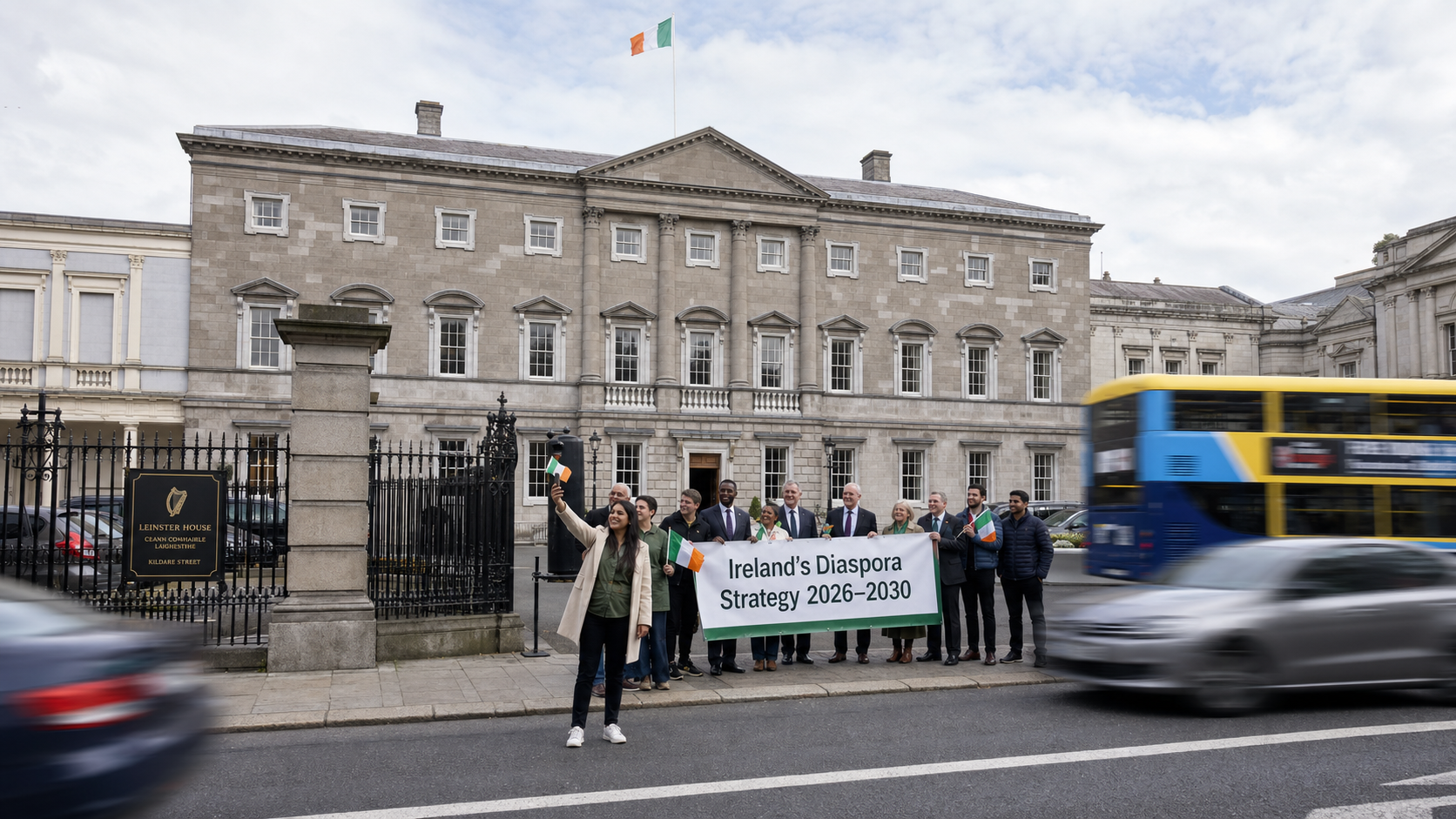
The Irish government has launched its 2026-2030 Diaspora Strategy, a comprehensive five-year plan to deepen and diversify Ireland's engagement with the estimated 70 million people worldwide who claim Irish descent or connection — a community that dwarfs the island's own population of seven million and that represents one of Ireland's most significant but often underutilised strategic assets.
Background
Ireland's diaspora is one of the most remarkable phenomena in modern demographic history. The combination of the Great Famine of the 1840s, which drove mass emigration on an unprecedented scale, and the successive waves of emigration that followed — driven by economic necessity, political upheaval, and the search for opportunity — has created a global Irish community of extraordinary size and reach. From the Irish-American communities of Boston, New York, and Chicago to the Irish communities of London, Sydney, and Buenos Aires, the Irish diaspora has shaped the cultures and politics of countries across the world.
The Irish government has maintained a formal diaspora policy since the 1990s, when the scale and significance of the global Irish community began to be recognised as a strategic asset. The Emigrant Support Programme, which provides funding for Irish community organisations overseas, has been a central element of that policy, supporting everything from welfare services for elderly Irish emigrants in Britain to cultural programmes for the Irish community in the United States.
But the nature of the Irish diaspora has been changing. The traditional centres of Irish emigration — Britain, the United States, Australia — remain important, but they are no longer the only significant destinations. Irish people are now living and working in continental Europe, the Middle East, Asia, and Africa in significant numbers, and the patterns of emigration and return have become more complex and more fluid than in previous generations.
Key Developments
The 2026-2030 Diaspora Strategy, launched on 19 June, sets out a comprehensive framework for Ireland's engagement with its global community over the next five years. The strategy's most significant conceptual innovation is the formal recognition of the "affinity diaspora" — people who are not of Irish descent but who have a strong, lasting connection to Ireland through having lived, worked, or studied here.
This group — which includes the many thousands of people from across the world who have spent time in Ireland and developed a genuine affinity with the country — is explicitly included in the strategy's vision and in the programmes it proposes to support. The recognition of the affinity diaspora reflects a more inclusive and expansive understanding of what it means to be connected to Ireland, and a recognition that the country's global network extends beyond its genealogical connections.
The global consultations that informed the strategy were held in a diverse range of locations, including Nairobi — a signal that the government is thinking beyond the traditional US-centric model of diaspora engagement and recognising the growing Irish presence in Africa and other emerging regions. The consultations gathered input from Irish community organisations, individual emigrants, and members of the affinity diaspora, providing a rich picture of the diversity of the global Irish community.
Why It Matters
The diaspora strategy matters because the global Irish community is a genuine strategic asset that Ireland has not always used as effectively as it might. The political influence of Irish-Americans in Washington, which was so important during the Northern Ireland peace process, is the most obvious example of diaspora power — but it is far from the only one. Irish communities across the world provide networks of connection, advocacy, and goodwill that can be mobilised in support of Irish interests in trade, diplomacy, and culture.
The recognition of the affinity diaspora is particularly significant in this context. Many of the people who have lived and worked in Ireland — who have built friendships, developed professional networks, and formed a genuine attachment to the country — are now in positions of influence in their home countries. Cultivating those connections, and treating those people as part of the broader Irish community, is a smart piece of soft power diplomacy.
The strategy also reflects a more honest reckoning with the reality of Irish emigration. Ireland continues to lose significant numbers of young, educated people to emigration each year — a loss that represents both a human cost and an economic challenge. The diaspora strategy cannot address the underlying causes of emigration, but it can help to maintain the connections between those who leave and the country they leave behind.
Local Impact
Within Ireland, the strategy will be implemented through the Department of Foreign Affairs and the network of Irish embassies and consulates worldwide. The Emigrant Support Programme, which currently funds Irish community organisations in Britain, the United States, Australia, and elsewhere, will be reviewed to ensure it reflects the broader definition of the diaspora and the changing geography of Irish emigration.
For Irish communities in Britain — where the largest concentration of Irish emigrants and their descendants is found — the strategy reaffirms the government's commitment to supporting their welfare and maintaining their connection to Ireland. The Irish community in Britain has faced particular challenges in the post-Brexit environment, and the strategy's attention to their needs is welcome.
What's Next
The Department of Foreign Affairs will publish an implementation plan for the 2026-2030 strategy in the autumn, setting out the specific programmes and initiatives that will be developed to deliver on its objectives. A new diaspora advisory forum, including representatives of both the heritage and affinity diaspora, is expected to be established before the end of the year. The first formal review of progress against the strategy's objectives is planned for 2028, with an interim assessment expected in 2027.