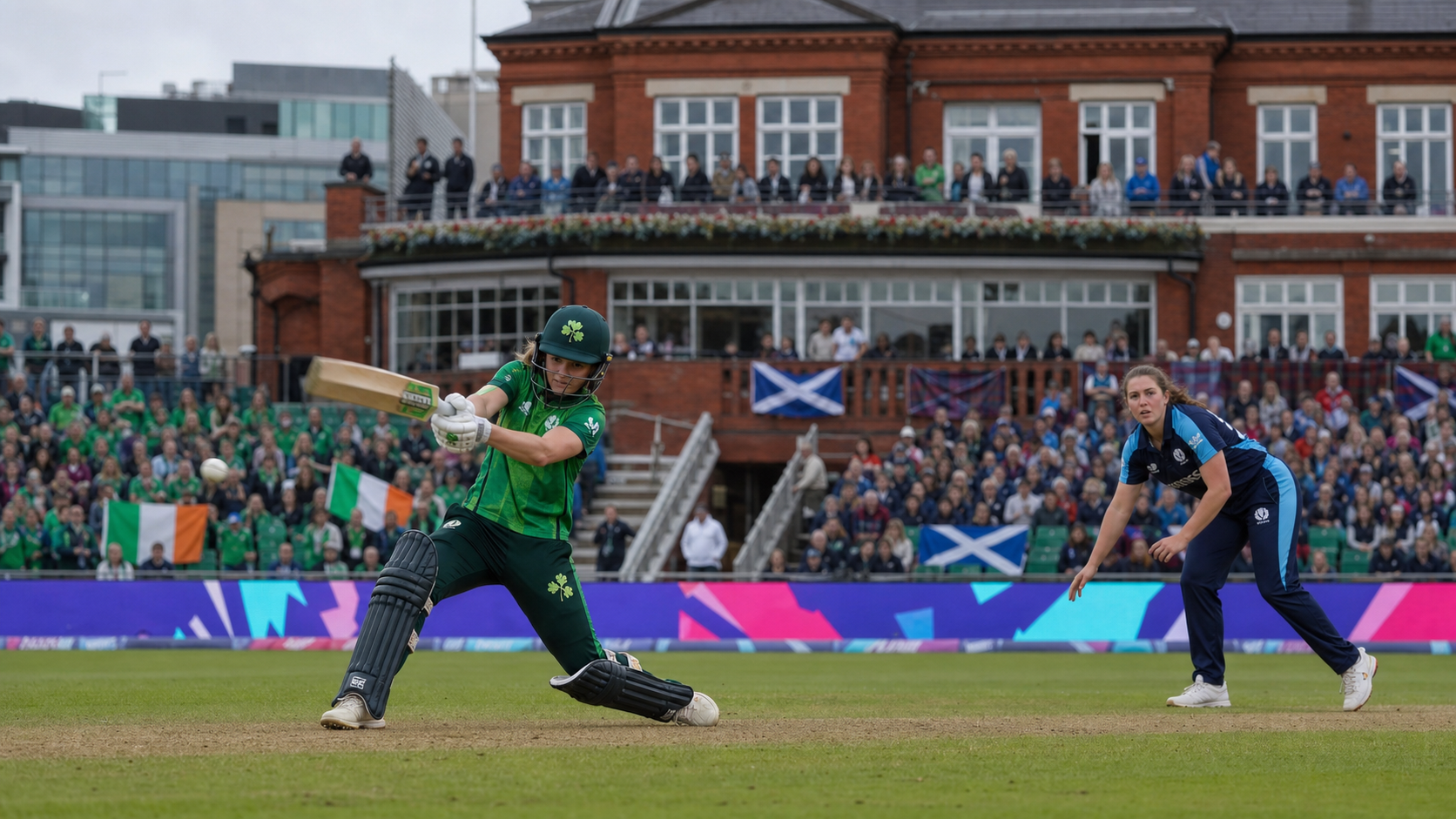
Ireland Women Begin T20 World Cup Campaign Against Scotland as Cricket Reaches New Heights
Ireland Women's cricket team have opened their ICC Women's T20 World Cup 2026 campaign at Old Trafford in Manchester, facing Scotland in an all-Celtic clash that marks the fifth time Ireland's women have competed at a World Cup — and the first time they have done so with a squad that includes several players who have come through the Cricket Ireland development pathway from junior level, a sign of the growing depth of the women's game in Ireland.
Background
Women's cricket in Ireland has undergone a remarkable transformation over the past decade. The sport was a minority pursuit for most of the twentieth century, with limited resources, few competitive opportunities, and little public profile. The granting of Full Member status to Cricket Ireland by the International Cricket Council in 2017 — which applied to both the men's and women's programmes — was a watershed moment, providing access to more funding, more international fixtures, and a clearer pathway to the sport's major tournaments.
The Ireland Women's team has made steady progress since then, qualifying for successive T20 World Cups and developing a core of players who are capable of competing with the best teams in the world on their day. Captain Gaby Lewis, who has been one of the most consistent performers in the team for several years, has been a central figure in this development, providing both on-field quality and off-field leadership that has helped to build the team's culture and ambition.
The qualification for the 2026 T20 World Cup came through the Global Qualifier in Nepal, where Ireland secured their place with a 62-run win over Thailand in the decisive match. The qualification was celebrated as a significant achievement, but the team's ambitions go beyond simply being present at the tournament — they want to win games and demonstrate that Ireland belongs at the top table of women's cricket.
Key Developments
The opening game against Scotland at Old Trafford was a significant occasion for both teams — an all-Celtic clash at one of cricket's most historic venues, with both nations seeking to establish themselves in the tournament. Ireland, who are in Group B alongside England, New Zealand, Sri Lanka, and West Indies, face a challenging group that will test the full range of their abilities. The England game, in particular, will be one of the most high-profile fixtures in the history of Irish women's cricket, providing an opportunity to demonstrate the progress that the team has made against one of the world's top sides.
The squad for the tournament includes several first-time World Cup call-ups, reflecting the depth of talent that has developed in the Irish women's game. These younger players have come through the Cricket Ireland development pathway — the provincial structures, the age-group programmes, and the high-performance academy — that has been built over the past decade with the explicit goal of producing players capable of competing at international level. Their presence in the squad is a measure of the success of that investment.
The domestic cricket calendar in Ireland was directly affected by the civil unrest in Northern Ireland, with Cricket Ireland postponing the Inter-Provincial T20 Festival that was scheduled to be held in Lisburn on 10 and 11 June due to safety concerns. The postponement was a reminder of the broader context in which Irish sport operates, and of the way that events outside the sporting world can have direct consequences for the game.
Why It Matters
Ireland Women's participation in the T20 World Cup matters because it is a measure of how far the women's game has come in a country where cricket has historically been a minority sport. The fact that Ireland are competing at a fifth World Cup, with a squad that includes players developed through a domestic pathway, is a testament to the investment that Cricket Ireland has made in the women's programme and to the dedication of the players and coaches who have built the team. It also matters because the T20 World Cup is one of the most watched cricket tournaments in the world, providing Ireland with a platform to showcase the women's game to a global audience and to inspire the next generation of Irish cricketers.
Local Impact
The impact of Ireland Women's World Cup participation is felt most directly in the cricket communities across Ireland — the clubs in Dublin, Cork, Leinster, Munster, and the other provinces where the game is played and where young girls are watching the national team and dreaming of following in their footsteps. The visibility that the World Cup provides is invaluable for the development of the women's game, and Cricket Ireland has been working to maximise the promotional opportunities that the tournament creates. In Northern Ireland, where the postponement of the Inter-Provincial T20 Festival was a disappointment for the cricket community, the Ireland Women's World Cup campaign provides a positive focus for supporters of the game.
What's Next
Ireland Women face a demanding group stage schedule, with games against England, New Zealand, Sri Lanka, and West Indies to follow the opening fixture against Scotland. The team will need to win at least two of their five group games to have a realistic chance of advancing to the knockout stages, and the management team will be carefully planning their approach to each fixture. The tournament continues through June and into July, with the final scheduled for later in the month. Cricket Ireland will be hoping that the team's performances generate significant media coverage and public interest in Ireland, building on the momentum that the women's game has developed in recent years.