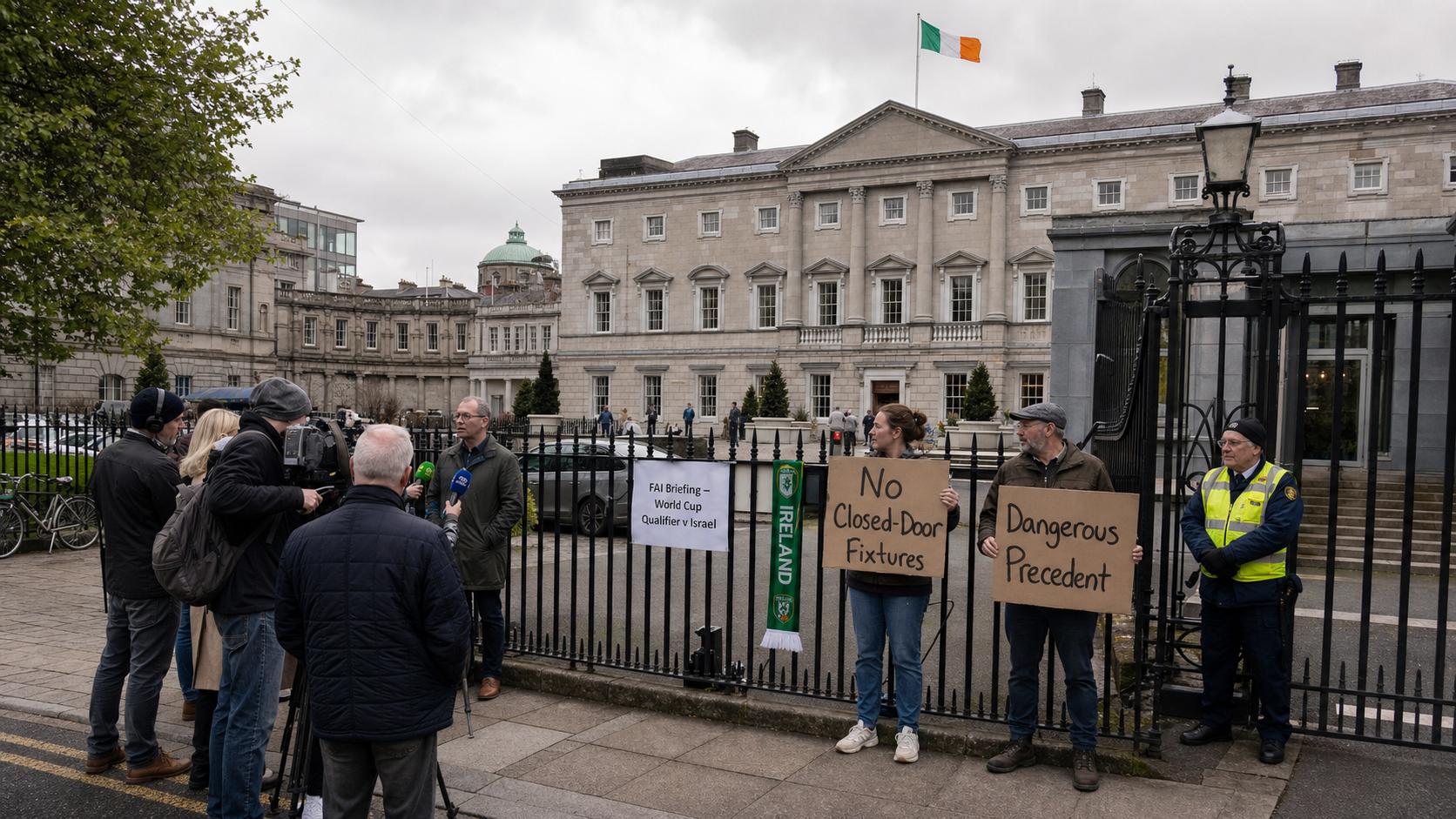
The Republic of Ireland's upcoming FIFA World Cup qualifier against Israel will be played at a neutral venue and behind closed doors, the Football Association of Ireland confirmed on Friday, following a decision by the Irish government that has ignited fierce debate across the political spectrum.
The announcement came after weeks of mounting pressure from pro-Palestinian advocacy groups and several opposition TDs who had called on the government to take a stand against Israel's ongoing military campaign in Gaza. The government ultimately directed the FAI to seek an alternative arrangement for the fixture, which had originally been scheduled to take place at the Aviva Stadium in Dublin.
Taoiseach Micheál Martin defended the decision, stating that the government had acted in accordance with Ireland's long-standing foreign policy position and its obligations under international law. "This was not a decision taken lightly," he told reporters at Government Buildings. "Ireland has consistently stood for the rights of the Palestinian people, and we believe this arrangement reflects the gravity of the current situation while allowing the sporting fixture to proceed."
The FAI confirmed that the match will be played at a venue yet to be confirmed, with no spectators permitted to attend. The association said it was working closely with UEFA and FIFA to ensure the fixture complies with all relevant regulations and that Ireland's World Cup qualification campaign is not adversely affected.
However, the decision drew sharp criticism from opposition parties, with Fine Gael's sports spokesperson arguing that the move sets a troubling precedent for the politicisation of sport. "We are deeply concerned about the implications of this decision," the spokesperson said. "Sport has always served as a bridge between nations, and using it as a political instrument risks undermining the integrity of international competition."
Sinn Féin, by contrast, broadly welcomed the government's stance, though some members of the party argued the decision did not go far enough and called for a complete suspension of sporting ties with Israel until a ceasefire is achieved in Gaza.
The controversy has reignited a broader debate in Ireland about the appropriate role of sport in international diplomacy. Several prominent Irish athletes and sporting figures have spoken out in recent weeks, with some supporting the government's position and others urging that sport be kept separate from political disputes.
UEFA issued a statement acknowledging the arrangement and confirming that it would not result in any sporting sanction against Ireland, provided the match is played in accordance with the governing body's regulations. FIFA similarly indicated that it was monitoring the situation and would work with both associations to ensure the fixture proceeds without incident.
The Irish women's national team had already played a 2027 World Cup qualifier against the Netherlands earlier this month, winning 3-2, before suffering a 1-0 defeat to France on 9 June. The men's team's qualification campaign has taken on added significance following the controversy, with supporters and officials alike hoping the off-field turbulence does not distract from preparations for the match itself.
For many Irish football fans, the situation represents an uncomfortable collision between their passion for the sport and deeply held political convictions. Online forums and social media have been awash with debate, with opinion sharply divided on whether the government made the right call.
The FAI said it would provide further details on the venue and logistics for the fixture in the coming days, and urged supporters to remain patient as arrangements are finalised. The association also confirmed that ticket refunds would be processed automatically for those who had already purchased seats for the original Aviva Stadium fixture.
The controversy has also raised questions about the future of Ireland's relationship with FIFA and UEFA, both of which have strict rules about the politicisation of sport. While both governing bodies have indicated that the neutral venue arrangement will not result in sanctions, some officials within the FAI are privately concerned about the long-term implications of allowing political considerations to influence the scheduling and staging of international fixtures.
Supporters' groups have been divided in their response to the announcement. The Aviva Stadium faithful, many of whom had already purchased tickets for the original fixture, expressed frustration at the disruption to their plans, while others said they understood and supported the government's decision. The FAI confirmed that full refunds would be processed automatically for all ticket holders.
The broader question of how Ireland navigates its sporting relationships in an increasingly polarised world is one that is likely to occupy policymakers and sporting administrators for years to come. As the 2026 World Cup unfolds and Ireland's qualification campaign continues, the decisions made in the coming weeks will set important precedents for how the country approaches similar situations in the future.