Ireland Plans New EU Mission to Train Lebanese Armed Forces as UNIFIL Mandate Approaches End
Ireland is actively engaged in planning for a new European Union mission to advise and train the Lebanese Armed Forces and Internal Security Forces, as the UNIFIL mandate approaches its expiry at the end of 2026 — a development that will require the Irish government to make decisions about the future of its military engagement in Lebanon, where Irish troops have served continuously since 1978.
Background
Ireland's connection to Lebanon through UNIFIL — the United Nations Interim Force in Lebanon — is one of the most enduring and significant commitments in the history of the Irish Defence Forces. Irish troops first deployed to Lebanon in 1978, in response to a UN Security Council resolution calling for the establishment of a peacekeeping force following Israel's invasion of southern Lebanon. In the nearly five decades since, Ireland has maintained a continuous presence in UNIFIL, contributing thousands of soldiers to the mission and suffering significant casualties — 47 Irish soldiers have died in Lebanon, a toll that has left a deep mark on the Defence Forces and on the communities from which those soldiers came.
UNIFIL's mandate has been renewed annually by the UN Security Council, but the force has faced increasing criticism in recent years for its inability to prevent the rearming of Hezbollah and to enforce the terms of UN Security Council Resolution 1701, which called for the disarmament of all armed groups in Lebanon south of the Litani River. The expiry of the UNIFIL mandate at the end of 2026 has prompted a fundamental reassessment of the international community's approach to security in Lebanon, with the European Union emerging as the most likely provider of a successor mission.
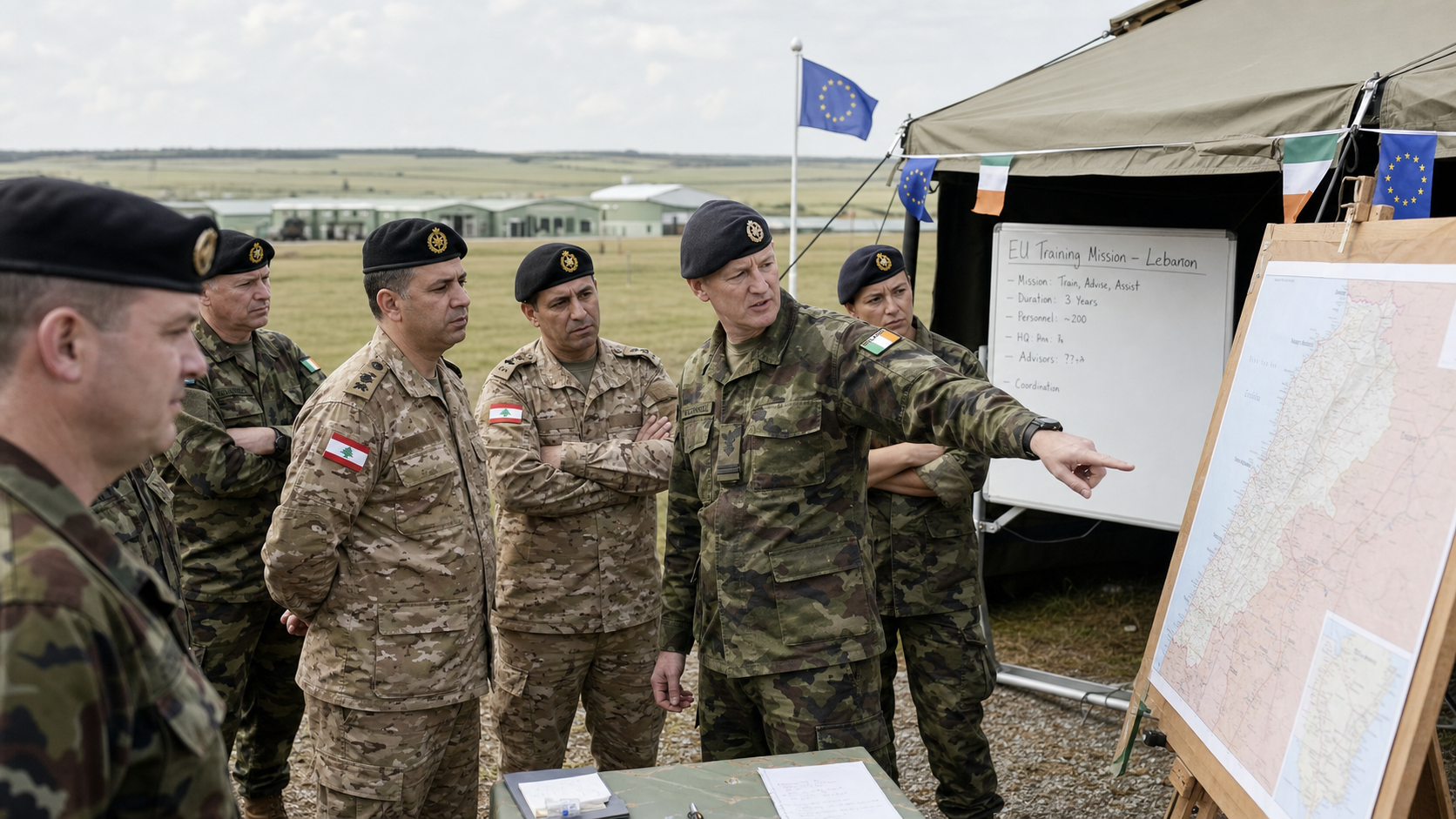
The new EU mission, which was discussed at the informal meeting of EU defence ministers in Wicklow on 1 September, would take a different form from UNIFIL. Rather than a traditional peacekeeping force, the mission would focus on advising and training the Lebanese Armed Forces and Internal Security Forces — strengthening the capacity of the Lebanese state to provide security across its territory and, potentially, to take on the disarmament responsibilities that UNIFIL has been unable to fulfil.
Key Developments
EU foreign policy chief Kaja Kallas confirmed at the Wicklow meeting that the bloc is developing the mission to provide counselling and training to the Lebanese military, with a focus on border and maritime security and the strengthening of internal security capabilities. At least ten EU member states have expressed willingness to contribute personnel and resources to the mission, and the EU aims to reach an official Council decision to launch it in October 2026, with deployment anticipated in late 2026 or early 2027.
General Seán Clancy, chair of the EU Military Committee, confirmed that planning for the mission is well advanced. "The planning is progressing well," he said. "We have a clear sense of what the mission needs to achieve and how it should be structured. The key now is to secure the political decisions that will allow us to move forward."
Ireland's role in the new mission has not yet been confirmed, but the government has indicated that it is open to contributing personnel within the framework of its military neutrality. The Defence Forces have significant experience of training and advisory missions — Irish troops have participated in EU training missions in Mali, Somalia, and other conflict-affected countries — and that experience would be directly relevant to a mission in Lebanon.
The transition from UNIFIL to the new EU mission will need to be managed carefully to avoid a security vacuum in southern Lebanon. EU officials have emphasised that the new mission is not intended to replace UNIFIL but to complement it, and that the two missions may operate in parallel for a period before UNIFIL's mandate finally expires.
Why It Matters
The question of Ireland's future role in Lebanon matters for several reasons. The Defence Forces' long service in UNIFIL has been a source of national pride and has given Ireland a distinctive voice in international discussions about peacekeeping and conflict resolution. The transition to a new EU mission represents both an opportunity and a challenge: an opportunity to continue Ireland's engagement in Lebanon in a form that may be more effective than UNIFIL has been, and a challenge to ensure that the transition is managed in a way that does not undermine the security gains that UNIFIL has helped to achieve.
The new mission also raises important questions about Ireland's approach to military neutrality. The EU mission would be a training and advisory mission rather than a combat mission, but it would involve Irish troops working alongside the armed forces of other EU member states in a context that is more explicitly military than traditional UN peacekeeping. The government will need to navigate these questions carefully, both in terms of the legal framework for Irish participation and in terms of the public debate about the nature and limits of Irish neutrality.
For the families of the 47 Irish soldiers who died in Lebanon, the transition from UNIFIL to a new mission is a moment of particular significance. Their sacrifice was made in the service of a UN peacekeeping mission that has, despite its limitations, contributed to a degree of stability in southern Lebanon. The question of whether a new EU mission can build on that legacy — and whether it can achieve what UNIFIL could not — is one that will be watched closely by those who have the most personal stake in the outcome.
Local Impact
In Ireland, the question of the future of the Lebanon mission is followed with particular interest in the communities that have provided soldiers to UNIFIL over the decades. Counties like Donegal, Mayo, Galway, and Cork have strong traditions of Defence Forces service, and the prospect of a new mission in Lebanon will be discussed in barracks, in community halls, and in family homes across the country. The Defence Forces themselves are watching the planning process closely, aware that any new mission will have significant implications for their resources, their training, and their operational capacity.
For the Irish diplomatic community, the Lebanon mission is also a significant issue. Ireland's long service in UNIFIL has given the country a credibility and a voice in Middle East diplomacy that is disproportionate to its size, and the government will be keen to ensure that any transition to a new mission preserves that credibility and that voice.
What's Next
The EU Council is expected to make an official decision on the new Lebanon mission in October 2026, with Ireland's participation to be confirmed in the weeks following that decision. The Defence Forces will then begin the planning process for any Irish contribution, with deployment anticipated in late 2026 or early 2027. The government has indicated that it will consult with the Oireachtas before confirming Ireland's participation in the mission, in line with the constitutional requirements for the deployment of Irish troops abroad.