Ireland's New Diaspora Strategy Embraces 'Affinity Irish' with Record €17.5 Million Support Fund
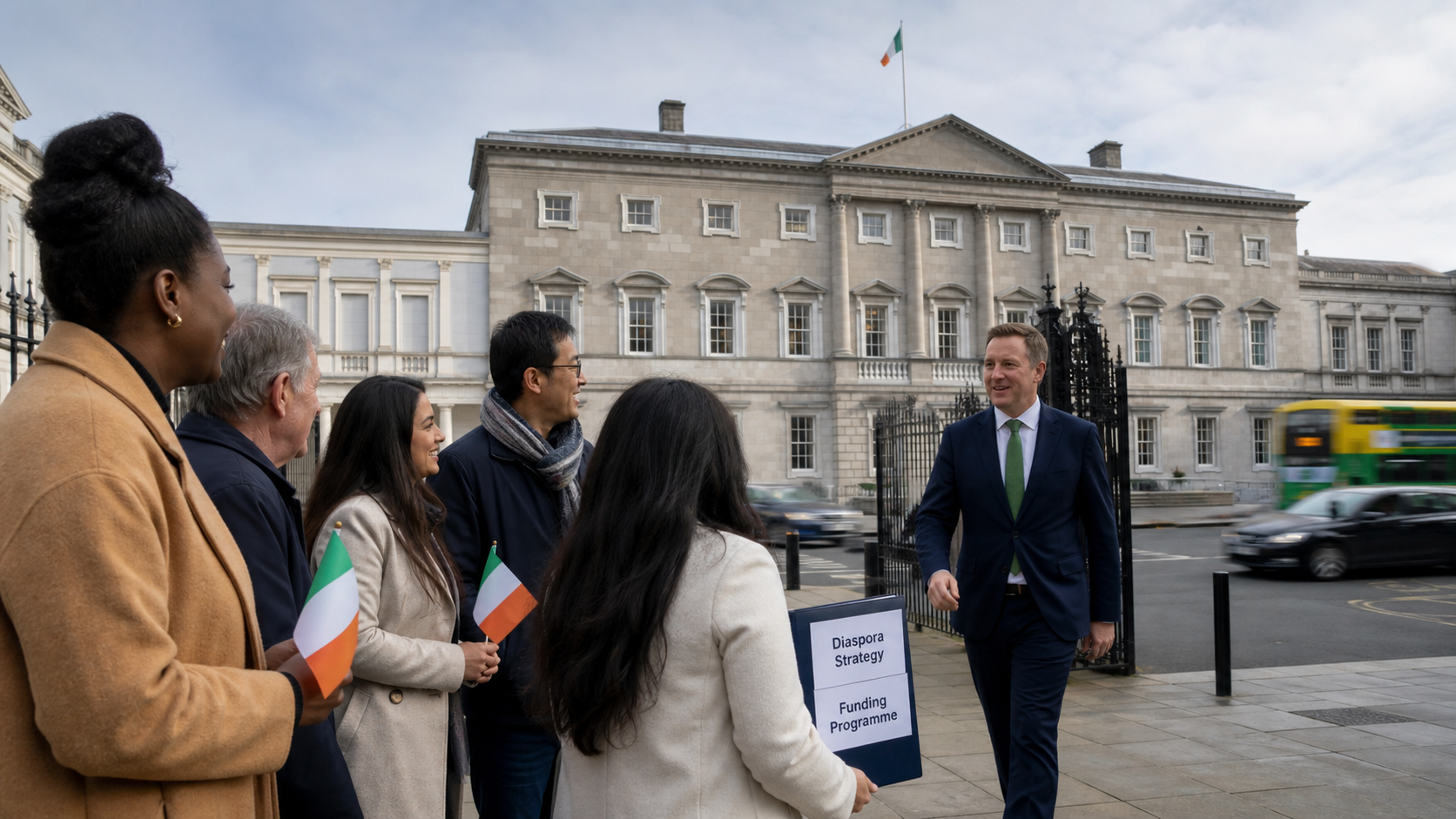
Ireland has launched its third Diaspora Strategy, covering 2026 to 2030, with a record €17.5 million allocation to the Emigrant Support Programme and a significant evolution in how the state defines and engages with its global community. The strategy, developed by Minister of State for International Development and Diaspora Neale Richmond following the largest consultation process in the state's history, introduces the concept of an "affinity diaspora" — people without hereditary Irish links who have lived, worked, or studied in Ireland and who maintain a deep connection to the country — and commits to 23 specific actions across five key areas.
Background
Ireland's relationship with its diaspora is one of the defining features of the country's national identity. The Irish diaspora — estimated at 70 million people worldwide who claim Irish heritage — is one of the largest in the world relative to the size of the home population, and it has been a source of cultural, economic, and political influence for generations. The Irish government has engaged formally with the diaspora through a series of strategies since 2015, and the 2026-2030 strategy represents the third iteration of that engagement.
The context for the new strategy is one of significant change in the nature and composition of the Irish diaspora. The traditional image of the Irish diaspora — rooted in the waves of emigration driven by the Famine, economic hardship, and political conflict — is giving way to a more complex and diverse picture. Contemporary Irish emigrants are more likely to be highly educated, to emigrate by choice rather than necessity, and to maintain strong connections with Ireland through digital technology and affordable travel. The diaspora is also increasingly diverse in terms of ethnicity, nationality, and cultural background, reflecting the transformation of Ireland itself into a multicultural society.
The concept of the "affinity diaspora" — people without hereditary Irish links who have lived, worked, or studied in Ireland and who maintain a deep connection to the country — is a significant innovation in the new strategy. It reflects a recognition that Irishness is not simply a matter of ancestry but of lived experience and cultural connection, and that the state has an interest in maintaining relationships with the many people who have been shaped by their time in Ireland, regardless of their ethnic background.
Key Developments
The new strategy commits to 23 specific actions across five key areas: wellbeing and advocacy, identity and culture, connection and contribution, departure and return, and sharing experience. The record €17.5 million allocation to the Emigrant Support Programme — the cornerstone of the state's engagement with the diaspora — reflects the government's commitment to supporting the most vulnerable members of the Irish community abroad, including elderly emigrants who may be isolated or in need of welfare support.
The strategy was developed following the largest consultation process in the state's history, including over 27 in-person meetings with diaspora communities around the world and the first-ever online Global Irish Survey. The consultation revealed a diaspora that is diverse, engaged, and eager to maintain connections with Ireland, but that also faces significant challenges — including the administrative barriers that make it difficult for emigrants to return to Ireland, the lack of voting rights for citizens living abroad, and the inadequacy of crisis-response protocols for repatriated citizens.
The shift in emigration patterns highlighted in the strategy is significant. Australia has become a primary destination for Irish emigrants, with 13,500 people moving there in the year to April 2025, compared to 6,100 to the United States. While the US remains a vital partner for Ireland, the government is actively looking toward new geopolitical and economic opportunities in Central and Eastern Europe and other emerging regions. The strategy also acknowledges that traditional advocacy issues like US immigration reform are currently off the political table, and commits to developing new approaches to supporting Irish emigrants in the United States.
Why It Matters
The Diaspora Strategy 2026-2030 is significant for several reasons. First, it represents a genuine evolution in how Ireland thinks about its relationship with its global community — moving from a narrow focus on hereditary ties to a broader, more inclusive definition of Irishness that encompasses the "affinity diaspora." This is a recognition that Ireland's soft power in the world is not simply a function of the number of people who claim Irish ancestry, but of the quality of the relationships that Ireland maintains with all the people who have been shaped by their connection to the country.
Second, the record €17.5 million allocation to the Emigrant Support Programme reflects a genuine commitment to the welfare of the most vulnerable members of the Irish community abroad. The programme funds a network of Irish community organisations around the world that provide welfare support, social services, and community activities for Irish emigrants — particularly the elderly and the most isolated. The increase in funding is a recognition of the growing needs of this community and of the importance of the state's role in supporting it.
Third, the strategy's focus on facilitating the return of emigrants to Ireland is significant in the context of Ireland's demographic challenges. Ireland has a long history of emigration, and the loss of talented and educated young people to other countries has been a persistent challenge for the economy and for communities across the country. The strategy's commitment to addressing the administrative barriers that make it difficult for emigrants to return — including the Habitual Residence Condition, housing access, and visa processing for non-Irish spouses — reflects a recognition that facilitating return is as important as supporting those who remain abroad.
Local Impact
The impact of the Diaspora Strategy will be felt in Irish communities around the world, but it will also be felt in Ireland itself. The strategy's focus on facilitating the return of emigrants has particular relevance for communities in the west of Ireland, where emigration has historically been highest and where the loss of young people has had the most significant demographic impact. In counties like Mayo, Galway, Roscommon, and Donegal, the return of emigrants — bringing skills, experience, and international connections — could make a significant contribution to local economies and communities. The strategy's commitment to expanding voting rights for citizens living abroad is also significant, as it would give the diaspora a direct voice in Irish politics for the first time. The government has indicated that it will bring proposals for overseas voting to the Oireachtas before the end of 2026.
What's Next
The implementation of the Diaspora Strategy 2026-2030 will be overseen by the Department of Foreign Affairs, with Minister of State Neale Richmond taking the lead. The first annual review of the strategy's implementation is expected to take place in early 2027. The Global Irish Civic Forum, which brings together representatives of diaspora communities from around the world, is expected to meet in Dublin in November 2026 to discuss the strategy's implementation and to provide feedback on its priorities. The government's proposals for overseas voting are expected to be published before the end of 2026, with a view to introducing legislation in 2027. The Emigrant Support Programme's record €17.5 million allocation will be distributed to community organisations around the world through a competitive grants process that is expected to open in October 2026.