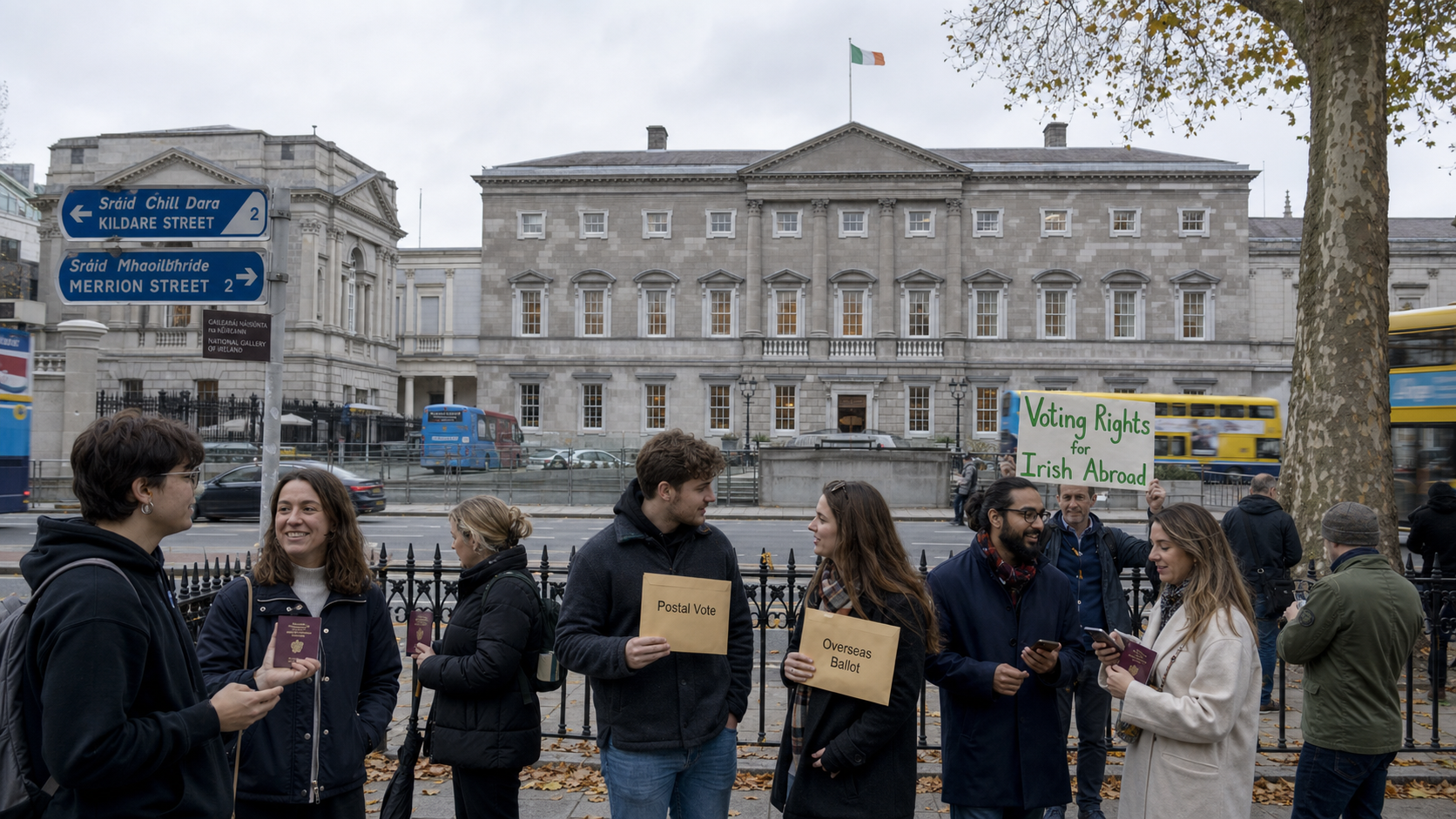
Ireland Launches 12-Month Task Force to Explore Voting Rights for Irish Citizens Living Abroad
The Irish government has initiated a 12-month Task Force to explore potential voting options for Irish emigrants in national parliamentary elections, a move that has been welcomed by diaspora organisations across the world as a long-overdue recognition of the democratic rights of the estimated 70 million people of Irish heritage and the hundreds of thousands of Irish citizens currently living abroad who have no voice in the elections that shape the country they remain deeply connected to.
Background
The question of voting rights for Irish citizens living abroad has been debated in Ireland for decades. Unlike many other countries — including France, Italy, and Portugal, all of which allow their citizens living abroad to vote in national elections — Ireland has historically restricted the right to vote in Dáil elections to citizens who are resident in the State. Irish citizens who emigrate lose their right to vote in Dáil elections, regardless of how recently they left, how strong their connection to Ireland remains, or how directly they are affected by the decisions made by the Oireachtas.
The argument for extending voting rights to the diaspora is straightforward: Irish citizens living abroad pay Irish taxes if they have Irish-source income, are subject to Irish law in many respects, and maintain deep personal, cultural, and economic connections to Ireland. Many emigrated not by choice but by necessity — driven out by the economic crises of the 1980s and 2000s — and they have a legitimate interest in the political direction of the country they were forced to leave.
The counter-argument — that people who do not live in Ireland should not have a say in how it is governed — has historically prevailed, but it is increasingly difficult to sustain in an era of globalisation, digital connectivity, and a diaspora that is more engaged with Irish life than at any previous point in history. The new Diaspora Strategy 2026-2030, launched by the government in May, explicitly commits to exploring the question of diaspora voting rights, and the Task Force announced on Monday is the mechanism through which that exploration will take place.
Key Developments
The Task Force, which will operate for 12 months, will examine a range of potential models for extending voting rights to Irish citizens abroad. These include the French model, in which diaspora citizens elect dedicated representatives to the national parliament; the Italian model, in which diaspora citizens vote in their country of residence for candidates on a diaspora-specific list; and the postal or electronic voting model, in which diaspora citizens vote in their home constituency by post or online.
Each model has advantages and disadvantages, and the Task Force will be expected to consult widely with diaspora organisations, constitutional experts, and electoral authorities before making its recommendations. The government has indicated that any changes to voting rights would require a constitutional referendum, given that the current restriction on diaspora voting is embedded in the Constitution.
The announcement has been welcomed by diaspora organisations across the world, including the Irish Abroad Network, the Ancient Order of Hibernians in the United States, and the Federation of Irish Societies in the United Kingdom. Many of these organisations have been campaigning for diaspora voting rights for years, and they have expressed cautious optimism that the Task Force represents a genuine commitment to change rather than another exercise in consultation without action.
Why It Matters
The question of diaspora voting rights is not merely a technical electoral matter — it goes to the heart of what it means to be Irish in the 21st century. Ireland's relationship with its diaspora has always been complex, shaped by the history of emigration that has sent millions of Irish people to every corner of the world. The diaspora has been a source of enormous pride and cultural richness, but it has also been a source of pain — a reminder of the economic failures that forced so many people to leave.
Extending voting rights to the diaspora would be a powerful statement that Ireland values its citizens wherever they live and that the bonds of citizenship are not severed by emigration. It would also bring Ireland into line with the majority of EU member states, which already allow their citizens abroad to participate in national elections. The practical impact on election outcomes would likely be modest — the diaspora is diverse in its political views — but the symbolic significance would be enormous.
Local Impact
In Ireland, the reaction to the Task Force announcement has been broadly positive, though some voices have raised concerns about the practical challenges of implementing diaspora voting and about the potential for the diaspora vote to be influenced by interests that are not aligned with those of people living in Ireland. These are legitimate concerns that the Task Force will need to address in its deliberations. In the diaspora communities themselves — in London, New York, Sydney, and cities across the world — the announcement has been met with genuine excitement and a sense that, after decades of campaigning, the question of voting rights is finally being taken seriously.
What's Next
The Task Force will begin its work in September, with a programme of consultations with diaspora organisations, constitutional experts, and electoral authorities planned for the autumn. The Task Force is expected to publish an interim report in early 2027 and a final report with recommendations by the end of the 12-month period. If the Task Force recommends extending voting rights to the diaspora, the government will need to decide whether to proceed with a constitutional referendum — a process that would require significant political will and public support. The coming months will determine whether Ireland is ready to take that step.