Ireland Hosts EU Agriculture Ministers in Dublin as Irish Presidency Advances CAP Negotiations
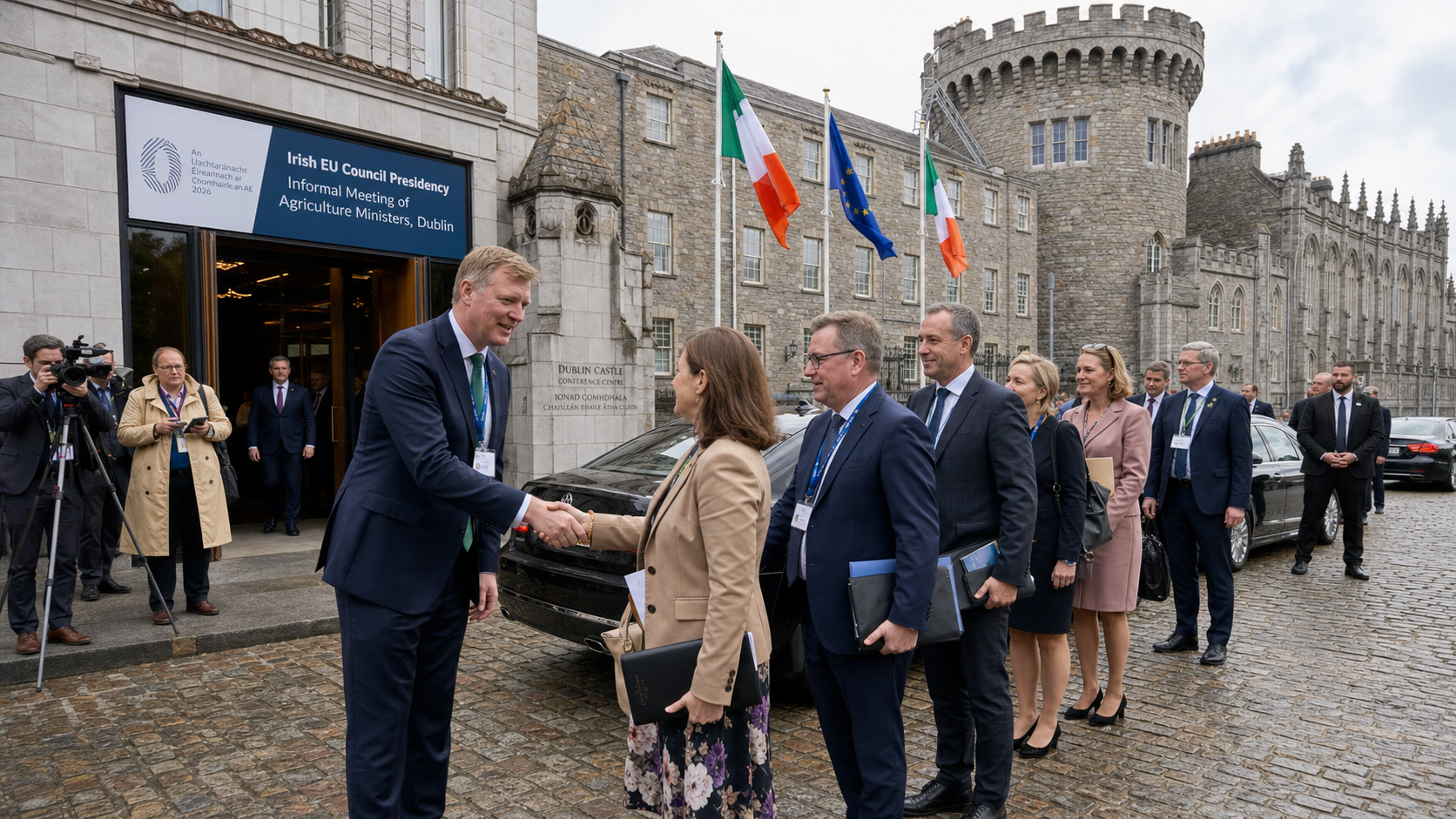
Ireland is hosting an informal meeting of EU Agriculture Ministers in Dublin from 6 to 8 September as part of its EU Council Presidency, with Minister for Agriculture, Food and the Marine Martin Heydon chairing discussions on the future of European livestock farming, food security, and the next Common Agricultural Policy. The meeting, which brings ministers from all 27 EU member states to the Irish capital, is one of the most significant diplomatic events of Ireland's six-month presidency and provides an opportunity to advance the CAP negotiations that will shape European agriculture policy for the next decade.
Background
Ireland assumed the Presidency of the Council of the European Union on 1 July 2026, taking over from Poland for a six-month term that runs until 31 December. The Irish Presidency operates under the motto "Ní neart go cur le chéile" — Strength with Unity — and has identified three core priorities: competitiveness, values, and security. Within the agriculture portfolio, the Irish Presidency has made the preparation for the next Common Agricultural Policy negotiations one of its central objectives, reflecting the importance of agriculture to the Irish economy and the Irish government's ambition to shape the future direction of European farm policy.
The Common Agricultural Policy is the EU's framework for supporting farmers and rural communities across the 27 member states, and it accounts for approximately one-third of the EU's total budget. The current CAP framework runs until 2027, and negotiations on the next framework — which will cover the period from 2028 to 2034 — are expected to begin in earnest during the Irish Presidency. The outcome of those negotiations will have profound implications for Irish farmers, who receive approximately €1.8 billion per year in CAP payments and who are among the most dependent on EU farm support of any member state.
The informal AGRIFISH meeting in Dublin is the second major agriculture event of the Irish Presidency, following the first formal AGRIFISH Council in Brussels in July. The informal meeting provides an opportunity for ministers to have more open and exploratory discussions than are possible in the formal Council setting, and is typically used to build consensus on the key issues that will need to be resolved in the formal negotiations.
Key Developments
The Dublin meeting, which runs from 6 to 8 September, will focus on two main themes: the role of livestock in European agriculture, and the future of food security and rural communities in the EU. The livestock discussion is particularly significant for Ireland, which has one of the most livestock-intensive agricultural sectors in Europe, with beef and dairy farming accounting for the majority of agricultural output. The European Commission's Livestock Strategy and Protein Plan, which is expected to be published later in 2026, will set out the Commission's vision for the future of livestock farming in the EU, and the Dublin meeting will provide an opportunity for ministers to shape that vision before it is finalised.
The food security discussion reflects the lessons of recent years, during which the Covid-19 pandemic and the war in Ukraine have highlighted the vulnerability of European food supply chains and the importance of maintaining a strong domestic agricultural sector. Ireland has been a strong advocate for food security as a core objective of the next CAP, arguing that the EU's ability to feed its own population should be treated as a strategic priority alongside environmental sustainability and climate action.
The meeting programme includes site visits on 7 September, allowing ministers to see examples of Irish agricultural innovation and sustainability in practice, and a gala dinner in the evening. The formal working sessions on 8 September will be followed by a press conference at which Minister Heydon will set out the key conclusions of the meeting and the next steps in the CAP negotiations.
Why It Matters
The Dublin AGRIFISH meeting matters for Ireland because it provides an opportunity to shape the future of European agriculture policy at a critical moment in the CAP negotiations. Ireland's position as Presidency holder gives Minister Heydon a unique platform to advance Irish priorities — including the protection of livestock farming, the recognition of food security as a strategic objective, and the importance of supporting rural communities — in a way that would not be possible if Ireland were simply one of 27 member states at the table. The informal setting of the meeting also allows for more candid discussions about the difficult trade-offs that will need to be made in the next CAP, including the balance between environmental ambition and economic viability for farmers.
The meeting also matters for the Irish agricultural sector, which is watching the CAP negotiations closely. Irish farmers receive approximately €1.8 billion per year in CAP payments, and the design of the next framework will determine how much of that support is maintained, how it is distributed between different types of farming, and what conditions are attached to it. The Irish Farmers' Association and other farm organisations have been lobbying intensively for a CAP that maintains income support for farmers while providing a realistic pathway to meeting environmental and climate targets.
Local Impact
The arrival of 27 EU agriculture ministers and their delegations in Dublin for the AGRIFISH meeting will generate significant economic activity for the city's hospitality sector, with hotels, restaurants, and conference facilities all benefiting from the influx of visitors. The meeting is being held at a venue in Dublin city centre, with site visits to agricultural locations in the surrounding counties. The Department of Agriculture has worked with Bord Bia and Teagasc to develop a programme of site visits that showcases the best of Irish agricultural innovation, including examples of sustainable farming practices, precision agriculture technology, and the agri-food processing sector.
For Irish farmers, the meeting is an opportunity to make their voices heard at the highest level of European policy-making. The Irish Farmers' Association has been granted an audience with Minister Heydon on the margins of the meeting, and has prepared a detailed submission setting out the farming sector's priorities for the next CAP. The IFA's key demands include the maintenance of direct payments at current levels, the simplification of environmental conditionality requirements, and the provision of adequate support for generational renewal in farming.
What's Next
The informal AGRIFISH meeting concludes on 8 September with a press conference at which Minister Heydon will set out the key conclusions and the next steps in the CAP negotiations. The next formal AGRIFISH Council is scheduled for October in Brussels, where the Irish Presidency will present a progress report on the CAP negotiations and seek a mandate from ministers to advance the discussions with the European Parliament. The European Commission is expected to publish its legislative proposals for the next CAP framework in early 2027, and the Irish Presidency will have laid important groundwork for those proposals through the Dublin meeting and the subsequent formal Council sessions.