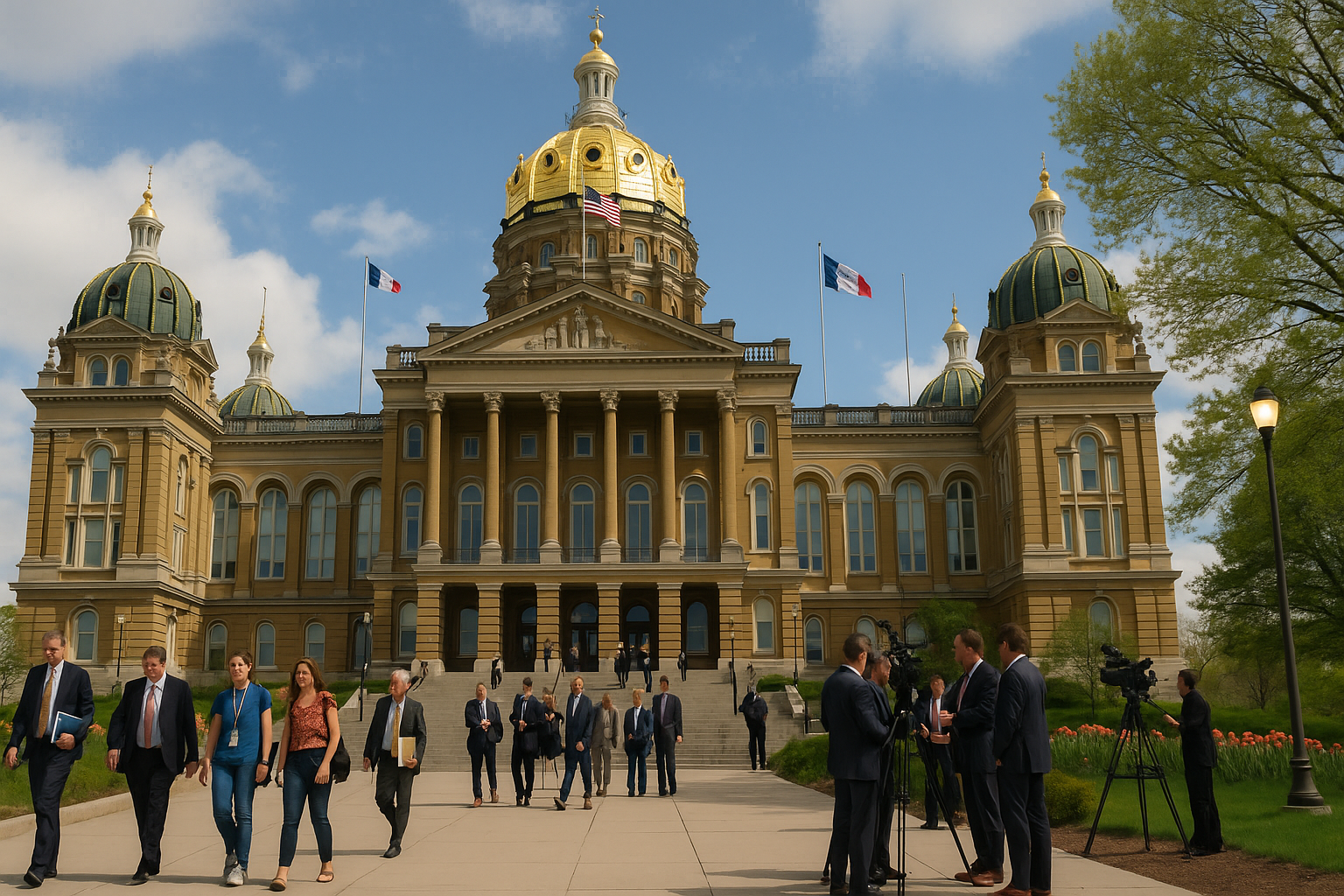
Iowa Wraps 2026 Legislative Session with Property Tax Deal, Nicotine Tax, and Repeat Offender Reform
Iowa lawmakers gaveled out of their 2026 legislative session on May 3 after a two-day marathon of votes that sent a sweeping package of legislation to Governor Kim Reynolds' desk. The session's final hours produced a property tax relief agreement that had eluded lawmakers for weeks, a new tax on vaping products and nicotine pouches with proceeds earmarked for pediatric cancer research, a seven-year mandatory minimum sentence for third-time felons, and a first-in-the-nation regulatory framework for geological hydrogen extraction.
Background
Iowa's 2026 legislative session opened in January with an ambitious Republican agenda centered on property tax relief, public safety reform, and economic development. Governor Reynolds, who won re-election in 2024 by 14 points, entered the session with strong legislative majorities in both chambers and a mandate to deliver on the property tax issue that has dominated Iowa politics for three consecutive election cycles. Rising property assessments — driven by the same housing market dynamics that have pushed values up across the Midwest — have produced tax bills that many Iowa homeowners, particularly retirees on fixed incomes, describe as unsustainable.
The session also took up a range of social and economic policy questions, from criminal justice reform to energy development, reflecting the breadth of issues that state legislatures — rather than a gridlocked Congress — are increasingly being asked to resolve.
Key Developments
The property tax agreement, reached in the session's final hours, caps annual growth in residential property tax levies and provides targeted relief for homeowners whose assessments have risen sharply. The specific cap formula was the subject of weeks of negotiation between the House and Senate, with the final compromise landing between the more aggressive House proposal and the more modest Senate version.
House File 2480 imposes a new tax on vaping products at 5 cents per milliliter of nicotine solution and on nicotine pouches at 5 cents per 20 units. The first $3 million in annual revenue is dedicated to pediatric cancer research at the University of Iowa Stead Family Children's Hospital — a provision that drew bipartisan support despite broader disagreements about the bill's scope. The repeat offender reform bill, House File 2542, mandates a seven-year mandatory prison sentence for a person's third felony conviction, a significant reduction from the 20-year minimum originally proposed. The geological hydrogen extraction framework, Senate File 2490, establishes a 6 percent severance tax on extracted hydrogen, requires 25 percent landowner consent for drilling projects, and provides compensation for non-participating landowners.
Why Americans Should Care
Iowa's legislative output matters beyond its borders for several reasons. The state's property tax relief framework is being watched closely by legislators in neighboring states — Minnesota, Wisconsin, Nebraska, and Missouri — where similar assessment-driven tax increases have generated political pressure. Iowa's nicotine tax structure, with its dedicated pediatric cancer research funding, offers a model that health advocates in states from Ohio to Colorado are already discussing as a template. The geological hydrogen extraction framework is particularly significant: Iowa sits atop geological formations that may contain substantial natural hydrogen deposits, and the regulatory structure Iowa establishes could become the template for other Midwestern states as the hydrogen economy develops. The repeat offender sentencing reform reflects a broader national debate about mandatory minimums that is playing out in state legislatures from Texas to New York, with Iowa's seven-year compromise representing a middle path between the tough-on-crime and criminal justice reform camps.
Why It Matters
Iowa's 2026 session is a case study in what state legislatures can accomplish when one party holds unified control and a clear electoral mandate. The contrast with the US Congress — which has struggled to pass basic appropriations bills and spent 75 days in a partial DHS shutdown earlier this year — is stark. Political scientists have documented a decades-long shift of policy innovation from Washington to state capitals, accelerated by congressional dysfunction and the Supreme Court's federalism jurisprudence. Iowa's hydrogen extraction framework is a particularly forward-looking example: the federal government has no comparable regulatory structure for geological hydrogen, meaning states that act first will shape the industry's development. The nicotine tax earmark for pediatric cancer research reflects a political strategy that has proven effective in multiple states — attaching new revenue measures to popular causes to build coalitions that cross partisan lines. That approach has worked in states as ideologically different as California and Utah, suggesting it has durable appeal across the political spectrum.
What's Next
Governor Reynolds is expected to sign the property tax relief bill and most of the session's major legislation within the next two weeks. The nicotine tax takes effect July 1, 2026, and the University of Iowa Stead Family Children's Hospital is expected to receive its first allocation of research funding in the fall. The geological hydrogen extraction framework will be administered by the Iowa Department of Natural Resources, which will begin drafting implementing regulations over the summer. The repeat offender sentencing changes apply to convictions occurring after the bill's effective date.
Sources: KCRG; Iowa Capital Dispatch; KTTC