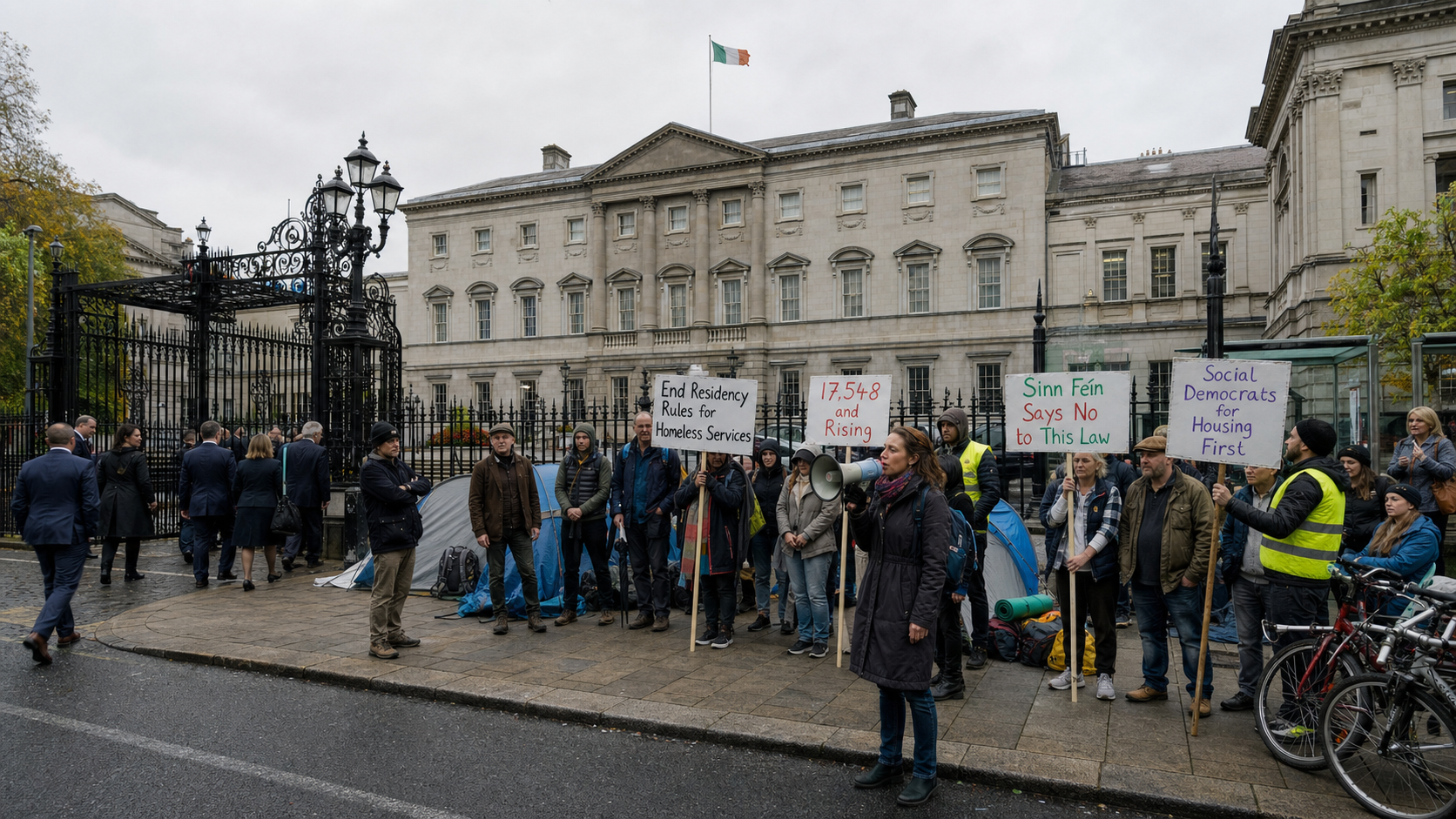
Homeless Services Residency Rules Row Erupts as Record 17,548 People Without a Home in May
A new 'lawful and habitual residency' requirement for access to homeless services, introduced by the Irish government in June 2026, has ignited a fierce political row as monthly homelessness figures reached a record 17,548 in May — with Sinn Féin and the Social Democrats accusing the government of creating barriers for vulnerable people and 'massaging' the figures, while the Dáil has heard that the HSE holds nearly 200 vacant properties that could be used to address the crisis.
Background
Ireland's homelessness crisis has been a defining feature of the country's political landscape for the better part of a decade. The combination of a chronic shortage of social housing, a private rental market characterised by high rents and insecure tenancies, and an inadequate supply of emergency accommodation has produced a situation in which tens of thousands of people are living in emergency shelters, hotels, and bed-and-breakfast accommodation at any given time. The human cost of this crisis — particularly for children, of whom there are several thousand in emergency accommodation — has been extensively documented.
The government's response to the crisis has been the subject of sustained criticism from opposition parties, housing advocacy groups, and the United Nations. The Residential Tenancies Act, which took effect on 1 March 2026, introduced six-year minimum tenancies but allowed landlords to reset rents to market rates on new tenancies — a provision that critics argue will accelerate rather than slow the rate of rent increases. Daft.ie data cited in the Dáil showed nationwide rents up 4.4% between December 2025 and March 2026, the largest quarterly rise since 2002.
Against this backdrop, the introduction of a new 'lawful and habitual residency' requirement for access to homeless services has been particularly controversial. The requirement, which came into effect in June 2026, means that people who cannot demonstrate a sufficient connection to Ireland may be denied access to emergency accommodation and other homeless services. The government argues that the requirement is necessary to ensure that services are directed at those most in need; critics argue that it creates an additional barrier for some of the most vulnerable people in the country.
Key Developments
The May 2026 homelessness figures, published by the Department of Housing, show 17,548 people in emergency accommodation — a record high and an increase of several hundred on the previous month. The figure includes thousands of children, and the proportion of families in emergency accommodation has been rising steadily. Opposition parties have pointed to the record figure as evidence that the government's housing strategy is failing.
In the Dáil, Labour leader Ivana Bacik raised the issue of nearly 200 vacant properties held by the HSE that could potentially be used to provide housing for homeless people. The HSE has been accused of "indifference" to the housing crisis in its management of these properties, many of which have been vacant for extended periods. The Department of Health has indicated that it is reviewing the properties, but has not committed to a timeline for bringing them into use.
Sinn Féin housing spokesperson Eoin Ó Broin has described the new residency requirement as a "cruel" measure that will push the most vulnerable people further into destitution. The Social Democrats have called for an immediate review of the requirement and for the government to publish data on how many people have been denied services as a result. The government has defended the measure, arguing that it is consistent with similar requirements in other EU member states.
Why It Matters
The homelessness crisis is not merely a housing policy failure — it is a public health emergency, an education crisis, and a child welfare crisis rolled into one. Children growing up in emergency accommodation face significant disadvantages in terms of educational attainment, physical health, and mental wellbeing. The long-term costs of failing to address the crisis — in terms of health, education, and social care — will far exceed the cost of the investment needed to resolve it.
The new residency requirement adds a further dimension of concern. Ireland's homeless population includes a significant number of people who have come to the country in recent years, including refugees, asylum seekers, and economic migrants. Many of these people are among the most vulnerable in the country, and the introduction of a residency requirement for homeless services risks creating a two-tier system in which some of the most destitute people are denied the most basic forms of support.
The HSE's vacant properties are a particular source of frustration. At a time when the government is spending hundreds of millions of euros on emergency accommodation in hotels and bed-and-breakfasts, the existence of nearly 200 vacant HSE properties represents a significant missed opportunity. The properties are not all suitable for residential use, but even a fraction of them could make a meaningful difference to the number of people in emergency accommodation.
Local Impact
In Dublin, where the homelessness crisis is most acute, the record May figures have been met with a mixture of anger and despair by housing advocates and frontline workers. The Dublin Region Homeless Executive, which coordinates homeless services across the capital, has warned that the emergency accommodation system is at capacity and that the introduction of the residency requirement is adding to the pressure on an already strained system. In Cork, Galway, and Limerick, local authorities are also reporting record numbers of people in emergency accommodation, with particular pressure in the private rental market driving more families into homelessness.
What's Next
The Dáil is expected to debate the homelessness figures and the residency requirement before the summer recess, with opposition parties planning to table motions calling for the requirement to be suspended. The government has indicated that it will publish a review of the requirement's impact in the autumn. The HSE's vacant properties review is expected to be completed by the end of June, with a report to the Minister for Health to follow. Budget 2027 will be the next major opportunity for increased investment in social housing and homeless services.