High Court Dismisses Challenge to Belfast City Council's Irish Language Policy
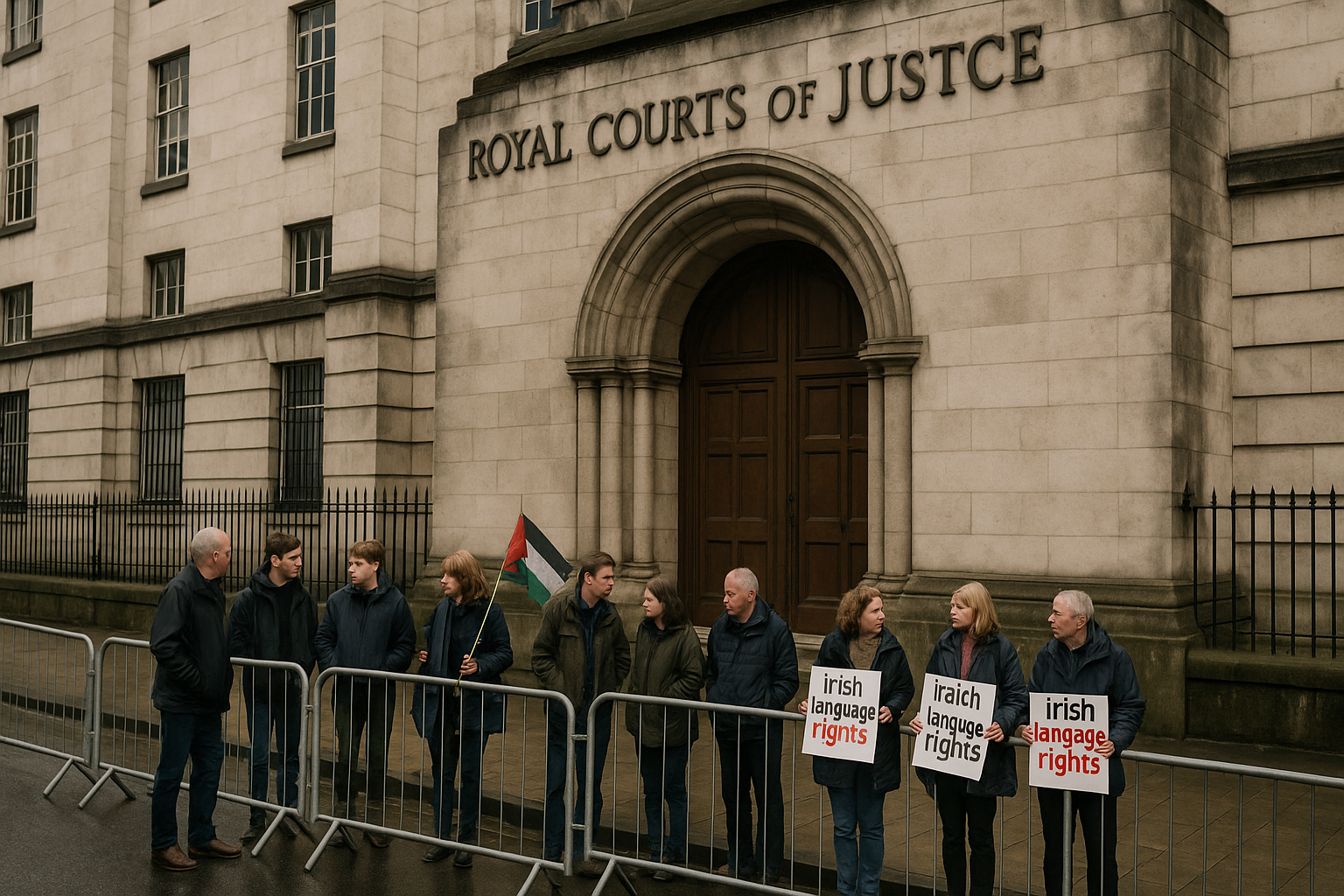
The High Court in Belfast has dismissed a legal challenge against Belfast City Council's proposed new Irish language policy, clearing the way for the council to proceed with plans for bilingual signage and logos on council facilities — though Justice McLaughlin identified a procedural defect in a separate decision to fly the Palestinian flag above City Hall, in a ruling that has been claimed as a partial victory by both sides of the debate.
Background
Belfast City Council approved a draft Irish language policy in October 2025, designed to promote the language in public life through bilingual signage and logos on council facilities, signage, and staff uniforms. The policy's approval by a majority of councillors prompted objections from unionist members, who activated the council's "call-in" mechanism — a procedure under the Local Government (Northern Ireland) Act 2014 that allows 15 per cent of councillors to request a formal reconsideration of a decision they believe could have a disproportionate adverse impact on a section of the community.
If the concerns raised in a call-in are deemed valid after a legal opinion is sought, the original decision may require an 80 per cent super-majority to be upheld — a threshold that would effectively give unionist councillors a veto over the policy. Traditional Unionist Voice member Ann McClure initiated the legal challenge, arguing that the council had improperly operated its call-in scheme by creating a "new filter" that allowed a simple majority to veto the minority protections the process was designed to provide.
Key Developments
Justice McLaughlin dismissed the core of the challenge related to the Irish language policy, ruling that the council's procedures for handling the call-in were not unlawful or beyond its legal powers. The judge clarified that a call-in request from 15 per cent of councillors does not automatically trigger a vote requiring an 80 per cent super-majority, and that councils have the autonomy to establish procedures to ensure that the concerns raised by the requisitioning members are well-founded before escalating to that threshold.
The ruling was welcomed by First Minister Michelle O'Neill as a victory for the Irish language community in Belfast. Dr Padraig O Tiarnaigh of Conradh na Gaeilge described the verdict as a significant step forward, while Ann McClure indicated plans to appeal findings related to the wider call-in process.
On the Palestinian flag question, Justice McLaughlin identified a "procedural confusion" and a "legal defect" in how the council handled the December 2025 vote to fly the flag over City Hall. He found that the process used to assess the call-in and proceed with the flag-flying was "without adequate legal foundation." However, the judge declined to quash the decision, reasoning that the ultimate outcome would likely have been the same even if the correct procedure had been followed. McClure described this aspect of the ruling as a "victory for unionism."
Why It Matters
The ruling is a significant development for the Irish language community in Belfast and for the broader question of how the city's bilingual identity is expressed in public life. The Irish language has been a deeply contested political issue in Northern Ireland for decades, with its promotion seen by nationalists and republicans as a matter of cultural rights and by many unionists as a political statement. The council's Irish language policy represents one of the most concrete expressions of the city's evolving identity in the post-Good Friday Agreement era, and the legal clarity provided by Justice McLaughlin's ruling — however partial — is an important step in resolving a dispute that has consumed considerable political energy.
The case has also highlighted the complex legal and political landscape surrounding the call-in mechanism, which was designed as a safeguard for minority communities but has become a tool of political contestation in Belfast's divided council chamber. The judge's clarification of when the 80 per cent super-majority threshold applies will have implications for future council decisions on contentious issues.
Local Impact
For Belfast's Irish language community, the ruling represents a meaningful, if incomplete, vindication of the council's right to promote the language in public life. Bilingual signage and logos on council facilities would represent a visible and daily affirmation of the city's linguistic heritage for Irish speakers, many of whom have long felt that their language is marginalised in public spaces. The decision will also be watched closely by Irish language advocates across Northern Ireland, who are monitoring the implementation of the Irish Language Act provisions agreed as part of the New Decade, New Approach deal. The call-in process must still be completed before the policy can be implemented, meaning the practical changes to signage and branding remain some way off.
What's Next
The call-in process for the Irish language policy will continue, and the policy remains on hold pending its completion. Ann McClure has indicated she will appeal certain aspects of the ruling, meaning the legal dispute is not yet fully resolved. The Palestinian flag decision, while procedurally flawed, will stand unless a further legal challenge is mounted. The council will need to review its call-in procedures in light of the judge's findings to ensure future decisions are made on a sound legal footing.
Sources: BBC News — Challenge to Council Procedures That Could Affect Irish Language Policy Dismissed; Belfast Live — Belfast City Council's Irish Language Procedures Were Not Unlawful