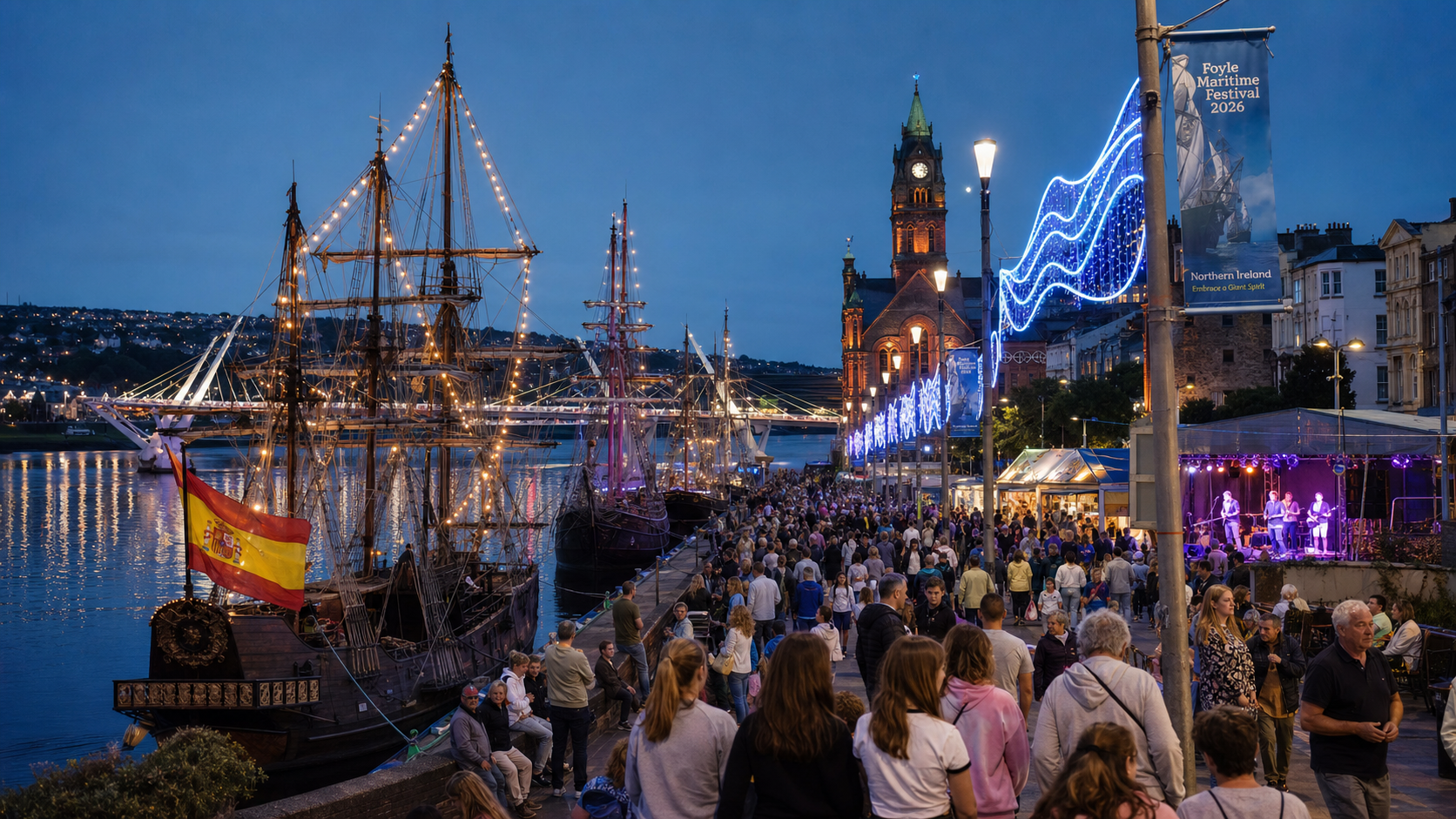
Foyle Maritime Festival Opens in Derry with Spanish Galleon, Tall Ships and a City Transformed by the River
The 2026 Foyle Maritime Festival opened in Derry~Londonderry on Thursday 25 June, bringing a 55-metre replica Spanish galleon, a fleet of tall ships, and tens of thousands of visitors to the city's riverfront in what organisers are billing as the most ambitious edition of the event since its revival — and a powerful statement about Derry's capacity to host world-class cultural events.
Background
The Foyle Maritime Festival has its roots in Derry's long and complex relationship with the sea. The city's position on the River Foyle, close to the Atlantic coast of Donegal, made it a significant port for centuries — a point of departure for generations of emigrants, a hub for the fishing industry, and, during the Second World War, a crucial Allied naval base from which the Battle of the Atlantic was partly coordinated. The festival draws on that heritage, using the river as both a stage and a symbol of the city's identity.
The event is organised by Derry City and Strabane District Council in partnership with Foyle Port and the Loughs Agency, with funding from Tourism NI and Diageo. It has grown significantly since its early editions, attracting international vessels and performers and establishing itself as one of the major cultural events on the Northern Ireland calendar. The 2024 festival attracted more than 135,000 visitors and generated approximately £7.7 million for the local economy — figures that the 2026 organisers are hoping to match or exceed.
The 2026 festival carries the theme "Forged by the Foyle: It's in Our DNA," a deliberate attempt to connect the event's maritime spectacle with the deeper story of how the river has shaped the city and its people. It is a theme that resonates in a city that has spent decades working to redefine its identity after the Troubles, and that has invested heavily in culture and tourism as drivers of economic regeneration.
Key Developments
The centrepiece of the 2026 festival is the Northern Ireland debut of the Galeón Andalucía, a 55-metre, six-deck replica of a 17th-century Spanish galleon that serves as a floating museum. The vessel, which has toured ports across Europe and the Americas, is the most visually dramatic addition to the festival's fleet and has drawn significant crowds to the riverfront since its arrival. Visitors can board the galleon and explore its decks, which are fitted out to recreate the experience of life aboard a Spanish trading vessel in the age of exploration.
The opening night on 25 June was headlined by Altan, the acclaimed Donegal traditional music band, whose connection to the northwest of Ireland gave the evening a particular resonance. The festival's entertainment programme extends across four days, with circus and street arts performances by groups including Hikapee, Tumble Circus, and Fraser Hooper, alongside a programme of family-friendly activities and educational experiences.
A notable new addition for 2026 is "Sails of Solas," an illuminated nighttime light installation that transforms the riverfront and the visiting vessels after dark. The installation, which uses projection mapping and LED technology, has been designed to be visible from both banks of the Foyle, creating a shared visual experience for residents of both Derry and the Donegal side of the river.
Why It Matters
The Foyle Maritime Festival matters for Derry in ways that go beyond the immediate economic impact of visitor spending. The city has worked hard over the past two decades to build a cultural identity that is distinct from the political and sectarian associations that dominated its international profile during the Troubles. Events like the maritime festival — inclusive, outward-looking, and rooted in a shared heritage that transcends community divisions — are central to that project.
The festival also demonstrates what is possible when local government, port authorities, and tourism bodies work together effectively. Derry City and Strabane District Council has been consistent in its support for the event, and the partnership with Foyle Port gives the festival access to infrastructure and expertise that would be difficult to replicate elsewhere. The result is an event that punches well above its weight in terms of international profile and visitor numbers.
For Northern Ireland more broadly, the festival is a reminder that the region's cultural offer extends well beyond Belfast. Derry is a city with a distinctive character, a rich history, and a creative community that has produced some of Ireland's most significant artists, writers, and musicians. The maritime festival gives that community a platform and a moment of genuine civic pride.
Local Impact
The festival's economic impact is felt across the city and the wider northwest region. Hotels, guesthouses, and self-catering accommodation in Derry and the surrounding area have reported strong bookings for the festival weekend, with visitors travelling from across Northern Ireland, the Republic, and further afield. The LegenDerry Food Village at Coppins Quay and the Merchant Market at Thompsons Quay provide a showcase for local food producers and artisan traders, channelling visitor spending directly into the local economy.
Road closures on Queen's Quay and the surrounding streets have been implemented to manage the large crowds, with free parking provided at Fort George and additional paid options available across the city. Translink has laid on additional bus services to the riverfront area, and the Foyle Bridge has seen increased pedestrian traffic as visitors cross between the two banks to take in the full spectacle of the illuminated fleet.
What's Next
The festival runs until Sunday 28 June, concluding with a large-scale fireworks display over the Foyle on Sunday evening. The full programme, including times for vessel boarding, entertainment performances, and the Sails of Solas installation, is available through the festival's official website and the Derry City and Strabane District Council events pages. Organisers will begin planning for the 2028 edition in the autumn, with early indications that the council intends to build on the 2026 programme's ambition and scale.