Dáithí Mac Gabhann Settles Back Into Belfast Life as Family Reflects on 'Miracle' Heart Transplant
Nine-year-old Dáithí Mac Gabhann, the Belfast boy whose family's tireless advocacy reshaped organ donation law across Northern Ireland, has returned home to his north Belfast community following a successful heart transplant at the Freeman Hospital in Newcastle upon Tyne, with his father Máirtín describing the transformation in his son's health as nothing short of miraculous.
Background
Dáithí Mac Gabhann was born in 2016 with hypoplastic left heart syndrome, a severe congenital condition in which the left side of the heart fails to develop properly. From his earliest days, it was clear that Dáithí would require a heart transplant to survive into adulthood, and his family began the long, uncertain wait that would define the next eight years of their lives.
Rather than retreat into private grief, Máirtín and Seph Mac Gabhann chose to campaign publicly for reform of Northern Ireland's organ donation system, which at the time operated on an opt-in basis — meaning organs could only be donated if the deceased had explicitly registered their wish to do so. The family argued, with growing urgency, that this approach was costing lives and that a soft opt-out system, in which all adults are presumed to consent unless they have registered otherwise, would dramatically increase the pool of available organs.
Their campaign, which gathered enormous public support and cross-party political backing at Stormont, culminated in June 2023 with the passage of what became known as Dáithí's Law — legislation establishing a soft opt-out system for organ donation in Northern Ireland. It was a landmark moment in the history of healthcare policy on the island, and it came directly from the determination of one family from north Belfast who refused to accept that the system could not be changed.
Key Developments
In July 2026, after eight years on the transplant waiting list, Dáithí received the call that his family had prayed for. A suitable donor heart had become available, and he was transferred to the Freeman Hospital in Newcastle — one of the UK's leading centres for paediatric cardiac surgery — where the transplant was performed successfully.
The recovery was, as Máirtín Mac Gabhann described it, a rollercoaster. There were difficult days and anxious nights, as is common with any major organ transplant, particularly in a child. But the medical team at the Freeman reported steady, positive progress, and by early August, Dáithí had been discharged from the hospital and was continuing his recovery in Newcastle before being cleared to travel home.
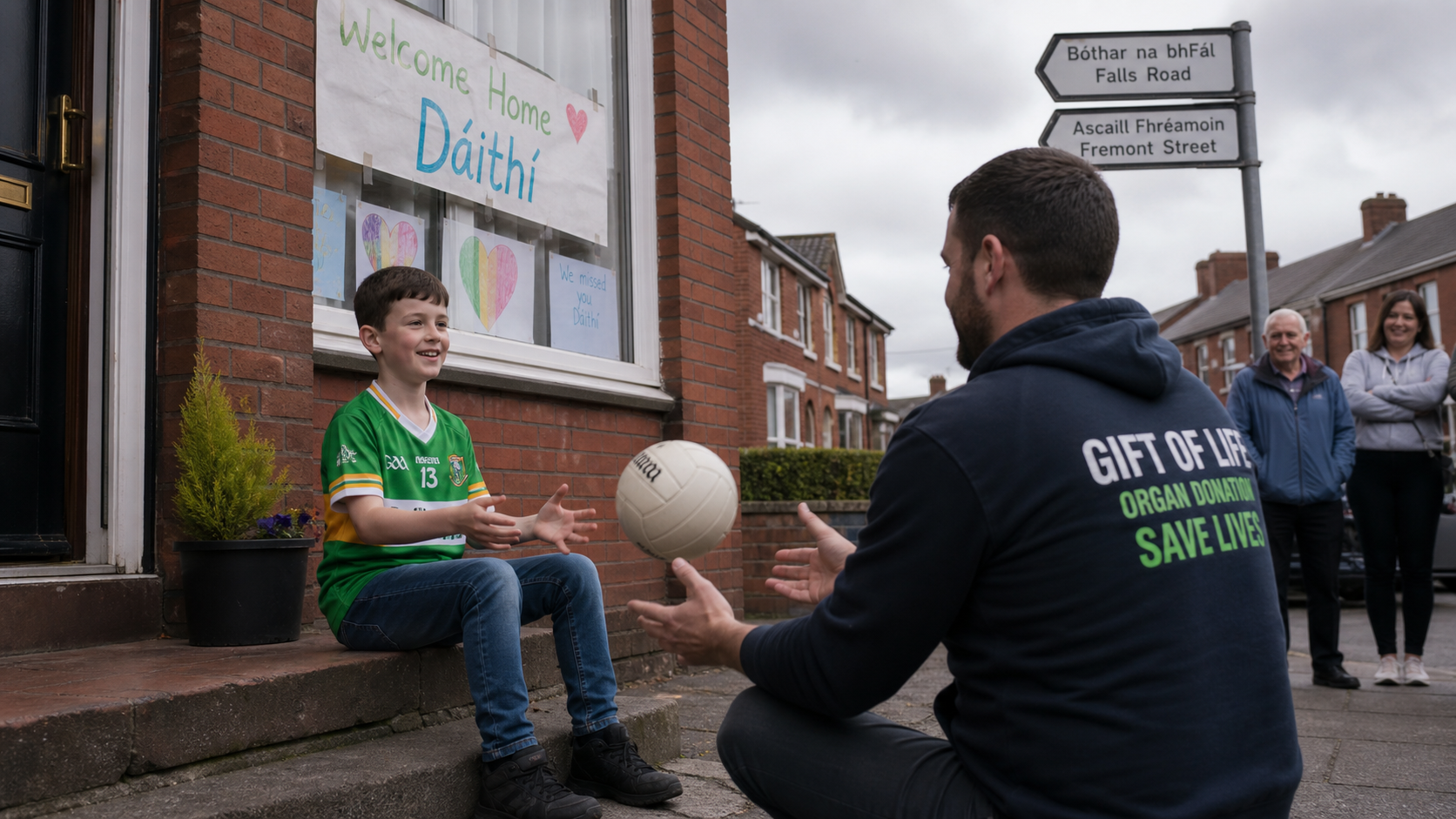
On 25 August, Dáithí arrived back in Belfast to a warm welcome from family, friends, and neighbours who had followed his journey for years. His father spoke of the physical changes that had already become visible — the natural colour returning to his son's cheeks and lips, the warmth in his hands and feet that had never been there before. "Things we had never seen," Máirtín said, his voice carrying the weight of years of worry finally beginning to lift.
Why It Matters
Dáithí's story is not simply a personal triumph, though it is emphatically that. It is also a demonstration of what sustained civic advocacy can achieve when it is rooted in genuine human need. The passage of Dáithí's Law in 2023 placed Northern Ireland ahead of England in adopting opt-out organ donation — Wales had led the way in 2015, Scotland followed in 2021, and England moved to a similar system in 2020. Northern Ireland was the last of the four nations to make the change, and it took a family from north Belfast to make it happen.
The broader significance is measurable. Opt-out systems have been shown in multiple international studies to increase donor registration rates and, over time, the number of organs available for transplant. In Wales, the number of deceased donors increased by approximately 25% in the years following the introduction of the opt-out system. Northern Ireland's system is still relatively new, but the trajectory is encouraging, and health officials have pointed to early signs of increased registration activity since the law came into force.
For the many families across Northern Ireland and the Republic who are currently waiting for transplants — hearts, kidneys, livers, lungs — Dáithí's homecoming is a reminder of what is possible and a renewed call to register as an organ donor.
Local Impact
In north Belfast, where the Mac Gabhann family are well known and deeply embedded in the Irish-language community, the news of Dáithí's return has been met with genuine joy. The family's connection to the Gaeltacht quarter and the broader Irish-speaking community in the city means that his story has resonated far beyond the immediate neighbourhood.
Dáithí is required to remain in a limited form of isolation for several weeks as his immune system adjusts to the new heart, but he is scheduled to return to school on 1 October — a milestone that his family have described as something they once dared not imagine. The Belfast Health and Social Care Trust, which has supported the family throughout their journey, has confirmed that appropriate community health supports are in place to assist with his ongoing recovery.
What's Next
Dáithí will continue to attend regular outpatient appointments at the Freeman Hospital in Newcastle for monitoring and medication management, as is standard practice following a paediatric heart transplant. His family have expressed profound gratitude to the donor family, whose generosity in the most devastating of circumstances made everything possible. Máirtín Mac Gabhann has said the family intends to continue advocating for organ donation awareness, ensuring that Dáithí's Law translates into real, lasting change for families across Northern Ireland who are still waiting.