Dáithí Mac Gabhann Returns Home to Belfast After Successful Heart Transplant as Family Celebrates 'Massive Milestone'
Nine-year-old Dáithí Mac Gabhann, the Belfast boy whose family's extraordinary campaign for organ donation reform changed the law in Northern Ireland, has returned home after a successful heart transplant at the Freeman Hospital in Newcastle — a moment his father Máirtín described as a 'massive milestone' that the family had waited years to reach.
Background
Dáithí Mac Gabhann was born in 2016 with hypoplastic left heart syndrome, a severe congenital condition in which the left side of the heart fails to develop properly, leaving the organ unable to pump blood effectively around the body. The condition is life-threatening from birth and, in Dáithí's case, required a heart transplant to give him any prospect of a normal life. He was placed on the transplant waiting list in 2018, beginning what would become an eight-year vigil for his family.
Rather than wait in silence, the Mac Gabhann family — led by Máirtín and Saoirse — channelled their anxiety into advocacy. They launched a sustained public campaign to introduce a soft opt-out system for organ donation in Northern Ireland, under which adults would be presumed to consent to donation unless they had explicitly registered an objection. The campaign gathered enormous public support, drawing backing from politicians across the Assembly's party divide and generating widespread media coverage that kept the issue in the public consciousness for years.
Their efforts bore fruit in June 2023, when the Northern Ireland Assembly passed what became known as Dáithí's Law — legislation that fundamentally altered the legal framework for organ donation in the region. The law represented one of the most significant pieces of health legislation passed at Stormont in years, and it came directly from the determination of one family from north Belfast who refused to accept that nothing could be done.
Key Developments
In July 2026, the call that the Mac Gabhann family had waited eight years for finally came. Dáithí was transported to the Freeman Hospital in Newcastle upon Tyne, one of the United Kingdom's leading centres for paediatric cardiac surgery, where he underwent the transplant operation. The surgery was a success. Máirtín Mac Gabhann described the immediate transformation in his son in terms that captured the profound relief of a parent who had spent years watching his child struggle: Dáithí's previously blue-tinted lips turned pink, and his extremities, which had long been cold due to poor circulation, became warm for the first time.
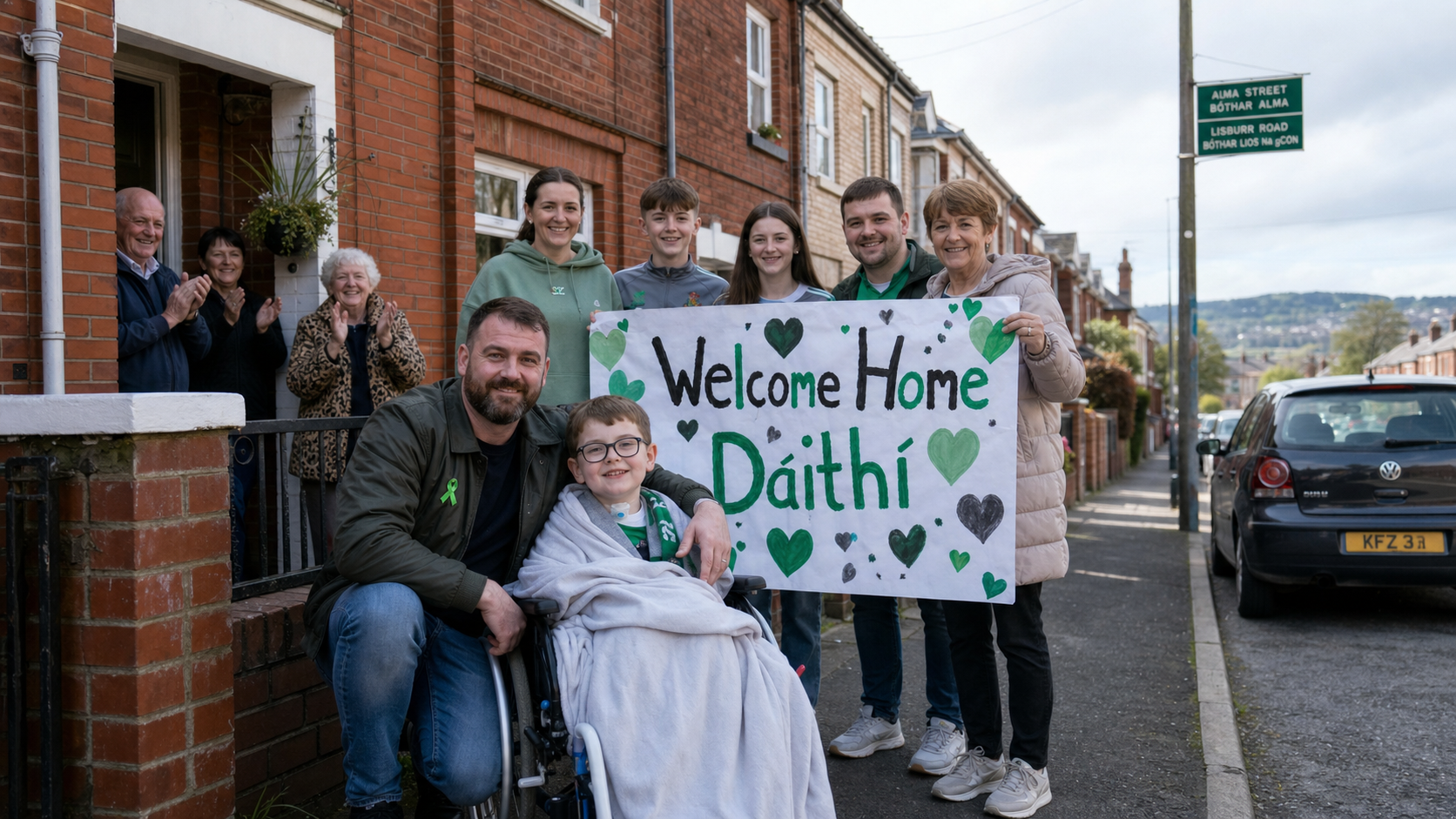
After several weeks of recovery and rehabilitation in England, Dáithí returned home to Belfast in late August 2026. His father described the homecoming as a "massive milestone" and expressed deep and heartfelt gratitude to the donor family, whose generosity in the most difficult of circumstances had given his son a future. Dáithí is currently observing a period of limited isolation as his immune system adjusts to the new heart, but he has been cleared to return to school on 1 October 2026 — a date the family is looking forward to with enormous anticipation.
Máirtín Mac Gabhann said the family is looking forward to Dáithí experiencing a level of normality he has never previously known, including the possibility of joining a sports team — something that had been impossible given the severity of his condition.
Why It Matters
Dáithí's story is significant on multiple levels. At the most personal level, it is the story of a child who has been given a chance at life that his condition would otherwise have denied him. But it is also a story about what determined advocacy can achieve within a political system that is often slow to act on health reform.
Dáithí's Law has already changed the landscape of organ donation in Northern Ireland. Under the previous opt-in system, the region consistently had lower donation rates than England, Scotland, and Wales, all of which had already moved to opt-out frameworks. The new law is expected to increase the pool of potential donors significantly over time, meaning that other families waiting for transplants — and there are always families waiting — stand a better chance of receiving the call that the Mac Gabhanns received in July.
The story also illustrates the particular power of personal testimony in health policy debates. Abstract arguments about donation rates and waiting list statistics rarely move legislators the way a family's lived experience does. The Mac Gabhanns understood this instinctively and used it to drive change that will outlast their own campaign by decades. For context, England introduced its opt-out system in 2020, Wales in 2015, and Scotland in 2021 — Northern Ireland's adoption of the same framework, driven by one family from north Belfast, completes the picture across the island of Britain and Ireland.
Local Impact
For the north Belfast community where Dáithí grew up, his return home is a moment of collective celebration. The family's campaign was rooted in their neighbourhood and drew support from across the city — from the Shankill to the Falls, from Glengormley to Castlereagh — in a way that transcended the usual divisions of Belfast life. Schools, GAA clubs, community groups, and churches all rallied behind the campaign at various points, and many in the city feel a personal connection to the outcome.
The Belfast Health and Social Care Trust, which oversees paediatric services in the city, has welcomed Dáithí's return and noted that his case has raised awareness of organ donation among a generation of Belfast families who might not previously have considered registering their wishes. The Trust has reported an increase in people registering on the NHS Organ Donor Register in the period since Dáithí's Law was passed.
What's Next
Dáithí is due to return to school on 1 October 2026, a date his family has circled with particular significance. He will continue to attend regular cardiac check-ups at the Freeman Hospital in Newcastle and will require lifelong medication to prevent rejection of the donor heart. His medical team has expressed cautious optimism about his long-term prognosis. The Mac Gabhann family has indicated they intend to remain active advocates for organ donation, using Dáithí's story to encourage others to register and to have conversations with their families about their wishes.