Dublin Commercial Property Market Faces Record Rent Threshold as Office Developers Demand €80 Per Square Foot to Justify New Builds
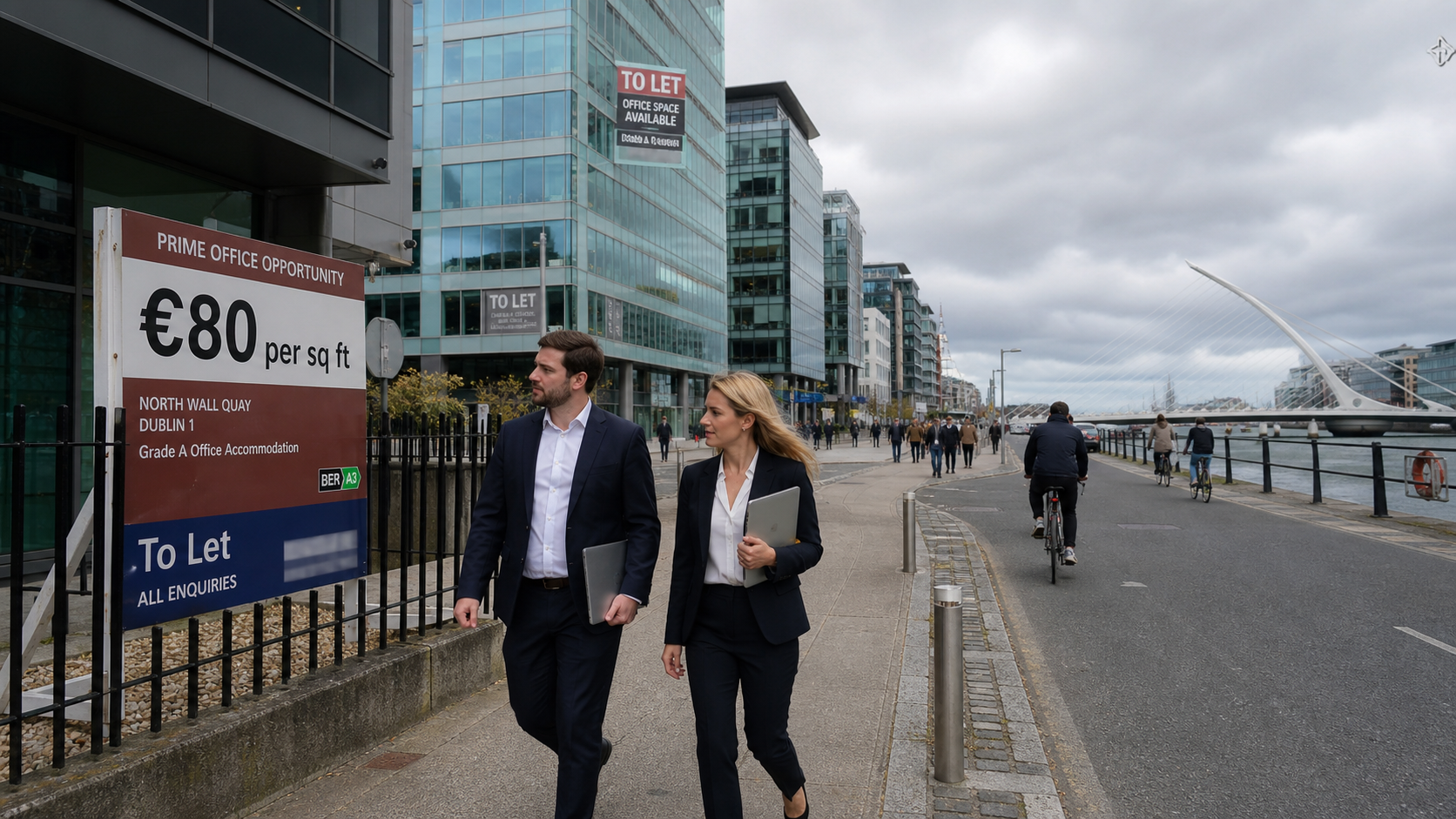
Dublin's commercial property market is at a critical juncture, with property consultancy HWBC warning that office rents must reach a record €80 per square foot before new office developments can be financially justified — a threshold that reflects the soaring construction costs and financing pressures that have made new commercial development increasingly difficult to deliver in the Irish capital.
Background
Dublin's commercial property market has been one of the most dynamic in Europe over the past decade, driven by the city's emergence as a major hub for multinational technology, financial services, and pharmaceutical companies. The arrival of Google, Facebook, Amazon, LinkedIn, and dozens of other major employers transformed the city's office market, driving demand for high-quality office space and pushing rents to levels that were, until recently, unimaginable in an Irish context.
The pandemic, however, fundamentally changed the dynamics of the office market. The shift to remote and hybrid working reduced the demand for office space, and many companies — including some of the largest occupiers in Dublin — have been rationalising their property portfolios, either by reducing the amount of space they occupy or by moving to more flexible arrangements. The result has been a significant increase in office vacancy rates across the city, with almost one in seven commercial properties in the Republic now lying empty.
At the same time, the cost of constructing new office buildings has risen sharply, driven by inflation in construction materials, labour costs, and financing costs. The combination of higher vacancy rates and higher construction costs has created a challenging environment for developers, who are finding it increasingly difficult to make the numbers work on new office projects.
Key Developments
HWBC's warning that office rents must reach €80 per square foot to justify new developments is a significant marker in the Dublin property market. Current prime office rents in the city centre are approximately €65-70 per square foot — already among the highest in Europe — but the consultancy argues that the gap between current rents and the level needed to support new development is a fundamental constraint on the supply of new office space.
The warning comes against a backdrop of significant activity in the Dublin property market. The site of the historic Ormond Hotel on the north quays of the Liffey has sold in an off-market deal for €12 million, with the buyer expected to develop the site for mixed commercial and residential use. The sale reflects the continued appetite of investors for well-located Dublin city centre sites, even in a market that is facing significant headwinds.
The owner of Sherry FitzGerald, Ireland's largest estate agency, is also reported to be eyeing a 52% profit from the sale of a Dublin retail park to a German fund — a transaction that reflects the continued interest of international investors in Irish commercial property, particularly in the retail sector, which has shown greater resilience than the office market in the post-pandemic period.
The Missionary Sisters of St Columban are seeking €4.5 million for a 50-acre estate in County Wicklow, while local residents in Waterford have expressed concerns about rights-of-way following billionaire James Dyson's purchase of the Ballynatray estate — transactions that illustrate the breadth and diversity of the Irish property market beyond the Dublin office sector.
Why It Matters
The state of Dublin's commercial property market matters for the broader Irish economy for several reasons. The office market is a key indicator of business confidence and of the health of the multinational sector that has been central to Ireland's economic success. A market in which new development is financially unviable is a market that cannot respond to demand when it returns — and the risk is that a shortage of high-quality office space could become a constraint on Ireland's ability to attract and retain major employers.
The high vacancy rate — almost one in seven commercial properties empty — is also a concern for the urban fabric of Irish towns and cities. Empty commercial properties are a blight on high streets and town centres, reducing footfall, undermining the viability of neighbouring businesses, and creating a sense of decline that can be difficult to reverse. The challenge of repurposing vacant commercial space — converting offices to residential use, for example — is one that planners and developers across Ireland are grappling with.
Local Impact
In Dublin city centre, the impact of high office vacancy is visible on streets that were, until recently, among the most vibrant commercial areas in the country. In the Docklands, where much of the city's new office development has been concentrated, some buildings that were completed in the past two years are still seeking tenants. In the traditional office districts of the south city — around Baggot Street, Fitzwilliam Square, and the Grand Canal — vacancy rates have risen as companies have reduced their footprints.
For the businesses that depend on office workers for their trade — coffee shops, restaurants, dry cleaners, and the many other services that cluster around office districts — the shift to hybrid working has had a significant impact on revenues. Many of these businesses have adapted by extending their opening hours or by diversifying their customer base, but the challenge of operating in a market where footfall is unpredictable remains significant.
What's Next
The Dublin commercial property market is expected to remain under pressure for the remainder of 2026, with the combination of high vacancy rates, rising construction costs, and uncertain demand making new development difficult to justify. The government's planning reforms, which are intended to streamline the development process and reduce the cost of bringing new commercial space to market, may provide some relief in the medium term, but their impact is unlikely to be felt before 2027 at the earliest. The Budget 2027 decisions on commercial rates and planning levies will also be closely watched by the property industry.