Dublin Artists Forced into Pubs and Hospitals as Venue Crisis Leaves 40% Without Workspace
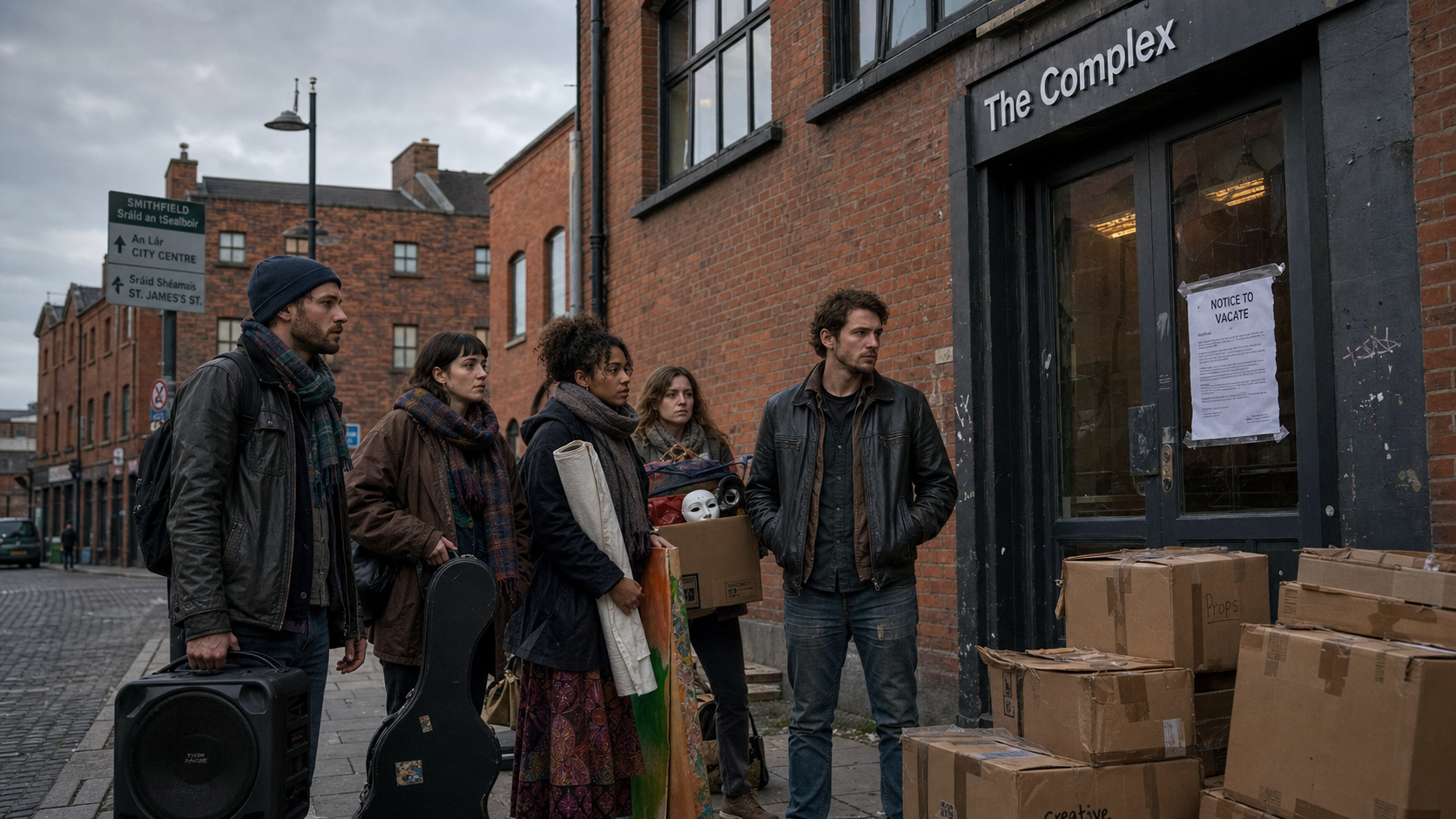
Four in ten artists in Dublin lack the workspace they need to earn a living, according to the city's Arts Officer, as a wave of venue closures — driven by rising rents, commercial redevelopment, and the housing crisis — has left the capital's creative community scrambling for space. The closure of The Complex in Smithfield in January 2026, which had operated for 18 years, was the most recent and most significant loss, displacing dozens of artists and cancelling a full year of programmed events, residencies, and exhibitions.
Background
Dublin's arts infrastructure has been under pressure for years, but the pace of venue closures has accelerated dramatically in the past two years. The list of lost spaces reads like a roll call of the city's cultural history: Jigsaw, Hangar, the Tivoli Theatre, Block T, and now The Complex — each closure representing not just the loss of a building but the loss of a community, a programme, and a set of relationships that had been built over years or decades.
The drivers of the crisis are well understood. Rising rents have made it impossible for arts organisations to compete with commercial tenants for city centre space. The housing crisis has led to a policy focus on converting vacant or derelict buildings into residential units, leaving little room for arts uses. And landlords, who have seen the value of their properties increase dramatically over the past decade, have little incentive to offer below-market rents to arts organisations when commercial tenants are willing to pay full market rates.
The result is that artists are being pushed out of the city centre and into non-traditional spaces — pubs, hospitals, community centres, and private homes — that can provide a temporary home for creative work but that lack the technical infrastructure that professional arts practice requires. A theatre company cannot rehearse properly in a pub function room; a visual artist cannot exhibit in a hospital corridor. The loss of dedicated arts spaces is not merely an inconvenience — it is a fundamental threat to the quality and sustainability of Dublin's cultural life.
Key Developments
The Journal reported on Monday that Dublin City Arts Officer Ray Yates has confirmed that 40% of the city's artists require workspace to maintain their livelihoods, yet existing facilities are insufficient to meet that need. The Arts Council has identified a "considerable need" for workspaces across various art forms, noting that current infrastructure fails to meet the specialist requirements of many practitioners.
The closure of The Complex in Smithfield in January 2026 was described by the arts community as a "massive blow." The venue had operated for 18 years as a hub for theatre, dance, visual art, and community arts, providing rehearsal space, studio space, and performance space to dozens of organisations and individual artists. Its closure displaced a significant portion of Dublin's independent arts sector and cancelled a full year of programmed events, residencies, and exhibitions that had been planned and funded in advance.
In response to the crisis, some artists have developed creative, decentralised models. One initiative, "Arts Bubbles," reclaims homes and overlooked public buildings for intimate, performance-based gatherings, maintaining community connections despite the lack of permanent venues. While these grassroots efforts are admirable, industry representatives maintain that they cannot replace the need for sustainable, dedicated, and professional-grade arts infrastructure.
Why It Matters
The Dublin arts venue crisis matters because culture is not a luxury — it is a fundamental component of a city's identity, its quality of life, and its economic vitality. The creative industries are a significant contributor to Dublin's economy, generating employment, attracting tourism, and enhancing the city's reputation as a place where talented people want to live and work. When the infrastructure that supports those industries is allowed to deteriorate, the consequences extend well beyond the arts community itself.
The crisis also matters because it reflects a broader failure of planning and policy. Dublin City Council has a statutory obligation to support the arts, and the Arts Council has a mandate to develop arts infrastructure across the country. Yet the pace of venue closures suggests that neither body has been able to translate that mandate into effective action. The planning system, which could in principle be used to protect arts spaces from commercial redevelopment, has not been deployed effectively for that purpose.
Unlike cities such as Berlin, Amsterdam, or even London — all of which have developed mechanisms for protecting arts spaces from the pressures of commercial development — Dublin has been slow to develop the policy tools needed to address the crisis. The result is a city that is becoming progressively less hospitable to the artists and cultural organisations that make it a distinctive and vibrant place to live.
Local Impact
The impact of the venue crisis is felt most acutely in the communities that have historically been home to Dublin's arts infrastructure — the Liberties, Smithfield, the north inner city, and the Docklands. These are areas where arts organisations have traditionally been able to find affordable space, and where the loss of venues has left a visible gap in the cultural landscape. For the artists who have been displaced, the practical consequences are severe: without adequate workspace, it is impossible to develop new work, to rehearse, to exhibit, or to collaborate. Many artists have been forced to work from home, in conditions that are far from ideal for professional creative practice.
What's Next
Dublin City Council is expected to publish a new Cultural Infrastructure Strategy before the end of 2026, which will set out a plan for addressing the venue crisis. The strategy is expected to include proposals for new arts spaces, mechanisms for protecting existing venues from commercial redevelopment, and funding streams for arts organisations that are struggling to meet their rental costs. The Arts Council has also indicated that it will increase its investment in arts infrastructure in Dublin as part of its next five-year strategy. Whether these measures will be sufficient to reverse the trend of venue closures remains to be seen.