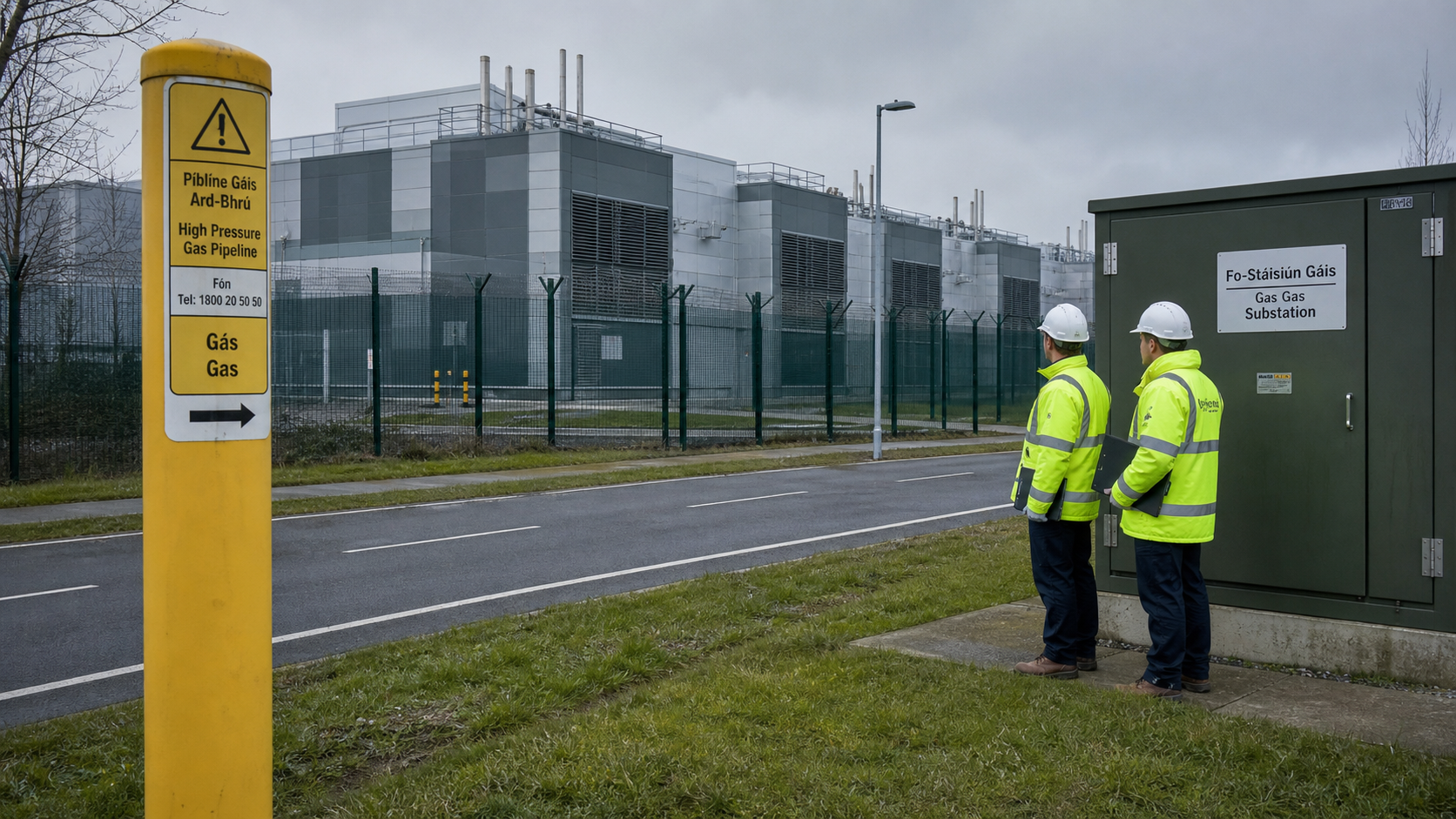
Data Centres Offered Cut-Price Gas Deals in Exchange for Interruptible Supply as Ireland Tackles Grid Pressure
Ireland's Commission for Regulation of Utilities is developing a framework that would offer data centres discounted gas tariffs in exchange for accepting interruptible supply arrangements — a mechanism that would allow Gas Networks Ireland to cut off gas to data centres during periods of peak demand, prioritising supply to households and essential services while managing the growing pressure that the sector is placing on the country's energy infrastructure.
Background
The rapid expansion of Ireland's data centre sector over the past decade has transformed the country's energy landscape in ways that were not fully anticipated when the sector began its growth. Ireland is now home to more data centres per capita than any other country in Europe, a consequence of its favourable tax regime, its skilled workforce, and its position as the European headquarters of many of the world's largest technology companies. The sector's energy consumption has grown correspondingly: data centres now account for approximately 21 per cent of Ireland's total electricity consumption, a figure that is projected to rise to 30 per cent by 2030.
The implications for Ireland's energy system are profound. Data centres maintain constant, high-volume energy demand regardless of the time of day or the season, which means they frequently push total system demand beyond the capacity of lower-cost renewable sources. This forces the electricity market to rely on natural gas plants to meet the deficit, driving up wholesale electricity prices for all consumers. Research commissioned by Friends of the Earth estimated that the "data centre price effect" added approximately €360 to the average Irish household's electricity bill between 2015 and 2023.
The Commission for Regulation of Utilities published a new connection policy for data centres in December 2025, introducing significant requirements for electricity grid connections. However, the policy explicitly noted that new measures for gas connections were not being introduced at that time, with the CRU indicating that it would consult separately on gas capacity products in the near term. That consultation is now under way.
Key Developments
The interruptible gas supply framework being developed by the CRU and Gas Networks Ireland would work as follows: data centres that agree to accept interruptible supply — meaning their gas could be cut off at short notice during periods of peak demand or supply constraint — would receive a discounted tariff on their gas consumption. The discount would reflect the value to the system of having a large, flexible demand that can be reduced quickly when needed. In effect, data centres would be paid, through lower tariffs, to act as a buffer for the gas network in the same way that large industrial consumers in other countries have long accepted interruptible supply arrangements.
The proposal has been broadly welcomed by the data centre industry, which has been seeking ways to demonstrate its commitment to operating responsibly within Ireland's energy system. Several major operators have already indicated that they would be willing to accept interruptible supply arrangements in exchange for tariff reductions, and some have invested in on-site gas storage capacity that would allow them to continue operating for a period even if their gas supply was interrupted.
Why It Matters
The interruptible supply framework is significant because it represents a more sophisticated approach to managing the relationship between data centres and Ireland's energy infrastructure than the blunt instrument of connection restrictions. By creating financial incentives for data centres to accept supply interruptions, the CRU is attempting to align the sector's commercial interests with the broader public interest in a secure and affordable energy supply. The framework also has implications for Ireland's carbon emissions: if data centres can be encouraged to shift their gas consumption away from peak periods, the overall efficiency of the gas network improves and the need for additional gas generation capacity is reduced. This is not a complete solution to the energy challenges posed by the data centre sector, but it is a meaningful step in the right direction.
Local Impact
The practical impact of the interruptible supply framework will be felt most directly by the data centre operators themselves, who will need to invest in the systems and processes required to manage supply interruptions. For households and businesses across Ireland, the benefit will be indirect: lower peak demand from data centres should reduce the frequency with which expensive gas generation is required to meet system demand, which in turn should moderate the upward pressure on electricity prices. The CRU has been careful to note that the framework is not a substitute for the broader structural changes required to manage the data centre sector's energy impact, including the requirement for new data centres to source 80 per cent of their annual power demand from additional renewable generation within six years of operation.
What's Next
The CRU's consultation on gas capacity products for data centres is expected to close before the end of September, with a decision paper anticipated in the first quarter of 2027. Gas Networks Ireland has been asked to develop the technical specifications for the interruptible supply product, including the notice periods that would apply and the circumstances in which interruptions could be triggered. The first interruptible supply contracts are expected to be in place by mid-2027. The CRU has also indicated that it will publish a comprehensive review of the data centre sector's energy impact in the first half of 2027, which will inform future policy decisions.