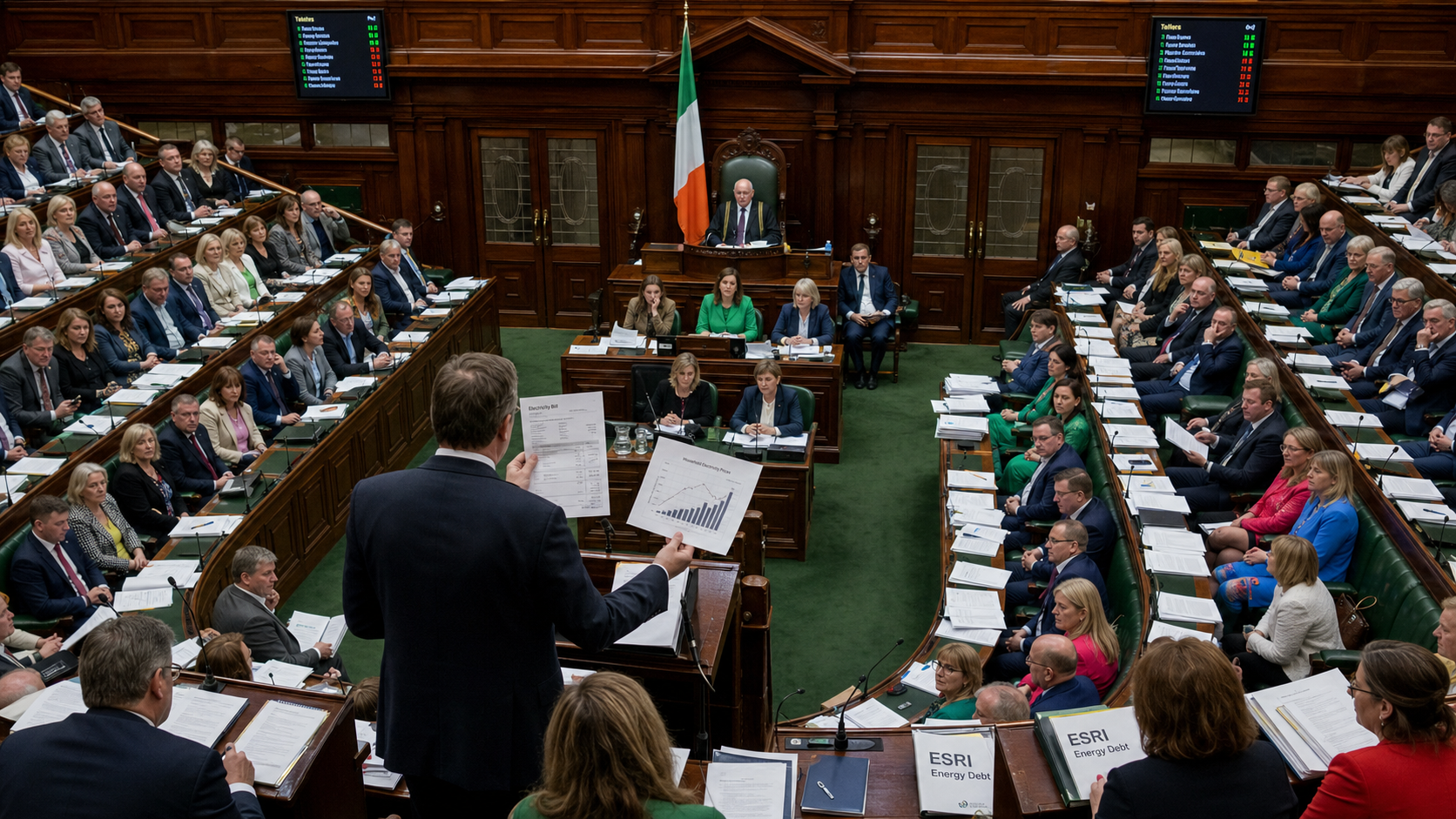
Dáil Addresses Growing Energy Debt Crisis as ESRI Warns Current Protections Favour Wealthier Households
The Dáil turned its attention on June 11 to the growing crisis of energy arrears among Irish households, as new research from the Economic and Social Research Institute revealed a troubling paradox at the heart of the government's approach to energy affordability: the protections currently in place against energy price hikes are benefiting wealthier households more than the vulnerable families they are ostensibly designed to help. With thousands of households now in debt to their energy providers, opposition parties are pressing the government to redesign its support measures before the next heating season begins.
Background
Ireland's energy market has been under significant pressure since the global energy price spike of 2021-22, which was exacerbated by the Russian invasion of Ukraine and the subsequent disruption to European gas supplies. While wholesale energy prices have moderated somewhat since their peak, retail energy prices in Ireland remain significantly higher than pre-crisis levels, and the cumulative impact on household budgets — particularly those of lower-income families — has been severe.
The government has responded with a series of energy credit schemes, providing lump-sum payments to households to offset their bills. These schemes have been broadly welcomed but have also attracted criticism for their universal nature — the same credit is provided to all households regardless of income, meaning that a family in a large, well-insulated home in a wealthy suburb receives the same support as a family in a poorly insulated flat in a deprived urban area. The ESRI's research has now provided empirical backing for this criticism.
Energy poverty — defined as the inability to afford adequate warmth and energy services — is a significant and growing problem in Ireland. The Society of St Vincent de Paul and other charitable organisations have reported sharp increases in the number of people seeking assistance with energy bills, and the number of households in arrears with their providers has risen substantially. The Commission for Regulation of Utilities has been monitoring the situation closely, but its powers to intervene in the market are limited.
Key Developments
The ESRI's findings, presented to the Dáil on June 11, showed that the current structure of energy supports — primarily flat-rate credits applied to all bills — disproportionately benefits households with higher energy consumption, which tend to be larger and wealthier. Lower-income households, which typically live in smaller properties and consume less energy, receive the same nominal credit but a smaller proportional benefit relative to their bills. The ESRI recommended a shift towards means-tested or income-linked supports that would direct more assistance to those who need it most.
Opposition parties, including Sinn Féin, Labour, and the Social Democrats, used the ESRI findings to press the government for a fundamental redesign of its energy support approach. Sinn Féin's energy spokesperson argued that the current system is "regressive" and called for the introduction of a social tariff — a reduced energy rate for households below a certain income threshold — similar to those operating in other European countries. Labour called for an emergency review of the energy credit scheme ahead of the next budget.
The government's response was to acknowledge the ESRI's findings while defending the speed and scale of the support provided during the energy crisis. Ministers pointed to the Warmer Homes Scheme and other targeted energy efficiency programmes as evidence that the government is addressing the structural causes of energy poverty, not just its immediate symptoms. However, opposition TDs noted that the Warmer Homes Scheme has a waiting list of several years, limiting its effectiveness as a near-term solution.
Why It Matters
The energy debt crisis matters because it is both a symptom and a cause of wider economic hardship. Households that fall into arrears with their energy providers face the risk of disconnection — a risk that is particularly acute for families with young children, elderly members, or people with medical conditions that require a warm home. The stress of energy debt also has documented impacts on mental health, family relationships, and children's educational outcomes.
The ESRI's finding that current protections favour wealthier households is significant because it challenges the narrative that the government's energy support measures have been broadly effective. If the design of the support system is itself regressive — if it provides more help to those who need it less — then the scale of the investment is less important than its structure. This is a lesson that applies not just to energy policy but to the broader design of social supports in Ireland.
Ireland's energy poverty rate is higher than the EU average, and the country's housing stock — much of which was built before modern insulation standards were introduced — is particularly energy-inefficient. Addressing energy poverty in Ireland therefore requires both immediate income support and long-term investment in retrofitting, a combination that the current policy framework has not yet delivered at the necessary scale or speed.
Local Impact
The impact of energy debt is felt most acutely in Ireland's urban areas, where rental accommodation is often poorly insulated and where low-income households are concentrated. In Dublin, areas including Ballymun, Tallaght, Clondalkin, and the north inner city have seen significant increases in energy arrears. In Cork, Limerick, and Galway, similar patterns are emerging in social housing estates and private rental properties.
Rural households face a different but equally serious challenge: many are dependent on oil heating rather than gas, and the oil market is less regulated than the gas market, leaving rural households more exposed to price volatility. The ESRI's research did not fully capture this rural dimension, and advocacy groups have called for a separate analysis of energy poverty in rural Ireland.
What's Next
The government has indicated it will consider the ESRI's recommendations as part of its pre-budget deliberations, with a decision on the design of energy supports for the coming winter expected by September. The Commission for Regulation of Utilities is also reviewing its approach to energy debt, with a consultation paper expected in July. Opposition parties have indicated they will table amendments to the upcoming Energy (Miscellaneous Provisions) Bill to introduce a statutory social tariff if the government does not act voluntarily.