Culture Night Belfast 2026 Draws Thousands to 200 Free Events as City Celebrates 20th Edition
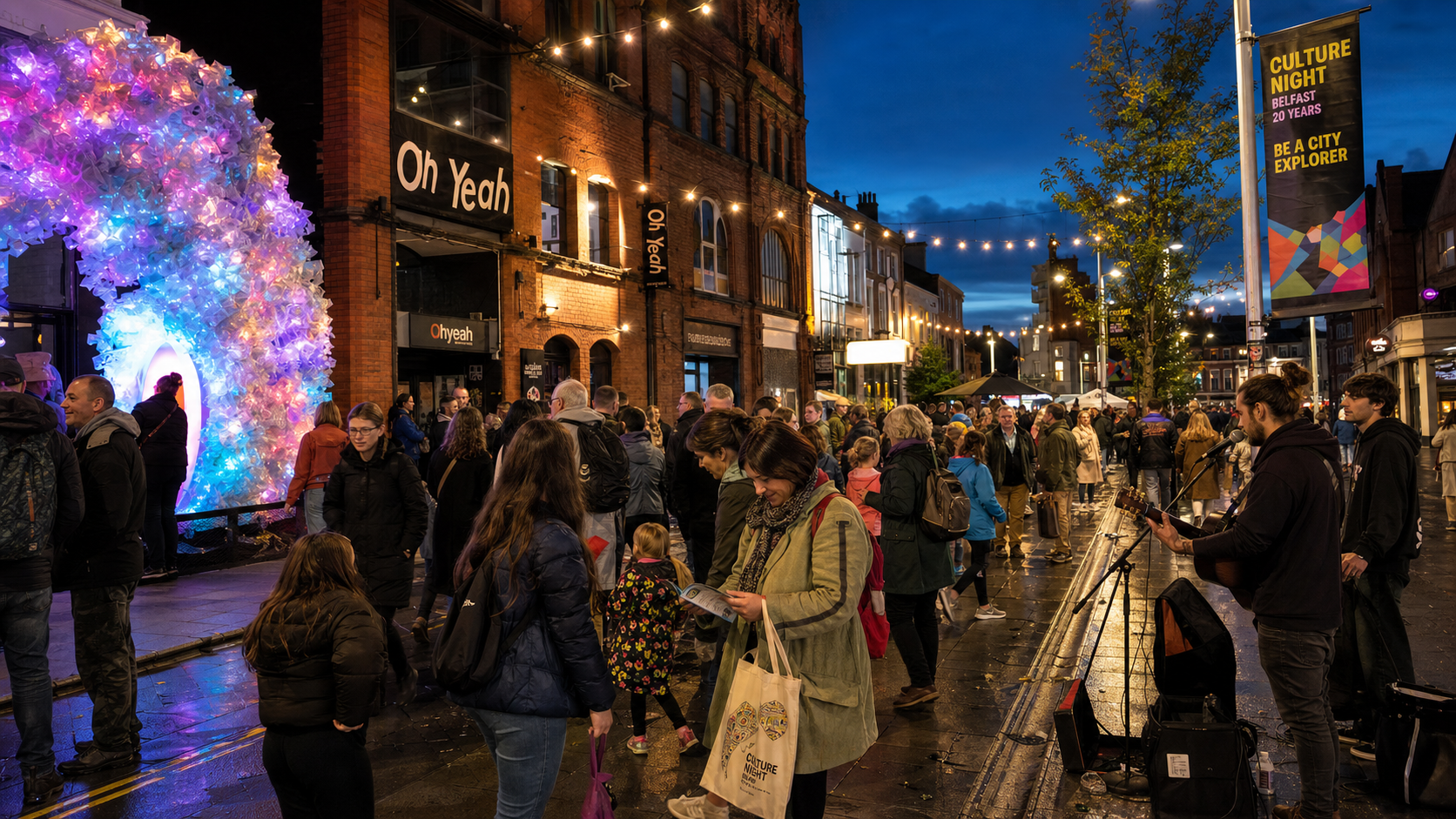
Belfast came alive on Friday evening as Culture Night 2026 transformed the city into an open-air festival of creativity, with more than 200 free events running from 4pm to 10pm across dozens of venues, marking the twentieth anniversary of an event that has become one of the most beloved fixtures in the Northern Ireland cultural calendar.
Background
Culture Night began as a modest initiative to open arts venues to the public free of charge on a single autumn evening, drawing inspiration from similar events across Europe. Over two decades, the Belfast edition has grown into something far more ambitious — a city-wide celebration that draws tens of thousands of participants and has played a meaningful role in reshaping how residents and visitors experience the urban landscape.
The event is funded by Belfast City Council with additional support from the Linen Quarter and Cathedral Quarter Business Improvement Districts, and is delivered by arts organisations MayWe and DaisyChain Inc. through an open-call process that invites local artists and creatives to propose events. That bottom-up model has been central to the night's success, ensuring that the programme reflects the genuine diversity of Belfast's creative community rather than a curated selection of established institutions.
This year's twentieth edition carried particular significance. The theme — 'Be a City Explorer' — was chosen to encourage participants to venture beyond familiar neighbourhoods and engage with parts of the city they might not ordinarily visit. For a city that has spent decades working through the legacies of division, the invitation to explore freely carries a resonance that goes beyond the merely cultural.
Key Developments
The programme for 2026 was the most expansive in the event's history. At the Ulster Hall on Bedford Street, The Belfast Busking Collective staged a series of performances that drew large crowds throughout the evening, with musicians ranging from traditional Irish session players to jazz ensembles taking to the stage in rotation. The venue, one of the city's most storied, was packed from early evening.
At 2 Royal Avenue, a large-scale illustrated wall art installation became one of the night's most photographed attractions, drawing queues of families and young people eager to capture the imagery against the backdrop of the city centre. The Oh Yeah Centre on Gordon Street hosted the SoulTrane Block Party, which brought together DJs and live performers in a celebration of Belfast's vibrant music scene.
In the Linen Quarter, the Belfast Grand Central Station hosted the Linen Quarter Wrestling Corner — an unexpected but enthusiastically received addition to the programme — while HALT on Great Victoria Street offered a 'Superhero HQ' for younger visitors. Drop-in poetry sessions at Native Coffee along the Maritime Mile provided a quieter counterpoint to the more boisterous events elsewhere.
Translink confirmed that Metro and Glider services would operate enhanced frequencies throughout the evening to transport participants between event hubs, with Beryl Belfast Bikes' 60 docking stations across the city also seeing heavy use. Designated quiet spaces were available at 2 Royal Avenue and The MAC for those who needed a respite from the crowds.
Why It Matters
Culture Night Belfast has become one of the most effective tools the city possesses for demonstrating what Belfast can be at its best. The event's model — free access, community-led programming, city-wide reach — stands in contrast to the ticketed, venue-specific model that dominates much of the arts calendar, and its success has influenced how cultural policy is discussed at both council and Stormont level.
The twentieth anniversary edition arrives at a moment when Belfast's cultural infrastructure is under pressure. Arts funding from the Arts Council of Northern Ireland has been subject to repeated cuts in real terms, and several smaller organisations have struggled to maintain programming. Against that backdrop, Culture Night's ability to mobilise hundreds of artists and thousands of participants on a single evening is a powerful argument for sustained public investment in the creative sector.
The event also serves a social function that is difficult to quantify but easy to observe. In a city where community boundaries can still feel rigid, Culture Night creates conditions in which people from different backgrounds share the same spaces, engage with the same art, and experience the city as a common inheritance rather than a contested territory. That is not a small thing.
Local Impact
The economic impact of Culture Night on Belfast city centre is substantial. Hospitality venues across the Cathedral Quarter, Linen Quarter, and city centre reported strong footfall throughout the evening, with restaurants and bars benefiting from the extended dwell time that the event encourages. For smaller creative businesses — galleries, independent studios, craft workshops — the night provides a level of visibility that would otherwise require significant marketing expenditure.
For residents of north and east Belfast, the enhanced Translink services made the city centre more accessible than on a typical Friday evening, with the Glider route along the Newtownards Road and the York Road corridor seeing particularly heavy use. Community arts groups from Ardoyne, the Short Strand, and the Markets were among those presenting work, ensuring that the night's geography extended beyond the traditional cultural quarter.
What's Next
The Culture Night Belfast team will begin planning for the 2027 edition in the coming weeks, with the open call for artist proposals expected to launch in early spring. Belfast City Council's culture committee is expected to review the event's funding model in October, with a decision on the 2027 allocation anticipated before the end of the year. The event's organisers have indicated that they are exploring options to extend the programme's geographic reach in future editions, potentially incorporating venues in south and west Belfast that have not previously participated at scale.