Cross-Border Trade Reaches €15 Billion as Island Economy Becomes 'Oasis of Calm' Amid Global Disruption
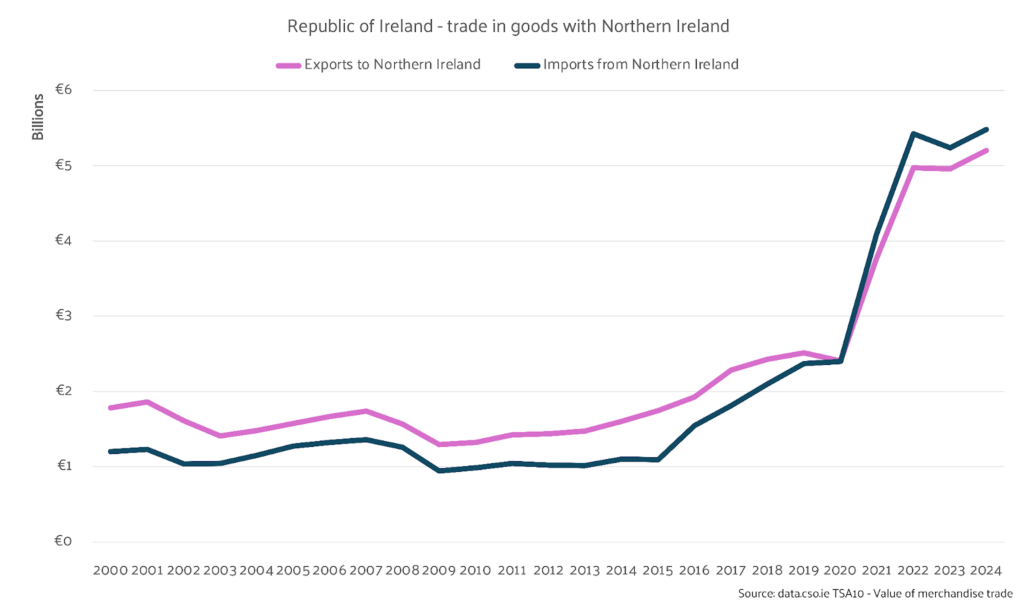
Cross-border trade between Northern Ireland and the Republic of Ireland has reached €15 billion annually — a sevenfold increase from the €2 billion recorded in 1998 — with business leaders and economists describing the all-island economy as an 'oasis of calm' amid the global trade disruption caused by US tariffs, geopolitical uncertainty, and the broader fragmentation of international supply chains.
Background
The transformation of cross-border economic activity since the Good Friday Agreement is one of the most striking, if underreported, success stories of the peace process. In 1998, the border between Northern Ireland and the Republic was a significant economic barrier, with trade flows constrained by customs procedures, different regulatory frameworks, and the practical difficulties of doing business across a frontier that had been heavily militarised for three decades.
The removal of border infrastructure following the Agreement, combined with both jurisdictions' membership of the European Union's single market and customs union, created the conditions for a dramatic expansion of cross-border economic activity. Businesses on both sides of the border were able to trade freely, supply chains could be organised on an all-island basis, and workers could move between the two jurisdictions without restriction. The result was a rapid growth in cross-border trade, investment, and economic integration that has continued, with some interruptions, for the past quarter century.
The Brexit process created significant uncertainty about the future of cross-border economic arrangements, with the prospect of a hard border between Northern Ireland and the Republic threatening to reverse much of the economic integration that had been achieved since 1998. The Windsor Framework, agreed in 2023, provided a resolution to the most acute tensions by maintaining Northern Ireland's access to the EU single market for goods while also preserving its place within the UK's internal market — an arrangement that has, in practice, given Northern Ireland a unique dual-market access that has been increasingly recognised as an economic advantage.
Key Developments
The €15 billion cross-border trade figure, compiled from data provided by InterTradeIreland and the Central Statistics Office, represents the total value of goods and services traded between Northern Ireland and the Republic in 2025. The figure includes both formal trade flows — goods crossing the border in commercial vehicles — and the significant volume of services trade that takes place through digital channels and professional networks.
Business leaders from both sides of the border have been particularly vocal in describing the all-island economy as a source of stability in a period of global trade disruption. The imposition of US tariffs on a range of goods has created significant uncertainty for exporters in both the Republic and Northern Ireland, but the cross-border market has provided a degree of insulation from the worst effects of the tariff regime. Companies that sell primarily to customers on the island of Ireland are largely unaffected by US trade policy, and the depth of the cross-border market provides a significant buffer against external shocks.
InterTradeIreland, the cross-border trade and business development body, has reported a significant increase in the number of businesses seeking to expand their cross-border activities in response to global trade uncertainty. The body's programmes supporting cross-border trade have been oversubscribed in recent months, reflecting the growing recognition among businesses in both jurisdictions that the all-island market offers a degree of stability that is increasingly valuable in a volatile global environment.
Why It Matters
The €15 billion cross-border trade figure matters because it demonstrates the concrete economic value of the peace process and the institutional arrangements that have flowed from it. The Good Friday Agreement is often discussed in political and constitutional terms, but its economic legacy — the creation of a deeply integrated all-island economy — is equally significant and arguably more durable.
The 'oasis of calm' framing is particularly apt in the current global context. The world economy is experiencing a period of significant disruption, with US tariffs, geopolitical tensions, and the fragmentation of global supply chains creating uncertainty for businesses across all sectors. Against this backdrop, the stability and predictability of the cross-border trading relationship between Northern Ireland and the Republic is a genuine competitive advantage for businesses on both sides of the border.
The cross-border trade figures also have implications for the constitutional debate about Northern Ireland's future. The economic case for maintaining and deepening the all-island economic relationship is increasingly compelling, and the €15 billion trade figure provides concrete evidence of the value that businesses on both sides of the border derive from the current arrangements.
Local Impact
The cross-border trade relationship has a direct and tangible impact on businesses and communities across the border region. In counties Armagh, Down, Fermanagh, and Tyrone, cross-border trade is a daily reality for thousands of businesses, from large agri-food processors to small retailers and service providers. The ability to trade freely across the border — to source supplies from the Republic, to sell to customers in the south, to employ workers from both jurisdictions — is fundamental to the business models of many companies in the border region.
In the Republic's border counties — Donegal, Leitrim, Cavan, Monaghan, and Louth — the cross-border economic relationship is similarly central to local economic life. The border towns of Dundalk, Monaghan, Cavan, and Letterkenny all have significant economic relationships with their Northern Ireland counterparts, and the free flow of goods, services, and people across the border is essential to their prosperity.
What's Next
InterTradeIreland is expected to publish its annual cross-border trade report later this month, providing a more detailed breakdown of the €15 billion figure by sector, county, and type of trade. The report is expected to show continued growth in services trade, particularly in the technology and professional services sectors, alongside sustained strength in agri-food and manufacturing. The body has also indicated that it will be launching a new programme to support small and medium-sized businesses in both jurisdictions to expand their cross-border activities, with a particular focus on digital trade and e-commerce.