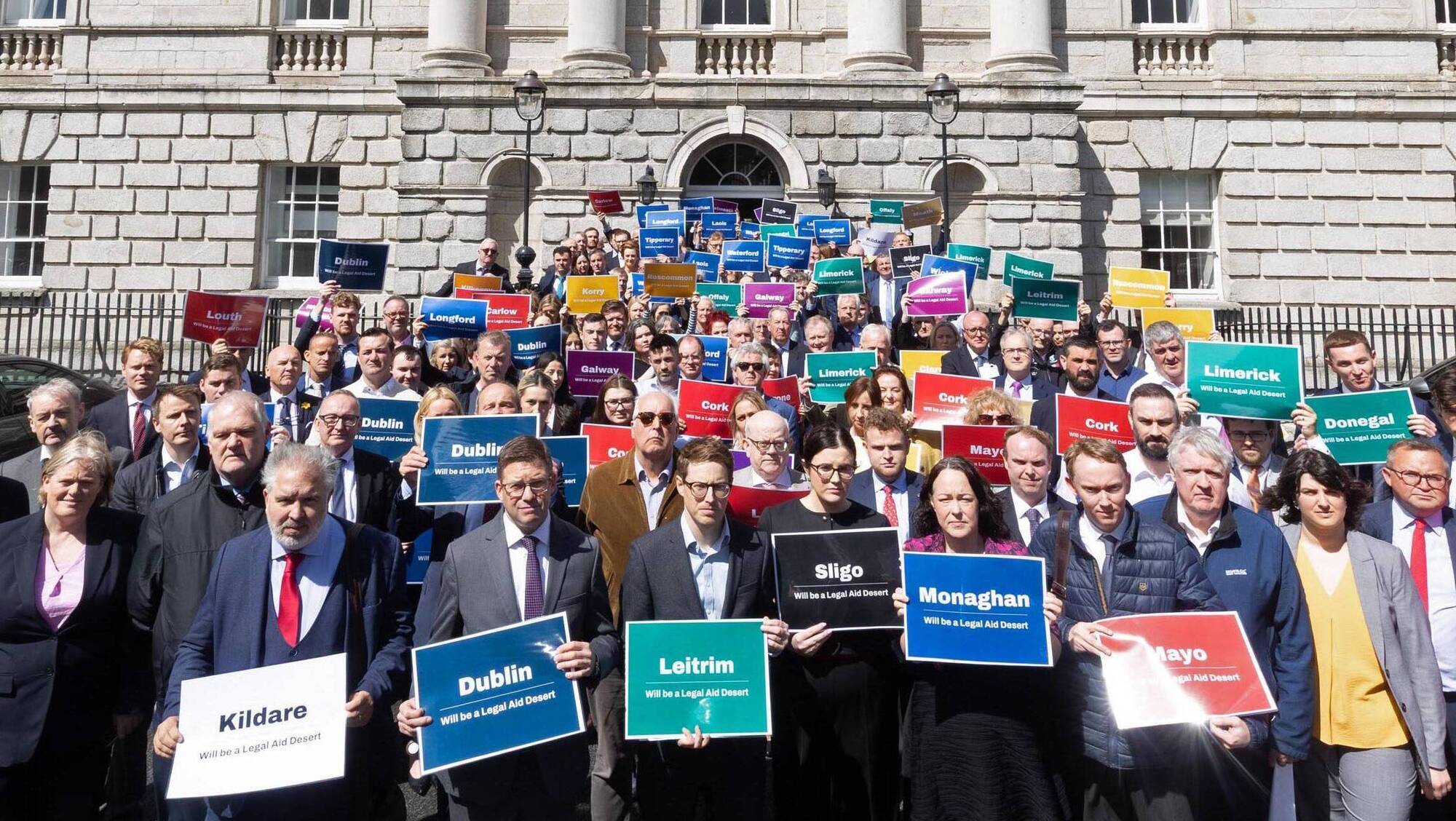
Criminal Legal Aid Dispute Costs Solicitors and Barristers €6.64 Million in Two Months as Court Backlogs Mount
The ongoing criminal legal aid dispute between defence solicitors and the Department of Justice has cost legal professionals €6.64 million in payments over July and August 2026, with the number of legal aid certificates granted in July collapsing by 93 per cent compared to the same month in 2025, as thousands of criminal cases have been adjourned and the courts system faces a growing backlog that threatens to undermine access to justice for defendants across the country.
Background
The criminal legal aid system in Ireland provides state-funded legal representation to defendants who cannot afford to pay for their own solicitor or barrister. The system is a cornerstone of the right to a fair trial, enshrined in the Constitution and in the European Convention on Human Rights, and it is particularly important for the most vulnerable defendants — those facing serious charges, those with mental health difficulties, and those who are in custody awaiting trial.
The dispute began in July 2026, when the Department of Justice implemented a new flat-fee payment structure for District Court criminal legal aid cases, replacing the previous system in which solicitors were paid for each individual court appearance. Under the new system, solicitors receive a flat fee of €520 per client for District Court cases, regardless of the number of appearances required or the complexity of the case. Minister for Justice Jim O'Callaghan argued that the previous system incentivised unnecessary adjournments and resulted in longer case durations, increasing costs for the state and delays for defendants.
Solicitors rejected the new system as unworkable, arguing that the flat fee fails to account for the varying complexity of cases, the number of charges, or the time required to represent vulnerable clients and children. The Law Society of Ireland and the Bar of Ireland both expressed serious concerns about the new structure, and by July 1st, more than 100 Dublin-based solicitors had withdrawn their services from the criminal legal aid system in protest.
Key Developments
Data from the Department of Justice, published in the Irish Times on Friday, reveals the scale of the financial impact on legal professionals. Total criminal legal aid payments for July and August 2026 amounted to €12.5 million — a decrease of €6.64 million compared to the €19.15 million paid during the same period in 2025. Solicitors experienced a reduction in payments of €3.16 million over the two-month period, while barristers — who were not directly involved in the dispute but who lost work as solicitors stopped instructing them — saw their payments fall by €3.48 million.
The operational consequences of the dispute have been severe. Courts Service data shows that the number of legal aid certificates granted in July 2026 plummeted by 93 per cent to 702, down from 10,277 in July 2025. Thousands of criminal cases have been adjourned, creating a backlog that will take months or years to clear. In some cases, defendants who were denied bail due to a lack of legal representation were subsequently found by the High Court to have been unlawfully detained — a development that has significant implications for the state's liability.
As of late September, more than 100 Dublin-based solicitors have confirmed their intention to continue the withdrawal of services. A judicial review challenging the statutory instrument underpinning the new fee structure is pending, with a High Court judgment expected on October 13.
Why It Matters
The criminal legal aid dispute is not merely a labour relations issue — it is a crisis of access to justice. The 93 per cent collapse in legal aid certificates in July means that thousands of defendants appeared in court without legal representation during that month, a situation that is incompatible with the constitutional right to a fair trial. The High Court's intervention in cases where defendants were unlawfully detained due to lack of representation is a stark illustration of the consequences of the dispute for individual defendants. The growing backlog of criminal cases will also have long-term consequences for the courts system, with cases that should have been heard in 2026 now likely to be delayed until 2027 or beyond. For victims of crime, the delays mean that justice is further postponed; for defendants, the uncertainty of an unresolved case hanging over them is a significant burden.
Local Impact
The impact of the dispute is felt most acutely in the District Courts, which handle the vast majority of criminal cases in Ireland. In Dublin, where the withdrawal of services has been most concentrated, the District Courts have been operating at significantly reduced capacity, with judges forced to adjourn cases that cannot proceed without legal representation. In provincial towns, where the pool of criminal legal aid solicitors is smaller, the withdrawal of even a handful of practitioners can have a disproportionate impact on the local courts. The backlog of cases will place additional pressure on an already stretched courts system, with implications for court staff, judges, and the Probation Service, which provides pre-sentence reports in many cases.
What's Next
The High Court judgment on the judicial review of the statutory instrument underpinning the new fee structure is expected on October 13. If the court finds in favour of the solicitors, the new fee structure will be struck down and the Department of Justice will be required to revert to the previous system or negotiate a new arrangement. If the court upholds the statutory instrument, the dispute is likely to continue, with solicitors exploring further legal and industrial action options. Minister O'Callaghan has indicated that he is willing to engage in further discussions with the Law Society, but has ruled out abandoning the flat-fee principle. The Law Society has said that the dispute "ends with the minister coming back to the table" — a formulation that suggests the two sides remain far apart.