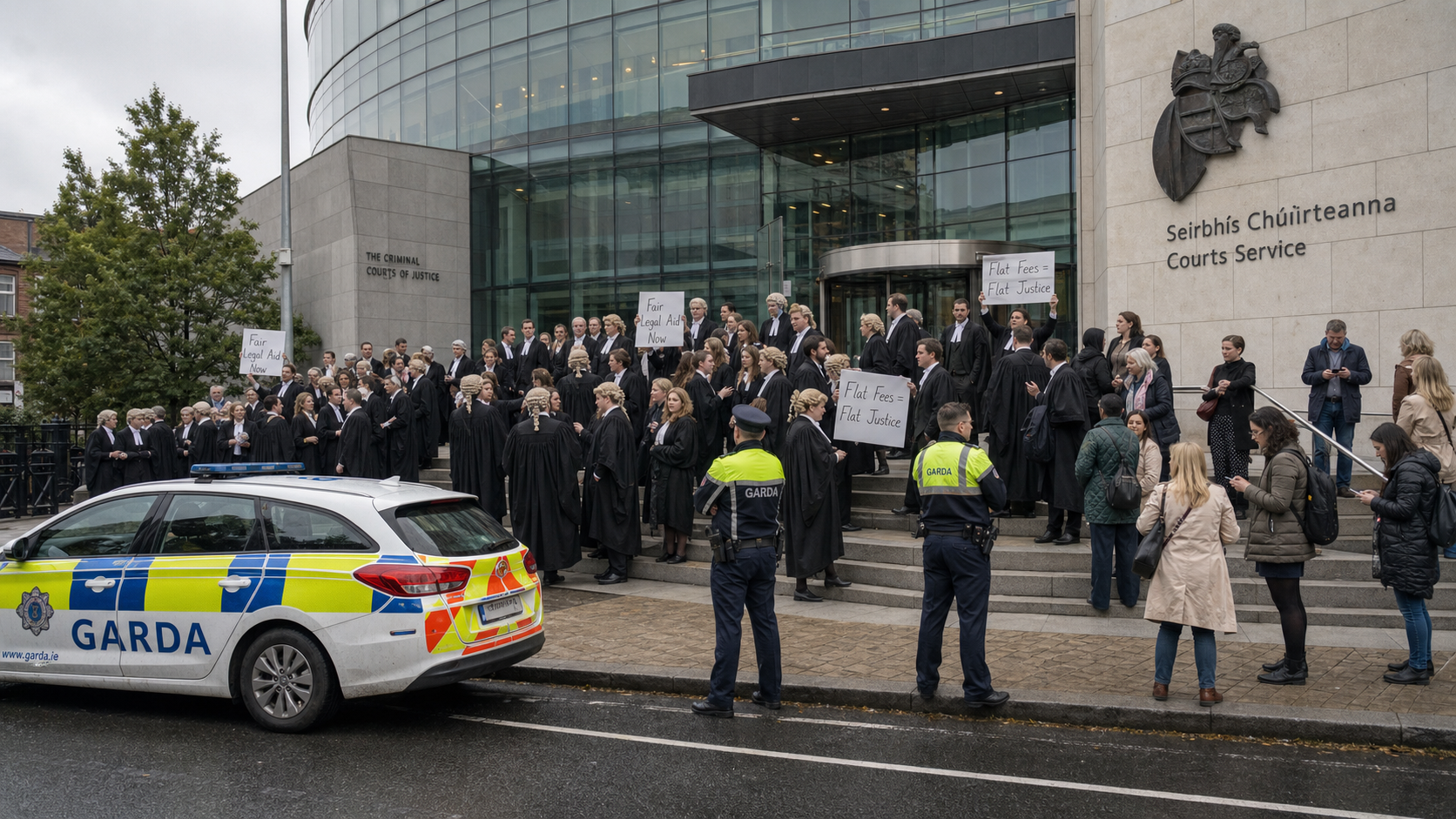
Courts in Chaos as Solicitors Strike Over New Legal Aid Fees in Blow to Criminal Justice System
Ireland's criminal justice system is experiencing significant disruption following the introduction of a new flat-fee payment model for criminal legal aid on 1 July 2026, with solicitors across the country taking industrial action in protest at what they describe as an unworkable and unjust system. Trials, sentencings, and arraignments have been adjourned in courts from Dublin to Cork, with the dispute showing no signs of early resolution as practitioners initiate High Court challenges against the new model and accuse Justice Minister Jim O'Callaghan of an "intransigent" approach to negotiations.
Background
Criminal legal aid in Ireland has been a source of ongoing tension between the legal profession and successive governments for many years. The system, which provides state-funded legal representation to individuals who cannot afford to pay for their own defence, is a constitutional requirement — the right to a fair trial, enshrined in the Irish Constitution, is meaningless without access to legal representation. But the cost of the system has grown significantly over the decades, and successive governments have sought ways to control that expenditure.
The previous system paid solicitors on a per-appearance basis, meaning that the longer a case ran and the more court appearances it required, the more the solicitor was paid. Critics of this model argued that it created perverse incentives for cases to be prolonged unnecessarily, driving up costs for the state. The new flat-fee model, introduced by the Department of Justice on 1 July, replaces per-appearance payments with a single fee for each category of case, regardless of how many court appearances it requires.
The legal profession has been warning for months that the new model is unworkable. Solicitors argue that the flat fee does not reflect the actual time and resources required to properly represent clients in complex cases, and that the system will effectively penalise practitioners who take on difficult or time-consuming cases. They also argue that the reform was introduced without adequate consultation with the profession.
Key Developments
The industrial action began on 1 July, the day the new system came into effect, with solicitors across the country refusing to accept briefs under the new fee structure. The impact on the courts has been immediate and significant, with judges in Dublin, Cork, Limerick, and other centres reporting widespread adjournments of criminal proceedings. Cases involving vulnerable defendants — including those on remand in custody — have been among those affected, raising serious concerns about the impact on individuals who are awaiting trial.
Justice Minister Jim O'Callaghan has maintained that the reform is necessary to address "serious inefficiencies" in the previous system and has declined to suspend the new model pending further negotiations. His approach has drawn sharp criticism from the legal profession, with one solicitor describing it as "Trumpian" — a reference to what practitioners see as a refusal to engage meaningfully with their concerns. Several solicitors have initiated High Court challenges against the new model, arguing that it is incompatible with the constitutional right to a fair trial.
The Law Society of Ireland has called for an urgent meeting with the Minister and has warned that the disruption to the courts will continue until a satisfactory resolution is reached. The Bar Council, representing barristers, has expressed solidarity with the solicitors' position, though barristers are not directly affected by the new model.
Why It Matters
The disruption to the criminal courts is not merely an inconvenience — it has real consequences for real people. Defendants awaiting trial, including those held on remand in custody, face extended delays in having their cases heard. Victims of crime who are waiting for justice see their cases pushed further into the future. Witnesses who have prepared themselves to give evidence face the stress of repeated adjournments. The cumulative human cost of the dispute is significant.
The constitutional dimension is also important. The right to a fair trial is not a luxury — it is a fundamental protection that distinguishes a democratic society governed by law from one governed by arbitrary power. If the new legal aid model genuinely undermines solicitors' ability to properly represent their clients, it is not merely a labour dispute but a constitutional crisis. The High Court challenges will test that proposition, and their outcome will have implications far beyond the immediate dispute.
The Minister's approach — introducing a significant reform without adequate consultation and then refusing to engage with the profession's concerns — has also raised broader questions about the government's relationship with the legal profession and its approach to reform of the justice system.
Local Impact
The impact of the dispute is being felt in courts across the country. In Dublin, the Criminal Courts of Justice on Parkgate Street has seen significant disruption, with the District Court and Circuit Court both reporting large numbers of adjournments. In Cork, the courthouse on Washington Street has similarly been affected. Legal aid solicitors in smaller towns and cities — where the criminal legal aid system is often the only source of legal representation for defendants — are also participating in the action, leaving some courts with no available defence solicitors.
The Legal Aid Board, which administers the criminal legal aid system, has been caught in the middle of the dispute, unable to resolve the fundamental disagreement between the Minister and the profession. The Board's staff are continuing to process applications for legal aid, but the practical effect of the industrial action means that many of those applications cannot be acted upon.
What's Next
The High Court challenges to the new legal aid model are expected to be heard in the coming weeks, with the outcome likely to determine whether the new system can continue in its current form. In the meantime, the Law Society has indicated that the industrial action will continue until the Minister agrees to suspend the new model and engage in meaningful negotiations. The Minister has shown no sign of doing so, suggesting that the disruption to the courts may continue for some time. The Oireachtas Justice Committee is expected to hold hearings on the dispute in the coming weeks.