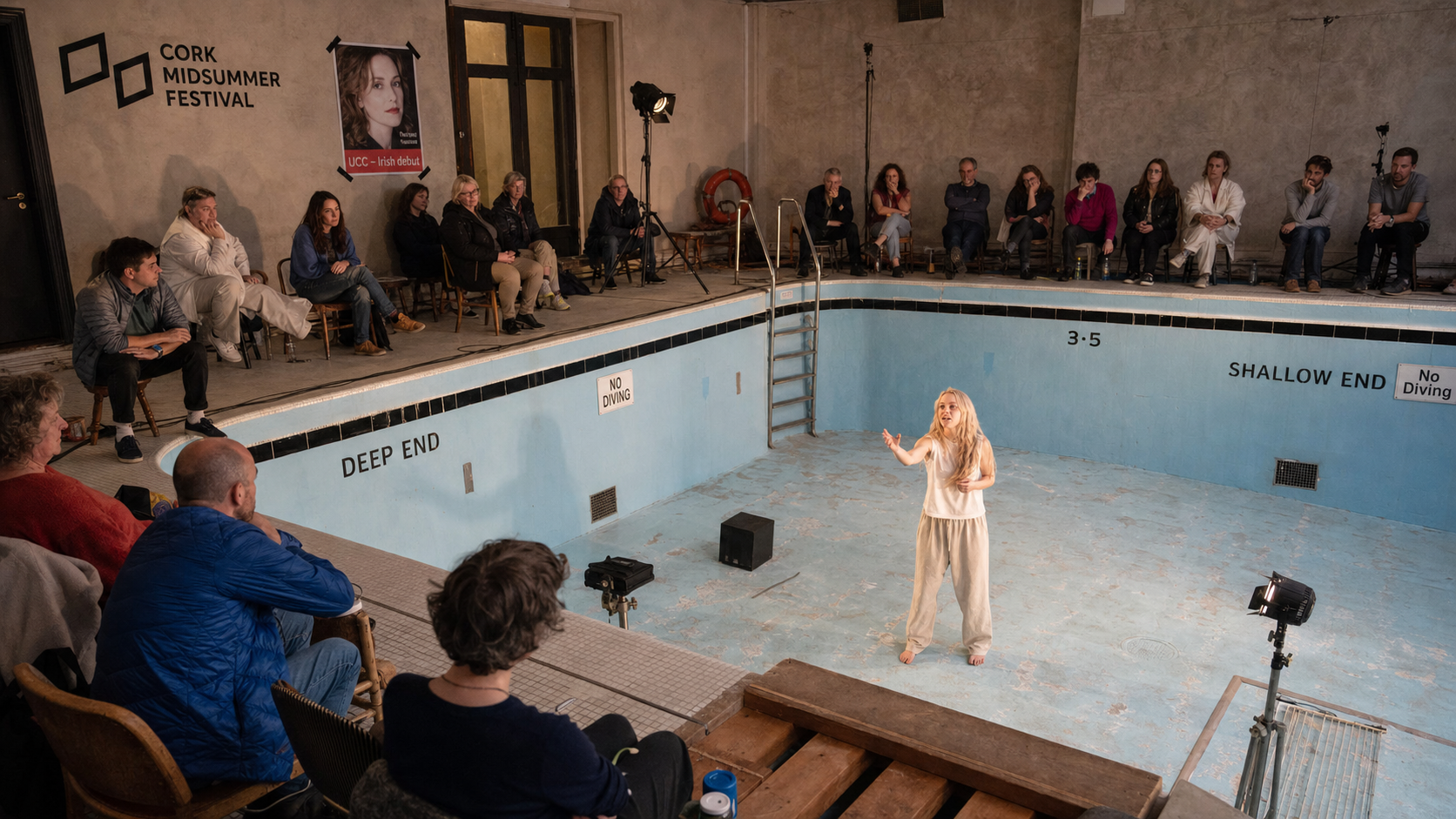
Cork Midsummer Festival Dazzles with Evanna Lynch in Empty Pool and Isabelle Huppert's Irish Debut
The Cork Midsummer Festival has produced some of its most striking and memorable work in years, with Co Louth actress Evanna Lynch performing in a production staged in an empty swimming pool at the Metropole Hotel, French cinema legend Isabelle Huppert making her debut Irish performance at University College Cork, and poet Doireann Ní Ghríofa reading from her new work at the former Our Lady's Psychiatric Hospital — a programme that has transformed Cork into one of the most exciting arts destinations in Europe for the duration of the festival.
Background
The Cork Midsummer Festival has been one of the most distinctive events in the Irish arts calendar since its establishment, built on a philosophy of site-specific performance that uses the city's buildings, streets, and public spaces as stages for work that could not be presented in conventional theatre venues. The festival's commitment to commissioning new work, to taking artistic risks, and to engaging with the full complexity of Cork's history and identity has given it a reputation for producing performances that are genuinely surprising and that stay with audiences long after the event.
The 2026 edition, running from June 12th to 21st, has been the most ambitious in recent years, with more than 50 events across 30 locations in the city. The programme has been developed over two years, with the festival's artistic team working with artists from Ireland and across the world to create work that responds to the specific character of Cork's spaces and communities. The result is a programme that ranges from intimate readings in historic buildings to large-scale outdoor performances that draw audiences of hundreds.
The festival's use of unconventional venues is one of its most distinctive features. The decision to stage a production in the empty swimming pool of the Metropole Hotel — a building with a rich history in Cork's social and cultural life — is characteristic of the festival's approach: finding the theatrical potential in spaces that are not normally associated with performance, and using that potential to create experiences that are impossible to replicate in a conventional theatre.
Key Developments
Evanna Lynch, best known internationally for her role as Luna Lovegood in the Harry Potter film series, has been one of the most talked-about performers at this year's festival. Her appearance in 'Pool (No Water)', staged in the empty swimming pool of the Metropole Hotel, has drawn audiences who have been struck by the combination of the unusual venue and Lynch's performance — a piece that uses the physical space of the pool to explore themes of absence, memory, and the body. Lynch, who grew up in Termonfeckin, County Louth, has been developing her theatre career in recent years, and her Cork Midsummer appearance has been widely praised as a significant step in that development.
Isabelle Huppert's debut Irish performance at UCC has been one of the festival's most anticipated events. The French actress, widely regarded as one of the greatest performers of her generation, read from the work of Guy de Maupassant in a performance that drew on her extraordinary ability to inhabit text and to communicate emotional complexity through the simplest of means. The event sold out within hours of tickets going on sale, and the response from audiences and critics has been uniformly enthusiastic.
Doireann Ní Ghríofa's reading from 'Said the Dead' at the former Our Lady's Psychiatric Hospital added a layer of historical resonance to the festival's programme. Ní Ghríofa, whose previous work 'A Ghost in the Throat' was one of the most celebrated Irish books of recent years, has been developing 'Said the Dead' as a response to the history of the psychiatric hospital — a building that carries the weight of generations of suffering and institutional care. The reading, in the building's former wards, was described by those who attended as one of the most powerful literary events they had experienced.
Why It Matters
The Cork Midsummer Festival matters for Irish cultural life because it demonstrates that world-class arts can happen outside Dublin — that Cork is capable of attracting and presenting work of the highest international quality in a context that is distinctively Irish and distinctively Corkonian. The presence of Isabelle Huppert, one of the most celebrated actresses in the world, at a festival in Cork is a statement about the ambition and the reach of Irish arts programming that should not be underestimated. The festival also matters because of its commitment to site-specific work that engages with the history and identity of the city. Cork has a complex and sometimes painful history — as a centre of the War of Independence, as a city that experienced significant industrial decline, and as a community that has grappled with the legacy of institutional care — and the festival's willingness to engage with that history through art is a form of cultural reckoning that has value beyond entertainment.
Local Impact
The Cork Midsummer Festival generates significant economic activity in the city, with hotels, restaurants, and cultural venues all reporting increased business during the festival period. The festival draws visitors from across Ireland and from abroad, many of whom use the occasion to explore Cork's wider cultural and culinary offer. The city's arts infrastructure — including the Cork Opera House, the Everyman Theatre, the Crawford Art Gallery, and the Triskel Christchurch arts centre — benefits from the increased visibility that the festival brings. For Cork's arts community, the festival provides opportunities for local artists to work alongside international figures and to develop their practice in a context of genuine artistic ambition. The festival's education and community engagement programme also reaches schools and community groups across the city, ensuring that the benefits of the event extend beyond the ticketed performances.
What's Next
The Cork Midsummer Festival runs until Sunday June 21st, with a full programme of events across the city each day. Tickets for remaining events are available through the festival website, though several performances are already sold out. The festival will publish a full review of the 2026 edition in the weeks following the event, including audience feedback and critical responses. Planning for the 2027 festival is expected to begin in the autumn, with the artistic team already in discussions about potential commissions and partnerships for next year's programme.