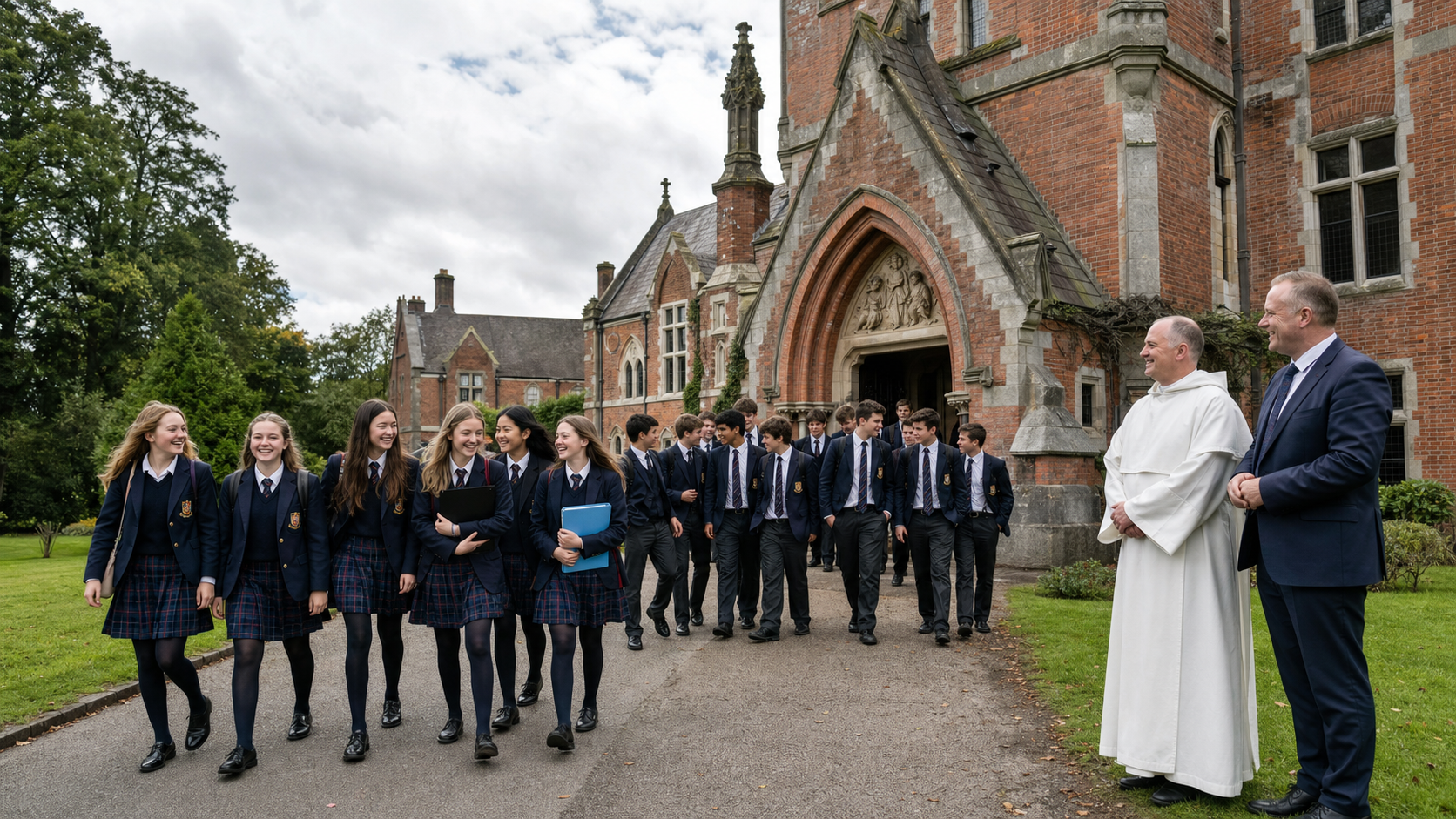
Cistercian College Roscrea Welcomes First Female Students in 120-Year History as Historic Co-Education Transition Begins
Cistercian College Roscrea, the prestigious Tipperary boarding school founded by Cistercian monks in 1905, has opened its doors to female students for the first time in its 120-year history, welcoming nine young women as day boarders in what the school describes as the beginning of a carefully planned and phased transition to full co-education.
Background
Cistercian College Roscrea — known colloquially as Roscrea or CCR — has occupied a distinctive place in the Irish secondary school landscape for more than a century. Founded by the Community of Our Lady of Silence, a Cistercian monastic community, the school has operated as an all-boys boarding institution since its establishment, drawing students from across Ireland and beyond for its academic rigour, sporting tradition, and the particular character that comes from a school embedded within a living monastic community.
The school sits on the grounds of Roscrea Abbey, a site of religious significance since the seventh century, and the presence of the monks — who live, pray, and work alongside the students — has long been considered central to the school's identity. CCR has produced a notable list of alumni across business, law, medicine, and public life, and its rugby tradition in particular has made it a significant name in Leinster Schools rugby for generations.
The decision to move to co-education was announced in May 2025, following an extensive consultation process involving staff, parents, past pupils, and school leadership. The school's patron, the Cistercian community, gave its support to the transition, describing it as consistent with the college's mission of fostering academic excellence and personal growth in a changing Ireland. The announcement was welcomed by many, though it also prompted reflection among some alumni for whom the single-sex character of the school had been formative.
Key Developments
Nine female students joined Cistercian College Roscrea at the start of the 2026 academic year, enrolling as day boarders across the junior and senior cycles. Their arrival brings the total student population to 259 — 250 boys and nine girls — a ratio that reflects the early stage of the transition rather than any intended long-term balance. The school has been clear that this is the beginning of a phased process, with plans to expand full boarding facilities to accommodate both boys and girls in the coming years.
School leadership has described the first days of the new term as positive, with the new students settling in well and the existing student body responding with maturity and welcome. The college has invested in facilities and pastoral support structures to ensure the transition is managed thoughtfully, and staff have undergone training to support a co-educational environment.
The move places CCR alongside a growing number of traditionally single-sex schools in Ireland that have made or are making the transition to co-education. The trend has accelerated in recent years as demographic pressures, changing parental preferences, and a broader cultural shift toward mixed-gender education have prompted schools to reconsider models that were established in a very different Ireland.
Why It Matters
The significance of this transition extends beyond the nine students who walked through CCR's gates this September. It marks a cultural shift in one of Ireland's most traditional educational institutions — a school whose identity has been shaped by its monastic roots, its single-sex character, and its boarding tradition. That such a school is now embracing co-education speaks to how profoundly Irish society has changed in the past generation.
Research consistently shows that co-educational environments benefit students of all genders in terms of social development, academic outcomes, and preparation for adult life. Ireland has been slower than many comparable countries to move in this direction at secondary level, particularly in the fee-paying boarding school sector, where single-sex traditions have been most entrenched. CCR's decision may encourage other similar institutions to accelerate their own transitions.
For context, the majority of Ireland's secondary schools are already co-educational. The remaining single-sex schools are concentrated in the fee-paying and religious-run sectors, where tradition has historically been a stronger brake on change. CCR's move is therefore symbolically significant as well as practically important for the students involved.
Local Impact
In Roscrea itself, the news has been received warmly. The school is a significant employer and cultural anchor in the town, and its continued vitality matters to the local community. The transition to co-education is seen by many in the area as a sign of the school's confidence in its future and its willingness to adapt to the needs of contemporary Irish families.
For families in Tipperary and the surrounding counties of Offaly, Laois, and Kilkenny who have traditionally sent their sons to CCR, the change opens up the possibility of sending daughters there as well — a practical benefit that several local families have already taken up in this first cohort. The school's boarding tradition, which draws students from across the country, means the impact of the transition will be felt well beyond the immediate locality.
What's Next
The school has indicated that it will review the first year of co-education carefully before confirming the timeline for expanding boarding facilities for female students. Full boarding for girls is expected to be introduced within the next two to three years, subject to the necessary capital investment and planning. The college has also committed to reviewing its curriculum, extracurricular offering, and pastoral structures to ensure they serve a co-educational student body effectively. Applications for the 2027 academic year are expected to reflect the new co-educational status, with the school anticipating increased interest from families who had not previously considered CCR as an option.