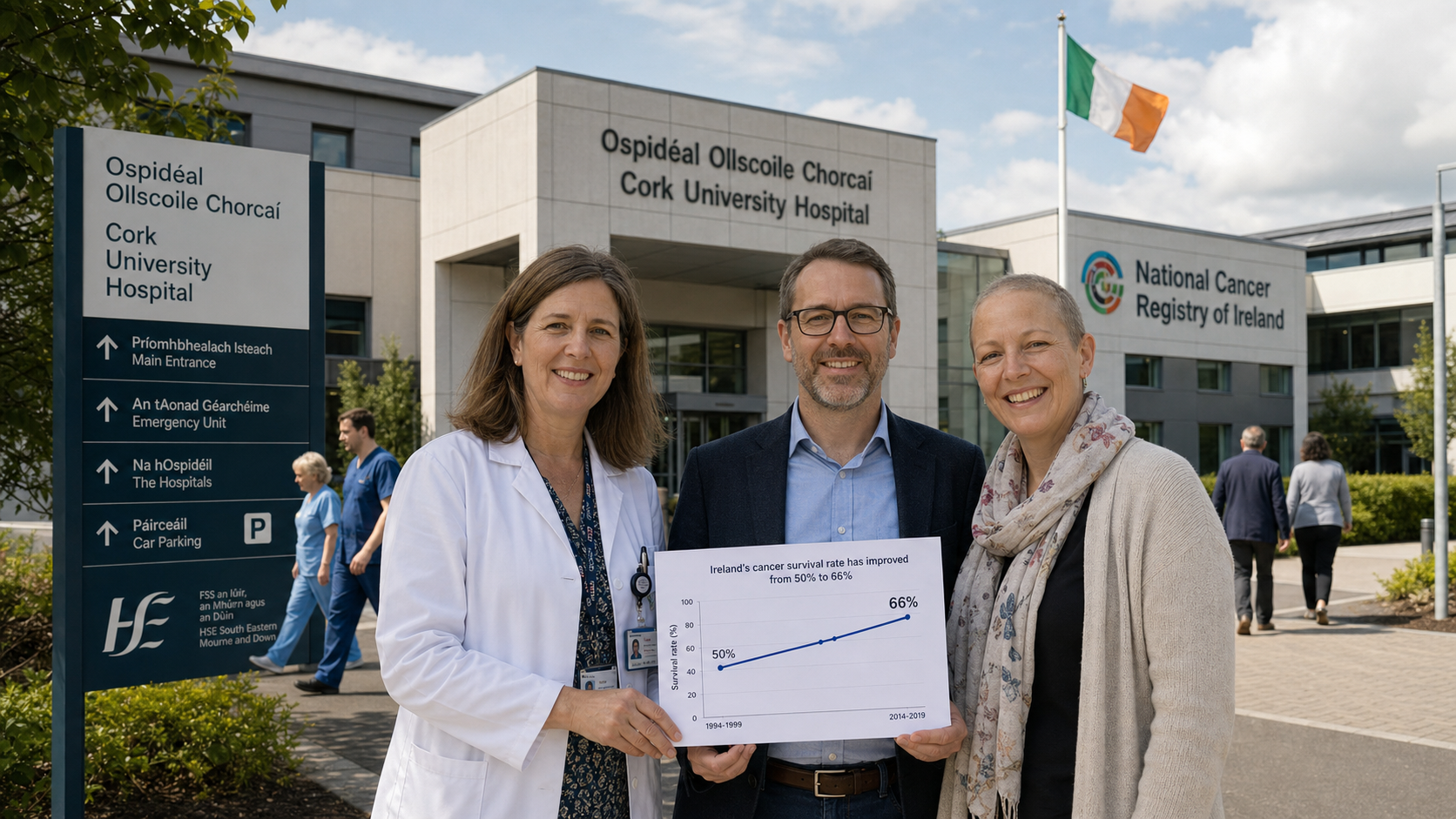
Cancer Survival Rates in Ireland Rise from 50% to 66% Over Three Decades as NCRI Report Marks Landmark Progress
A landmark report from the National Cancer Registry of Ireland published on Tuesday has found that five-year cancer survival rates have risen from 50% to 66% over the past three decades, with age-adjusted incidence rates declining for both men and women despite a rising absolute number of diagnoses driven by population growth and an ageing society. The findings represent the most comprehensive assessment of cancer outcomes in Ireland since the Registry was established.
Background
The National Cancer Registry of Ireland has been tracking cancer diagnoses, treatments, and outcomes since 1994, providing the most detailed longitudinal picture of the disease's impact on Irish society available anywhere on the island. The Registry's work underpins national cancer control policy, informs clinical practice, and provides the evidence base for investment decisions in oncology services across the country.
Ireland's approach to cancer control has evolved significantly over the past three decades. The establishment of designated cancer centres, the rollout of national screening programmes for breast, cervical, and bowel cancer, and sustained investment in oncology staffing and equipment have all contributed to the improvements documented in Tuesday's report. The National Cancer Strategy, which has been renewed and updated at regular intervals, has provided a framework for coordinated action across the health system.
The context for Tuesday's report is one of cautious optimism tempered by ongoing challenges. While survival rates have improved markedly, cancer remains the leading cause of death in Ireland, accounting for nearly 30% of all deaths. The absolute number of diagnoses continues to rise, driven primarily by population growth and demographic ageing rather than any increase in underlying risk. This distinction — between rising case numbers and declining age-adjusted rates — is central to understanding what the data actually shows.
Key Developments
The NCRI's analysis, covering the period from 1994 to 2023, found that the overall five-year survival rate for invasive cancers rose from 50% for patients diagnosed between 1999 and 2003 to 66% for those diagnosed between 2019 and 2023. For some specific cancer types, survival rates have reached as high as 95%, reflecting the transformative impact of targeted therapies and improved surgical techniques.
Age-adjusted cancer incidence rates have declined for both men and women over the period studied, a finding that Acting Director Dr Theresa Redaniel described as "genuinely encouraging" while cautioning that continued investment in detection and treatment services would be essential to sustain the trend. Particular progress has been recorded in cervical and colorectal cancers — both of which benefit from early detection through screening — as well as prostate cancer and multiple myeloma, where treatment options have advanced substantially.
The report also highlights areas where improvement has been slower. Lung cancer survival rates, while improving, remain significantly below those for other common cancers, reflecting the challenges of late-stage diagnosis. Pancreatic cancer outcomes have shown limited improvement despite advances in surgical technique, and the Registry has called for accelerated investment in research into cancers where progress has been most elusive.
Why It Matters
The improvement in survival rates documented by the NCRI represents one of the most significant public health achievements in Ireland over the past generation. For context, a 16-percentage-point increase in five-year survival rates over two decades is a substantial gain by any international standard. The European average for five-year cancer survival has improved over the same period, but Ireland's trajectory compares favourably with comparable countries, reflecting the effectiveness of the national cancer control framework.
The distinction between rising absolute case numbers and declining age-adjusted rates is important for public understanding. Ireland's population has grown significantly since the mid-1990s and is ageing rapidly, meaning that more people are reaching the ages at which cancer risk is highest. The fact that age-adjusted rates are falling means that the underlying risk of developing cancer — controlling for demographic change — is actually decreasing, a finding that reflects the impact of lifestyle changes, screening programmes, and improved environmental health.
The report arrives at a moment when the health system is under significant pressure, with waiting lists for cancer diagnostics and treatment remaining a concern. Dr Redaniel's call for continued investment in detection, treatment, and survivorship services reflects the understanding that the gains of the past three decades are not guaranteed to continue without sustained commitment of resources.
Local Impact
Across Ireland, the improvements documented by the NCRI translate into thousands of additional lives saved each year compared with outcomes three decades ago. In practical terms, a patient diagnosed with breast cancer in Ireland today has a significantly better chance of long-term survival than a patient diagnosed in the mid-1990s, and the same is true across a wide range of cancer types. The expansion of cancer services to regional centres — including in Cork, Galway, Limerick, and Waterford — has improved access to specialist care for patients who previously faced long journeys to Dublin for treatment. The HSE's cancer screening programmes, available to eligible adults across all 26 counties, have been central to the early detection gains reflected in the data.
What's Next
The NCRI will publish a more detailed breakdown of outcomes by cancer type, region, and socioeconomic group in the coming months. The Department of Health is expected to use the report's findings to inform the next iteration of the National Cancer Strategy, which is due for review in 2027. Dr Redaniel has called for a specific focus on cancers where survival rates have improved least, and for investment in survivorship services to support the growing number of people living with and beyond cancer in Ireland.