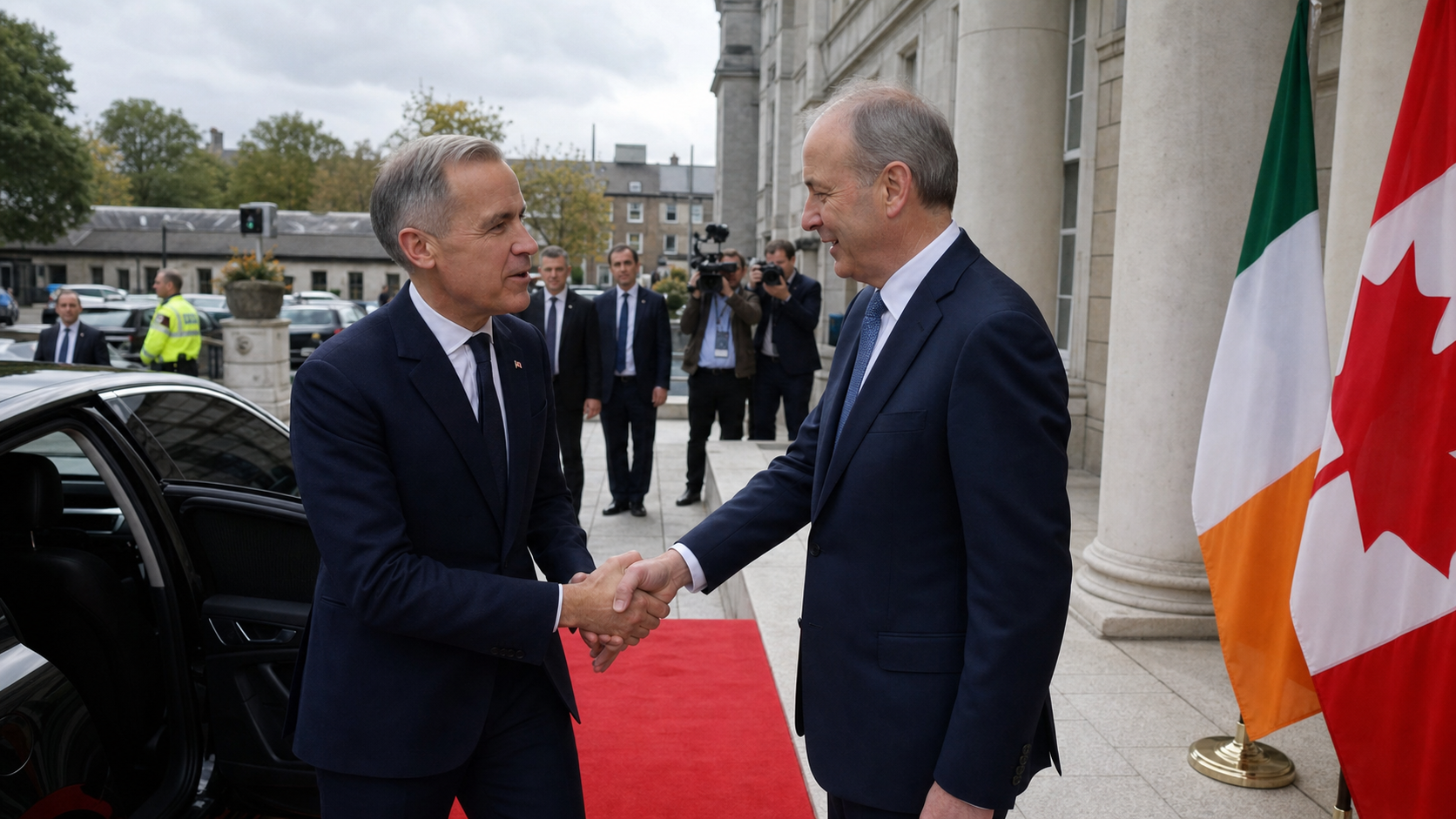
Canadian PM Mark Carney Arrives in Dublin for State Visit as Ireland and Canada Deepen Economic Ties
Canadian Prime Minister Mark Carney touched down in Dublin on Friday for a two-day state visit that will see him hold substantive talks with Taoiseach Micheál Martin on trade, investment, and the shared challenges facing open, rules-based democracies in an increasingly turbulent world. The visit is the first by a Canadian prime minister to Ireland in several years and reflects a deliberate effort by both governments to deepen a relationship that has historically been warm but underutilised.
Background
The relationship between Ireland and Canada is rooted in history. The Irish diaspora in Canada is one of the largest in the world, with millions of Canadians claiming Irish heritage — a legacy of the waves of emigration that followed the Great Famine and continued through much of the twentieth century. Cities such as Toronto, Montreal, and Vancouver have significant Irish-Canadian communities, and the cultural connections between the two countries remain strong.
But the relationship has not always been matched by the depth of economic and political engagement that the historical ties might suggest. Trade between Ireland and Canada, while growing, remains modest relative to Ireland's trade with the United States and the European Union. Investment flows in both directions have been increasing, driven partly by the presence of major Irish companies in Canada and Canadian companies in Ireland, but there is a widespread view in both governments that the economic relationship has significant untapped potential.
Mark Carney's election as Canadian prime minister earlier this year brought a new energy to the bilateral relationship. Carney, a former governor of both the Bank of Canada and the Bank of England, is a figure well known in Irish financial and economic circles, and his government has signalled a strong interest in deepening Canada's relationships with European partners at a time when the transatlantic relationship with the United States is under strain.
Key Developments
Carney was received at Government Buildings by Taoiseach Micheál Martin on Friday afternoon, with a formal programme of meetings and engagements scheduled for both Friday and Saturday. The talks are expected to cover a range of issues, including trade and investment, climate policy, international security, and the situation in Ukraine. Both leaders are expected to issue a joint statement at the conclusion of the visit.
On the economic front, the Irish government is keen to attract further Canadian investment into Ireland's technology, pharmaceutical, and financial services sectors. The Irish-Canadian Chamber of Commerce has been briefed on the visit and is expected to host a business roundtable on Saturday at which Irish and Canadian executives will discuss specific investment opportunities. The government is also exploring the possibility of a bilateral investment promotion agreement that would provide additional legal certainty for investors in both directions.
The Irish Independent reported that Carney's visit includes a meeting with President Michael D. Higgins at Áras an Uachtaráin, as well as engagements with representatives of the Irish-Canadian community and a visit to Trinity College Dublin, where he is expected to deliver a brief address on the theme of international economic cooperation.
Why It Matters
Carney's visit matters in the context of a broader shift in Ireland's diplomatic strategy. As the country prepares to assume the EU Council Presidency in the second half of 2026, it is actively seeking to strengthen its relationships with key partners outside the EU — particularly with countries that share Ireland's commitment to multilateralism, free trade, and the rules-based international order. Canada, under Carney's leadership, is a natural partner in this endeavour.
The visit also matters because of the specific economic moment both countries are navigating. Ireland's economy, despite the statistical distortions caused by multinational activity, is fundamentally strong but faces significant structural challenges — including over-reliance on a small number of large foreign companies and a housing crisis that is constraining growth. Canada faces its own economic challenges, including a housing affordability crisis that in some respects mirrors Ireland's. The two leaders are expected to exchange notes on policy approaches, with both governments interested in learning from each other's experience.
For the Irish diaspora in Canada, the visit is a welcome signal that the Irish government values and maintains its connections with the communities that have made Canada their home. The Diaspora Strategy 2026-2030, launched earlier this year, explicitly commits the government to deepening engagement with Irish communities abroad, and Carney's visit provides a high-profile opportunity to demonstrate that commitment.
Local Impact
In Dublin, the visit has generated significant interest in business and diplomatic circles. The Department of Enterprise, Trade and Employment has been working with IDA Ireland and Enterprise Ireland to identify specific investment and trade opportunities that could be advanced during the visit. Several Irish companies with operations in Canada have been invited to participate in the business roundtable, and a number of Canadian companies with Irish connections are expected to announce new investment commitments during the visit.
What's Next
The joint statement expected at the conclusion of the visit is likely to include commitments on trade promotion, investment facilitation, and cooperation on climate and security issues. The two governments are also expected to announce the establishment of a bilateral working group on housing policy, reflecting the shared interest in addressing affordability challenges. Carney will depart Dublin on Saturday evening, with his next stop on a European tour that also includes visits to Berlin and Paris. The Taoiseach is expected to visit Canada later in the year as part of a reciprocal engagement programme.