Cabinet to Consider €500 Million GPO Redevelopment Plans as Heritage and Modernisation Debate Looms
The Irish Cabinet is set to review proposals for the most significant redevelopment of the General Post Office on Dublin's O'Connell Street since the building was reconstructed following the destruction of the 1916 Rising, with the estimated cost of the project ranging from €200 million to €500 million depending on the scope of works ultimately approved. The plans, which will be presented to ministers for consideration of their scale, funding, and timeline, aim to modernise a building that is simultaneously one of Ireland's most important historical sites and one of its most underutilised public spaces — a tension that has defined debates about the GPO's future for decades.
Background
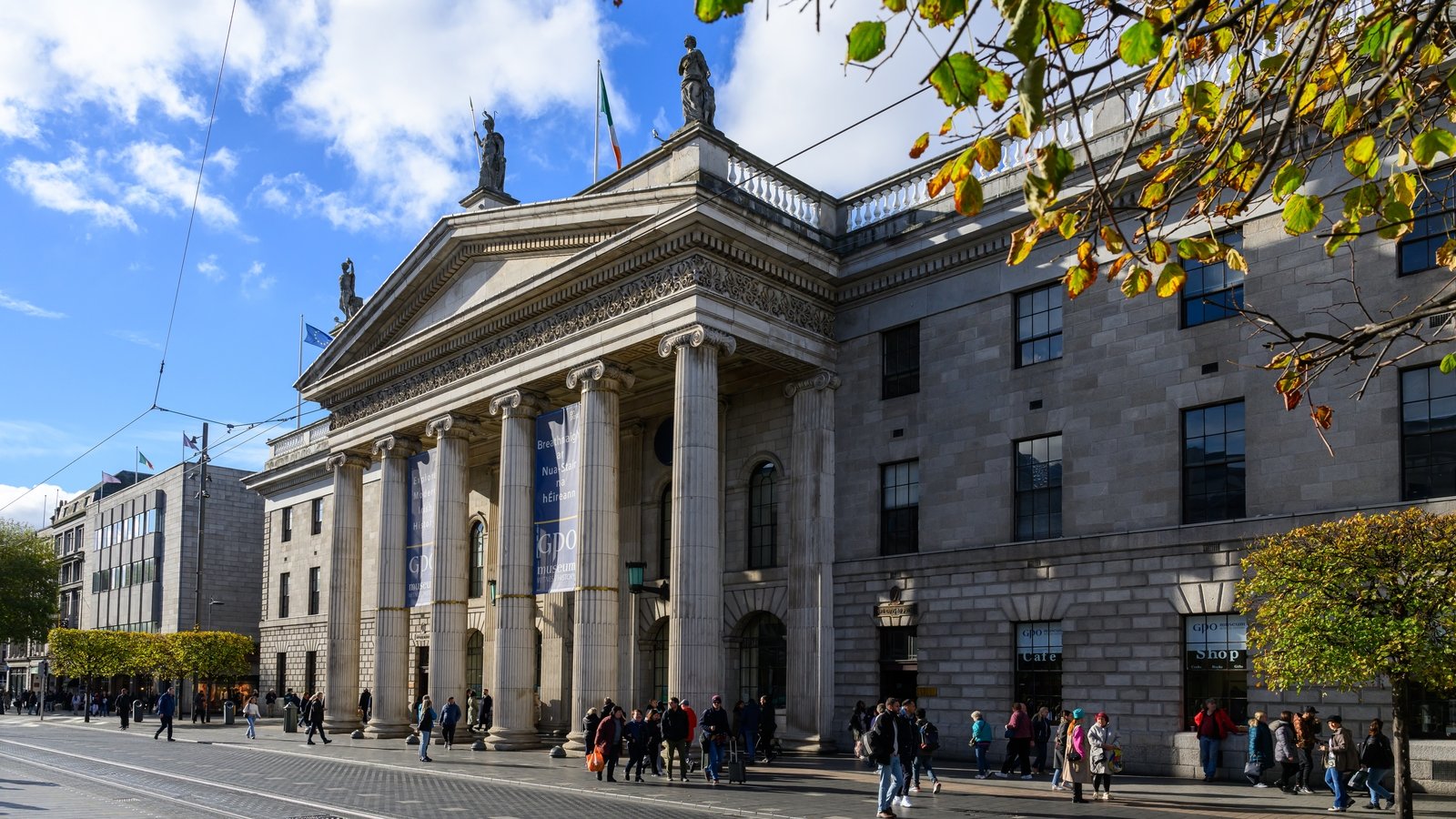
The General Post Office on O'Connell Street is one of the most recognisable buildings in Ireland, its neoclassical facade and the bullet holes still visible in its columns serving as a permanent reminder of the events of Easter Week 1916. The building served as the headquarters of the Provisional Government of the Irish Republic during the Rising, and it was from its steps that Patrick Pearse read the Proclamation of Independence. Its destruction in the fighting and subsequent reconstruction in the 1920s gave it a second life, but the building has struggled in recent decades to fulfil its potential as both a functioning public building and a site of national significance.
The GPO Witness History visitor experience, which opened in 2016 to mark the centenary of the Rising, has been a significant success, attracting hundreds of thousands of visitors each year and providing an immersive account of the events of Easter Week. But the visitor experience occupies only a small part of the building, and the rest of the GPO — including its vast public hall and the upper floors — has been used primarily for operational postal services that are a fraction of what they once were. The question of what to do with the building as a whole has been the subject of discussion for years, with various proposals put forward and none yet implemented.
The current proposals represent the most serious attempt yet to address the GPO's future in a comprehensive way. The involvement of the Cabinet signals that the government is prepared to commit significant public resources to the project, and the range of the cost estimate — from €200 million to €500 million — reflects the genuine uncertainty about what the final scope of works will be.
Key Developments
The proposals being presented to Cabinet are understood to include options for the redevelopment of the GPO's interior to create a significantly enhanced public and cultural space, the expansion of the visitor experience, the creation of new commercial and retail areas, and improvements to the building's energy efficiency and accessibility. The plans also address the wider context of O'Connell Street, which has been the subject of a long-running regeneration effort that has had mixed results.
The cost range of €200 million to €500 million reflects the different options under consideration. A more modest intervention — focused primarily on the visitor experience and the public hall — would be at the lower end of the range, while a comprehensive redevelopment of the entire building, including the upper floors and the surrounding streetscape, would be at the higher end. Ministers will be asked to indicate their preferred approach and to consider the funding mechanisms that would be used to finance the project.
An Taisce, the National Trust for Ireland, has indicated that it will be watching the proposals closely to ensure that any redevelopment respects the heritage character of the building and its setting. The organisation has previously expressed concern about developments on O'Connell Street that it felt were not in keeping with the street's historic character, and it is expected to engage actively with the consultation process that will follow the Cabinet's initial consideration of the proposals.
Why It Matters
The GPO is not just a building; it is a symbol. Its place in the Irish national consciousness is unique — a physical embodiment of the founding moment of the state, a site of pilgrimage for Irish people at home and in the diaspora, and a landmark that defines the character of Dublin's principal thoroughfare. Any decision about its future carries a weight that goes far beyond the architectural or commercial considerations that would apply to an ordinary building.
The scale of the proposed investment — up to €500 million — is also significant in the context of Ireland's public finances. While the state has the resources to fund a project of this scale, the decision to do so will inevitably invite scrutiny of the priorities it reflects. At a time when housing, healthcare, and infrastructure are all competing for public investment, the case for spending hundreds of millions on the redevelopment of a single building — however iconic — will need to be made clearly and convincingly.
The potential benefits, however, are real. A successfully redeveloped GPO could become one of the great cultural destinations of Europe, drawing visitors from around the world and generating significant economic activity for Dublin city centre. It could also serve as a catalyst for the wider regeneration of O'Connell Street, which has struggled to fulfil its potential as the capital's main street despite years of investment and planning.
Local Impact
For Dublin city centre, the GPO redevelopment represents a significant opportunity. O'Connell Street has faced persistent challenges in recent years, with high vacancy rates, antisocial behaviour, and a perception among some Dubliners that the street has lost its status as the city's premier public space. A major investment in the GPO, if well designed and well executed, could help to reverse that decline and restore O'Connell Street to its rightful place at the heart of the capital.
The construction phase of the project would also generate significant economic activity, with thousands of jobs in construction, engineering, and related trades. The longer-term economic impact — through tourism, retail, and the cultural economy — would depend on the quality of the final product, but the potential is substantial. Dublin City Council has been supportive of the redevelopment proposals and is expected to work closely with the government on the planning and implementation of the project.
What's Next
Following the Cabinet's initial consideration of the proposals, the government is expected to commission a detailed feasibility study and cost-benefit analysis of the different options. A public consultation process will follow, giving heritage groups, architectural bodies, business organisations, and the general public an opportunity to contribute their views. Planning permission will be required for any significant works, and the involvement of An Taisce and other heritage bodies in the planning process is expected to be significant. The government has indicated that it hopes to have a preferred option agreed and a funding plan in place by the end of 2026, with construction potentially beginning in 2027 or 2028.