Belfast Volunteers Who Fed and Sheltered Migrant Families During June Unrest Honoured at City Hall
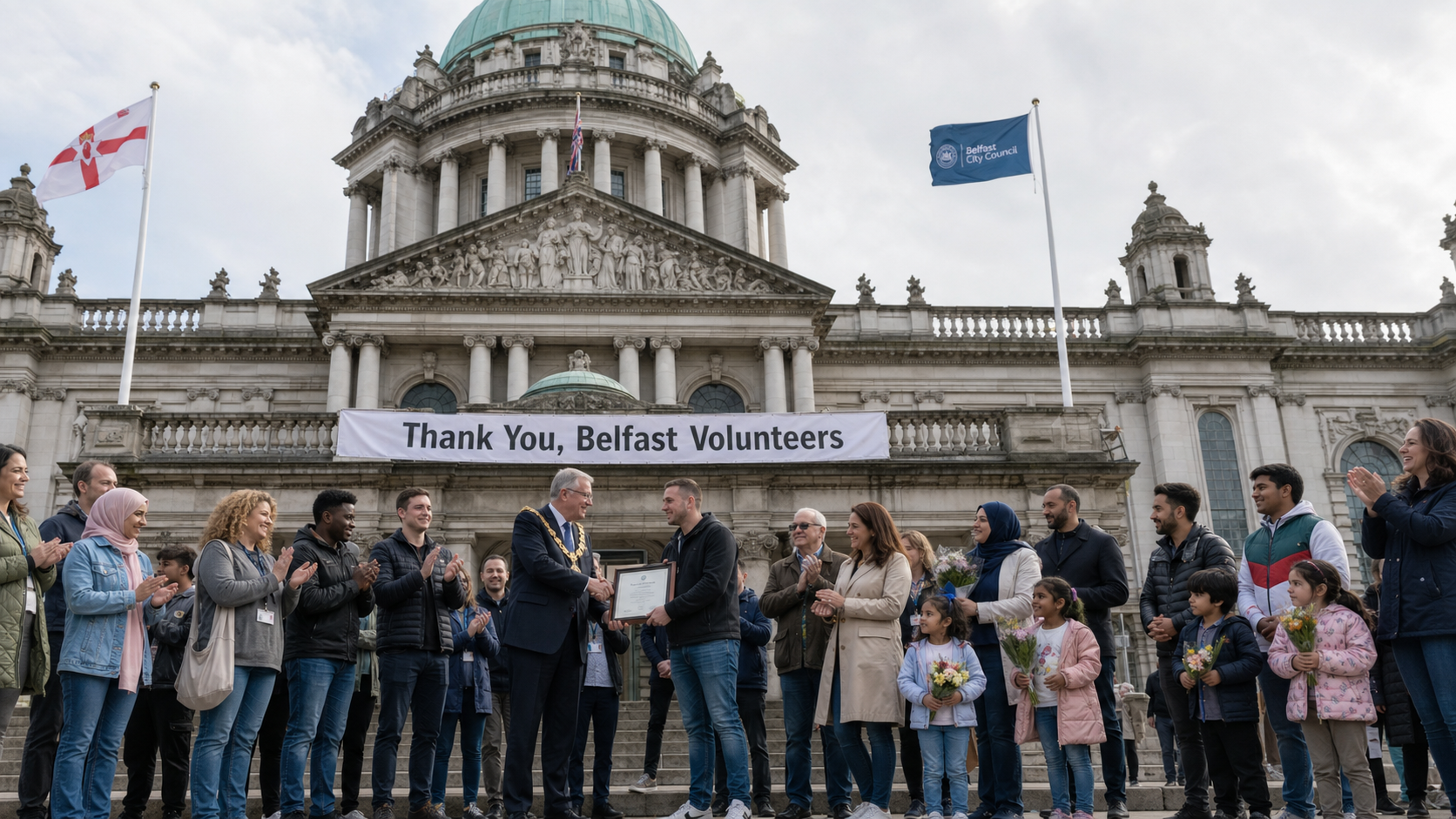
Hundreds of ordinary Belfast residents who mobilised within hours to feed, shelter, and protect migrant families during the violent disorder that swept parts of the city in mid-June have been formally recognised at a ceremony at Belfast City Hall, with community leaders describing their actions as among the most powerful expressions of civic solidarity the city has witnessed in a generation.
Background
When anti-immigrant protests erupted across several Belfast neighbourhoods in the second week of June 2026, the immediate human cost fell hardest on migrant families who found themselves unable to leave their homes, cut off from food and essential supplies, and in some cases physically displaced by arson attacks on properties. The disorder, which drew widespread condemnation from political leaders across the island, lasted several nights and left a trail of damage across parts of north and east Belfast.
Yet even as the violence unfolded, a parallel story was taking shape. Across the city, individuals with no prior connection to one another began reaching out through community WhatsApp groups, local Facebook pages, and word of mouth, asking a simple question: what do people need, and how can we help? Within twenty-four hours, an informal but remarkably effective volunteer network had taken shape, coordinating food deliveries, temporary accommodation, and emotional support for families who had been left isolated and frightened.
The response drew on Belfast's deep tradition of community activism, a tradition forged through decades of conflict and its aftermath. Organisations including Multi-Ethnic Sports and Cultures NI, which has worked for years to build bridges between Belfast's settled and newcomer communities, played a central coordinating role. But the scale of the response went far beyond any single organisation, drawing in individuals from every background and every part of the city.
Key Developments
Among those recognised at the City Hall ceremony was Jahswill Emmanuel of Multi-Ethnic Sports and Cultures NI, whose organisation served as a hub for volunteer coordination during the worst nights of the disorder. Emmanuel described the response as "humbling beyond words," noting that many of those who turned up to help had never previously been involved in community activism of any kind.
Student Ruchira Rangaprasad, who cooked more than one hundred individual meals over the course of three days and personally delivered them to families in north Belfast, was among those singled out for particular recognition. Rangaprasad, who is studying at Queen's University Belfast, said she had simply done what felt necessary. "People were scared to go to the shops. The least I could do was make sure they had something to eat," she said.
At a "Together Against Hate" rally held at Belfast City Hall on 13 June, speakers explicitly acknowledged the volunteers who had "evacuated people, provided meals, and reassured frightened communities," drawing a deliberate contrast between their actions and those of the rioters. The rally, which drew several thousand people, became a focal point for the city's response to the disorder and set the tone for the formal recognition that followed.
Belfast City Council has confirmed that a community resilience fund, drawing on existing council resources, will be established to support grassroots organisations that played a role in the response. The fund is expected to be operational by September 2026.
Why It Matters
The volunteer response to the June disorder matters not simply as a feel-good counterpoint to the violence, but as a concrete demonstration of what civic infrastructure looks like when it functions at its best. Belfast has spent more than two decades building community relations structures in the aftermath of the Troubles, and while those structures are often criticised as bureaucratic and underfunded, the events of June 2026 showed that the underlying culture of community solidarity they have helped to nurture is real and resilient.
This is the third time in the past decade that Belfast's volunteer networks have mobilised at scale in response to a crisis — the previous occasions being the 2017 flooding in the Ravenhill area and the early weeks of the Covid-19 pandemic in 2020. Each time, the response has been faster and better coordinated than the last, suggesting that the city's informal civic infrastructure is genuinely strengthening over time.
For the migrant communities at the centre of the June disorder, the volunteer response carried a significance that went beyond the practical. In a moment when they had been made to feel unwelcome and unsafe, the sight of strangers arriving at their doors with food and offers of help was, as one community leader put it, "a reminder that Belfast is bigger than its worst moments."
Local Impact
The practical impact of the volunteer effort was felt most acutely in the north Belfast neighbourhoods of New Lodge and Tiger's Bay, and in parts of east Belfast around the Newtownards Road, where the disorder was most concentrated. Families in these areas received food parcels, nappy supplies, and medication deliveries organised through the volunteer network. Several families were temporarily housed with local residents after their own accommodation was damaged or made unsafe.
The Belfast Health and Social Care Trust confirmed that its community mental health teams have been deployed to provide follow-up support to families affected by the disorder, with particular attention to children who witnessed the violence. The Trust has also been working with voluntary sector partners to ensure that families who may be reluctant to engage with statutory services can access support through trusted community intermediaries.
What's Next
Belfast City Council's community resilience fund is expected to open for applications in September 2026, with grants of between £2,000 and £20,000 available to community organisations. A broader review of the city's community relations infrastructure, commissioned by the Executive Office, is due to report by the end of the year. The Together Against Hate coalition has announced plans for a follow-up community event in October, designed to build on the solidarity demonstrated during the June crisis and develop longer-term connections between Belfast's diverse communities.