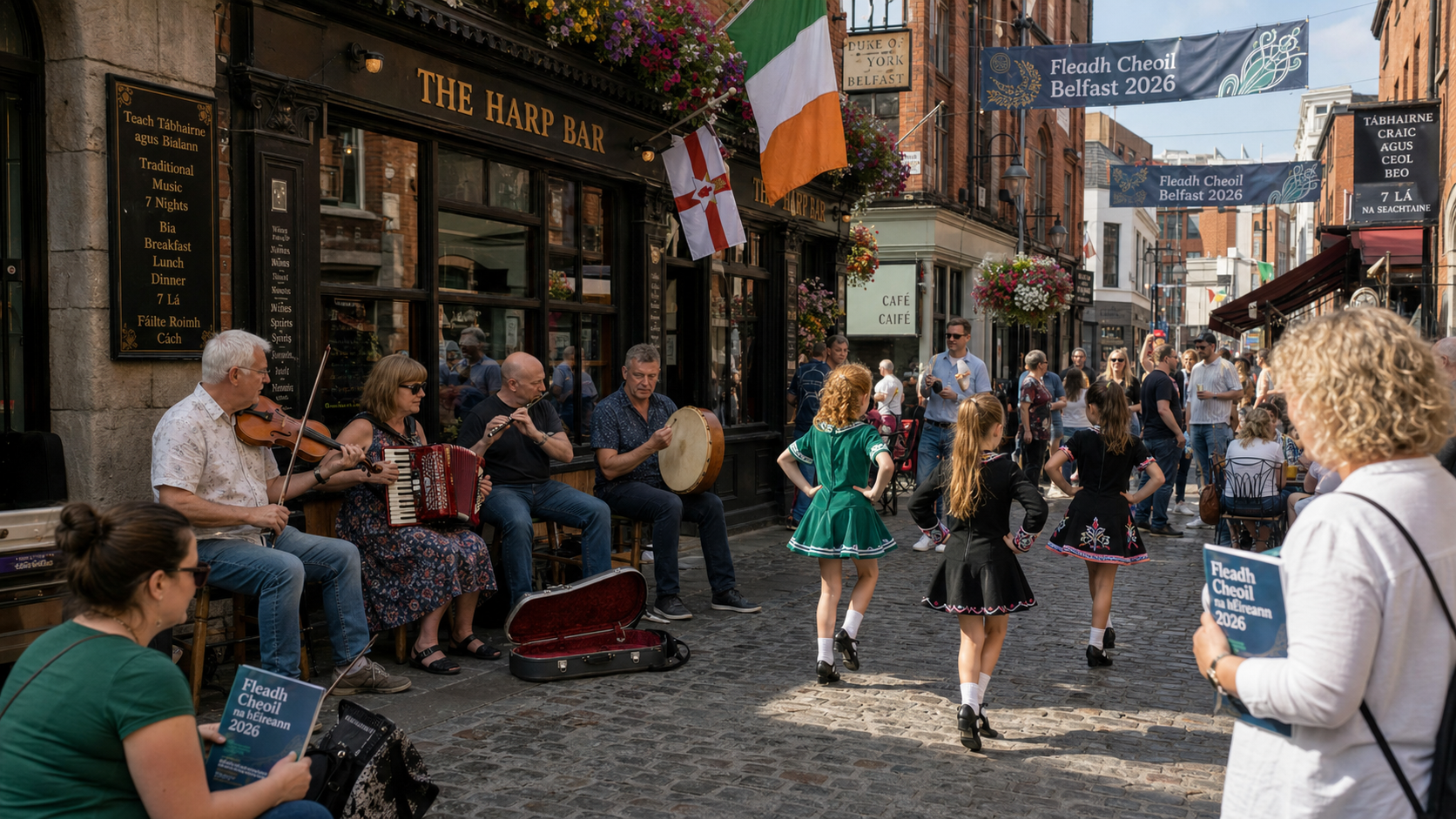
Belfast to Host Fleadh Cheoil na hÉireann for First Time as Traditional Music Renaissance Reaches City
Belfast has been confirmed as the host city for Fleadh Cheoil na hÉireann in August 2026, marking the first time in the festival's 75-year history that the world's largest gathering of traditional Irish music, song, and dance will be held in the city — a landmark moment that local musicians and cultural leaders are describing as a defining statement about Belfast's place at the heart of the Irish traditional music renaissance.
Background
Fleadh Cheoil na hÉireann — the All-Ireland Festival of Music — is the pinnacle of the traditional Irish music calendar. Founded in 1951 by Comhaltas Ceoltóirí Éireann, the organisation dedicated to the promotion and preservation of Irish traditional music, the Fleadh has grown from a modest gathering of musicians in Mullingar to a week-long festival that attracts hundreds of thousands of visitors and is broadcast to audiences across the world. The festival encompasses competitions across dozens of instruments and vocal categories, as well as sessions, concerts, céilís, and street performances that transform the host town or city into a living celebration of Irish musical culture.
The Fleadh has been held in towns and cities across Ireland and, on one occasion, in the United States, but it has never previously been hosted in Belfast. The city's complex political history — and the association of traditional Irish music with nationalist and republican identity — made Belfast an unlikely host for much of the festival's history. The fact that it is now being held in the city is a measure of how much has changed in Northern Ireland since the Good Friday Agreement, and of the growing confidence of Belfast's traditional music community.
Belfast has developed a vibrant traditional music scene in recent decades, centred on venues like the Duke of York, the Sunflower Bar, and the Belfast TradFest — an annual festival that has been growing steadily in scale and ambition. The city's traditional music community is diverse and inclusive, drawing musicians from both communities and from the city's growing international population.
Key Developments
The confirmation of Belfast as the 2026 Fleadh host was announced by Comhaltas Ceoltóirí Éireann following a competitive bidding process in which several towns and cities across Ireland submitted proposals. Belfast's bid was supported by Belfast City Council, Tourism NI, and a coalition of traditional music organisations from across the city and the wider north of Ireland.
Local flautist Brian Finnegan, one of the most respected traditional musicians in Ireland and a Belfast native, described the announcement as a "historic moment" for the city's musical community. "Belfast has always had a deep connection with traditional music, even if that connection has not always been visible or celebrated," he said. "The Fleadh coming to Belfast is a statement that this city is at the heart of the Irish traditional music renaissance — not on the margins of it."
The festival is expected to draw between 400,000 and 500,000 visitors to Belfast over the course of the week, generating significant economic activity for the city's hospitality, retail, and transport sectors. Tourism NI has estimated the economic impact at over £30 million, making it one of the most significant tourism events in Northern Ireland's history.
The Fleadh will be held in the last week of August, with the main competition days taking place over the weekend of August 22-23. The festival will use venues across the city, including the SSE Arena, the Ulster Hall, and a series of outdoor stages in the city centre. The Belfast TradFest, which runs from July 26 to August 2, will serve as a warm-up event, building the city's traditional music atmosphere in the weeks before the main festival.
Why It Matters
The Fleadh coming to Belfast matters at multiple levels. At the most immediate level, it is a major economic and tourism event that will bring significant benefits to the city. But its cultural and symbolic significance goes much deeper than the economic impact.
For the traditional music community in Belfast and across Northern Ireland, the Fleadh represents a validation of their work and their identity. Traditional music has sometimes been seen as a cultural marker of one community rather than a shared heritage, and the Fleadh's arrival in Belfast challenges that perception. The festival's inclusive ethos — which welcomes musicians of all backgrounds and traditions — is a powerful statement about the universality of Irish musical culture.
For Belfast's broader cultural identity, the Fleadh is another step in the city's remarkable transformation from a place associated primarily with conflict and division to a vibrant, confident cultural capital. The city has invested heavily in cultural infrastructure in recent years — from the Titanic Belfast museum to the MAC arts centre to the Grand Central Station development — and the Fleadh is a further affirmation of that cultural ambition.
Local Impact
The practical preparations for the Fleadh are already under way, with Belfast City Council and Comhaltas working together to develop the festival programme and to put in place the infrastructure needed to host hundreds of thousands of visitors. The city's hotels are already reporting strong advance bookings for the festival week, and the hospitality sector is anticipating one of its busiest periods in years.
For traditional musicians in Belfast and across Northern Ireland, the Fleadh represents an opportunity to compete at the highest level of their art form on home ground. The competition categories cover every instrument in the traditional music canon — from fiddle and uilleann pipes to tin whistle, flute, and bodhrán — as well as singing, dancing, and storytelling. Musicians from across the north of Ireland have been preparing for the competitions for months, and the standard is expected to be exceptionally high.
What's Next
Comhaltas Ceoltóirí Éireann will publish the full festival programme in the coming weeks, including details of the competition schedule, the concert programme, and the céilí and session events. Tickets for the main concerts and events will go on sale in mid-July, with free events and street performances available throughout the festival week. Belfast City Council has established a dedicated Fleadh coordination team to manage the logistics of the event, and Translink has been working with the council to develop a transport plan that will manage the expected influx of visitors.

/https://tf-cmsv2-smithsonianmag-media.s3.amazonaws.com/filer_public/2a/f1/2af1d2f8-4d99-4e0d-8c0f-c7ec6063487c/gettyimages-1233439729.jpg)