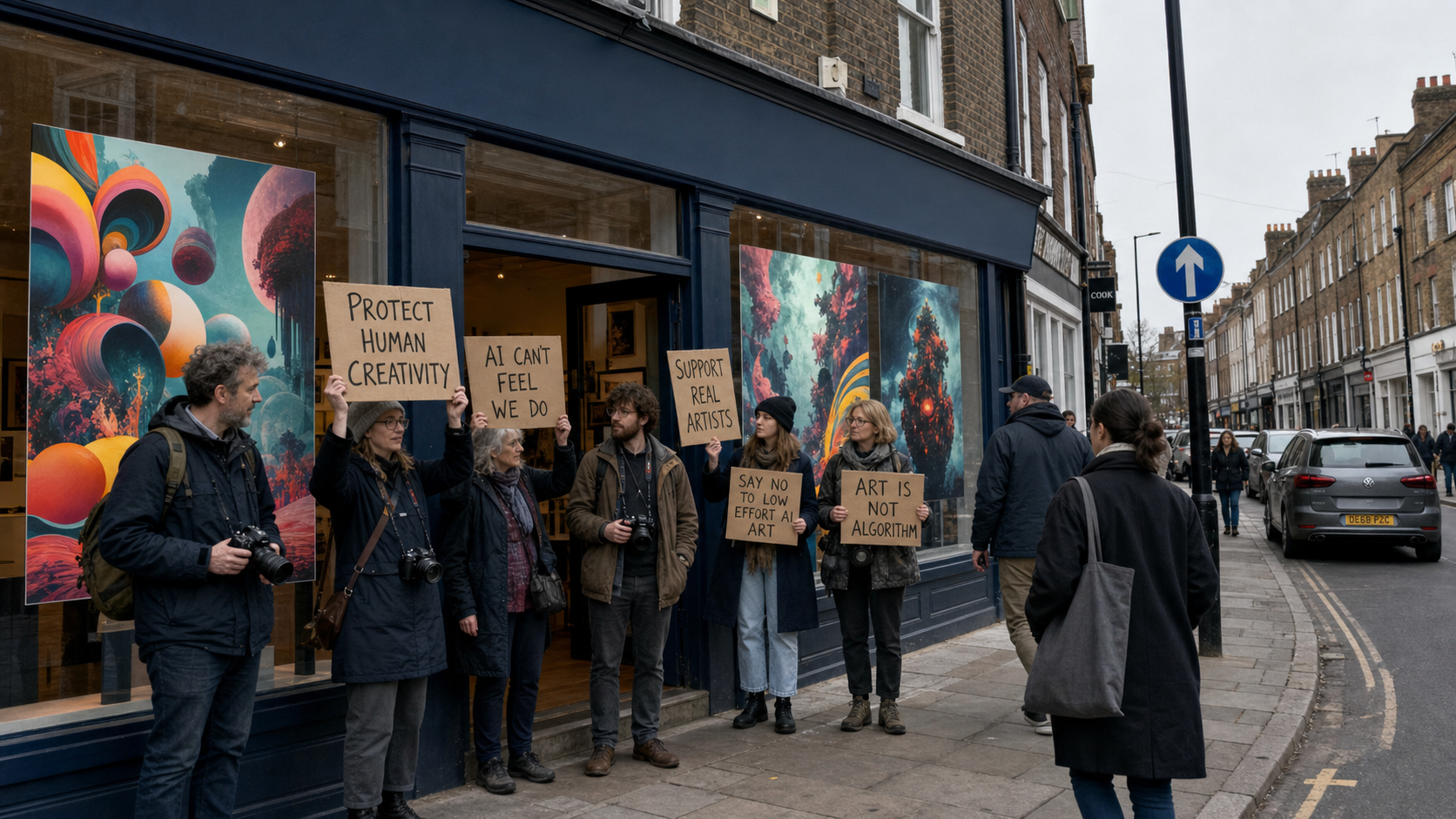
Belfast Exposed Gallery Stands Firm on AI Art Exhibition Amid Photographer Backlash
Belfast Exposed gallery has defended its decision to include AI-generated imagery in its Beneath the Surface exhibition, standing firm in the face of fierce criticism from local photographers and artists who have labelled the work "AI slop," accused the gallery of devaluing human creative labour, and called for a "No AI" policy at one of Northern Ireland's most respected photography institutions.
Background
Belfast Exposed is one of Northern Ireland's most significant photography organisations, with a history stretching back to the 1980s and a reputation for supporting emerging talent and challenging work. The gallery, based in the Cathedral Quarter, has long been a focal point for Belfast's photographic community, and its exhibitions have consistently pushed at the boundaries of what photography can be and do. The decision to include AI-generated imagery in the Beneath the Surface exhibition — a showcase of work by nine MFA photography graduates from Ulster University — was therefore a significant departure from the gallery's traditional focus on lens-based work.
The specific work at the centre of the controversy is a series titled Galatea by MFA graduate Jonny Sheridan, which explores the "perils of AI" through the narrative of a man and his robotic AI partner. Sheridan has defended the work as a serious artistic investigation of questions about AI alignment with human values and the broader impacts of the technology on society, arguing that each image underwent extensive rounds of prompting, revision, and consideration regarding composition, lighting, and symbolism.
The backlash from the photography community was swift and intense. Critics labelled the images "AI slop" and argued that their presence in a photography gallery was an insult to traditional artists. The core objections centred on the ethical dimension of generative AI — the fact that AI image-generation systems are trained on vast datasets of existing artists' work, often without permission or compensation — and on the broader question of whether AI-generated images can legitimately be described as photography at all.
Key Developments
Belfast Exposed, led by CEO Deirdre Robb, has maintained throughout the controversy that the gallery's purpose is to provide a platform for contemporary photography and to foster critical dialogue on challenging topics. The gallery issued a public statement in late July clarifying that the themes and approaches in the exhibition belonged to the individual artists, and hosted a public panel discussion titled AI, Art and Society on July 24, which brought together the gallery's CEO, local politicians, and the director of the Ulster University MFA programme.
Local artist Chloe Austin and photographer Brendan Harkin have been among the most vocal critics. Austin argued that AI "completely devalues creative labour" and contributes to the erosion of creative jobs. Harkin raised additional concerns about the environmental impact of AI, noting the significant water consumption and energy requirements of the data centres used to power generative AI systems. Both have called for Belfast Exposed to adopt a formal "No AI" policy for future exhibitions.
Why It Matters
The Belfast Exposed controversy is a microcosm of a debate that is playing out across the arts world globally. The question of whether AI-generated imagery belongs in a photography gallery is not merely a technical one — it goes to the heart of what photography is, what art is, and what galleries are for. Photography has always been a medium that sits at the intersection of technology and human vision, and the history of the form is full of debates about what counts as a "real" photograph. But the specific challenge posed by generative AI is different in kind from previous technological disruptions: it is not just a new tool for photographers to use, but a system that can produce images without a photographer at all.
For Northern Ireland's arts community, the controversy also raises questions about the responsibilities of publicly funded institutions. Belfast Exposed receives funding from the Arts Council of Northern Ireland, and some critics have argued that public money should not be used to platform work that undermines the livelihoods of the artists the arts council is supposed to support. The gallery has rejected this framing, arguing that critical engagement with difficult questions is precisely what publicly funded arts institutions should be doing.
Local Impact
The controversy has generated significant attention for Belfast Exposed and for the Beneath the Surface exhibition, with visitor numbers reportedly higher than for previous shows. Whether that attention translates into a productive conversation about AI and creativity, or simply into conflict and division within the photographic community, remains to be seen. For the Cathedral Quarter's arts scene — which includes the Oh Yeah Music Centre, the Black Box, and a range of galleries and studios — the debate has been a reminder of the vitality and the tensions that characterise a genuinely engaged creative community. The Arts Council of Northern Ireland has indicated it is monitoring the situation and will consider the issues raised in the context of its broader policy on AI and the arts.
What's Next
The Beneath the Surface exhibition continues at Belfast Exposed through the remainder of August. The gallery has indicated it will publish a formal response to the concerns raised by the photography community before the exhibition closes, and has committed to ongoing dialogue about the role of AI in photography and the arts. The Arts Council of Northern Ireland is expected to develop a policy position on AI-generated art in the coming months, which will have implications for funding decisions across the sector. The debate is unlikely to be resolved quickly — the questions it raises are fundamental ones that the arts world will be grappling with for years to come.