Belfast Brothers Pedal 3,800 Miles Across America in Tribute to Brother Bedridden by MS
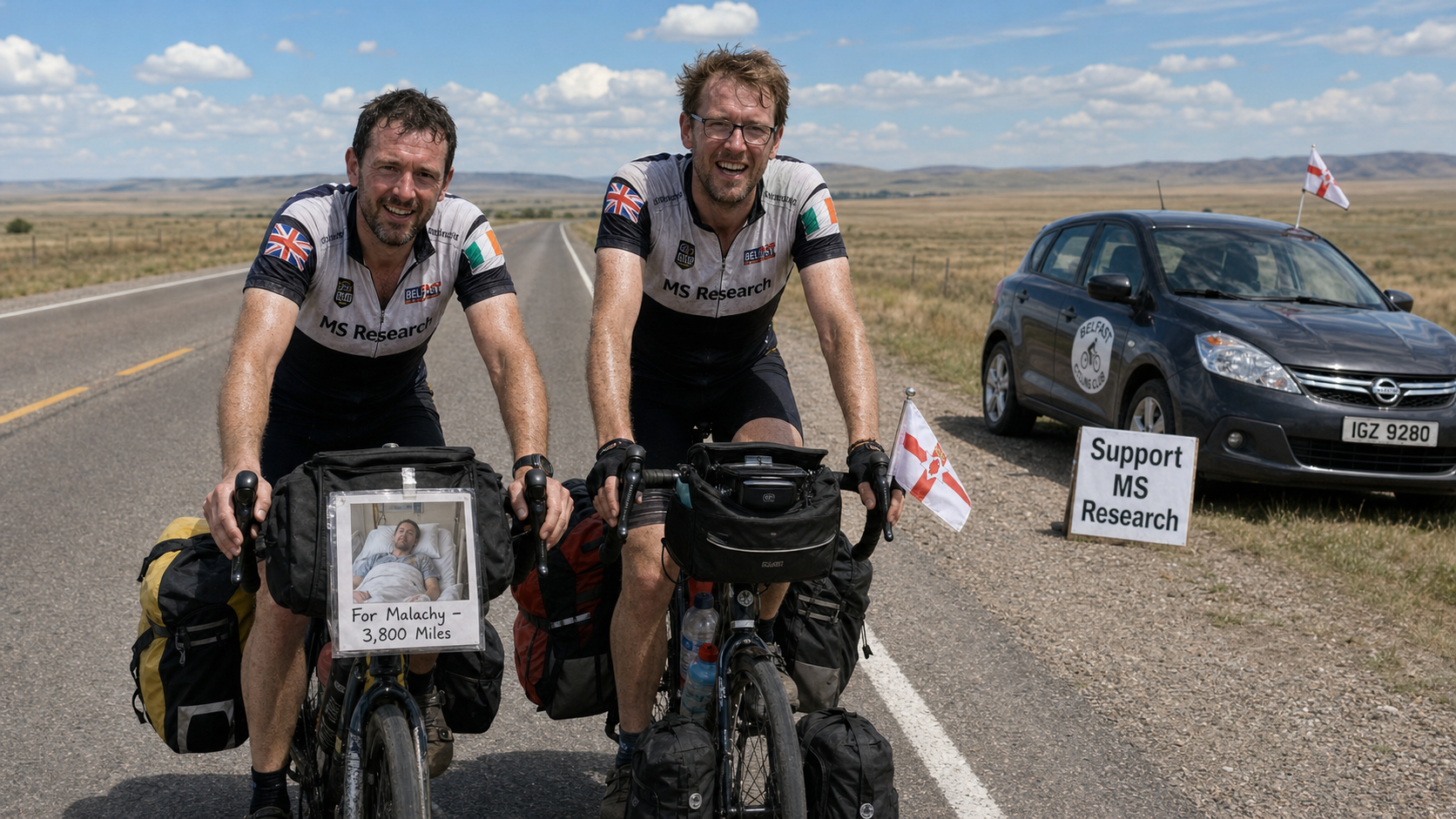
Two brothers from Belfast are undertaking one of the most gruelling fundraising challenges in recent Irish sporting memory — a 3,800-mile cross-country cycle across the United States — to raise money for multiple sclerosis research in honour of their brother Malachy, who has been bedridden for years after living with the condition for four decades. Michael O'Hare, 58, and Eamonn O'Hare, 62, have already raised approximately $120,000 and are matching every donation received, dollar for dollar.
Background
Multiple sclerosis is a chronic, often disabling disease of the central nervous system that affects an estimated 9,000 people in Northern Ireland and around 16,000 in the Republic of Ireland, making the island of Ireland one of the highest-prevalence regions in the world. The condition, which disrupts the flow of information between the brain and the body, can progress in a variety of ways — from relapsing-remitting episodes to the kind of severe, progressive deterioration that has left Malachy O'Hare, 61, largely confined to his bed after four decades of living with the disease.
For Michael and Eamonn, the decision to undertake a transcontinental cycle was not made lightly. Both men are in their late fifties and early sixties, and neither had previously attempted anything approaching this scale of endurance challenge. Michael, a retired head of HR, began planning the route months in advance, identifying a path that would take him through 15 American states over approximately 48 days. The cause, however, was never in doubt: the brothers wanted to direct funds to an award-winning MS researcher at the University of Pennsylvania whose work they believe holds genuine promise for future treatments.
The O'Hare family's connection to MS spans generations. Watching Malachy's condition deteriorate over the course of four decades has given both brothers an intimate understanding of the disease's cruelty — and a fierce determination to do something meaningful in response.
Key Developments
Michael O'Hare set off from Portland, Oregon, on 20 August 2026, beginning a solo journey that would take him east across the Rocky Mountains, the Great Plains, and the Appalachians before finishing in Portland, Maine, on 6 October 2026. Eamonn joined the ride in Minnesota, cycling the final 1,500 miles alongside his brother in a show of solidarity that has captured the imagination of supporters back home in Belfast and across the Irish diaspora in the United States.
The brothers have pledged to match all donations received, effectively doubling the impact of every contribution. As of mid-September 2026, the total raised stands at approximately $120,000 — equivalent to around £90,000 — a figure that has exceeded the family's initial expectations and drawn attention from MS charities on both sides of the Atlantic. The funds are earmarked specifically for the University of Pennsylvania researcher, whose work focuses on neuroprotection and the mechanisms by which MS damages myelin, the protective sheath surrounding nerve fibres.
Updates from the road, shared via social media, have attracted a growing following, with supporters from Belfast's north and west — where the O'Hare family has deep roots — tracking the brothers' progress daily. Local GAA clubs and community groups have organised fundraising events in parallel, adding to the total.
Why It Matters
The O'Hare brothers' challenge speaks to something fundamental about the Irish community response to illness — the instinct to act, to do something tangible in the face of a condition that medicine has not yet conquered. MS research is chronically underfunded relative to the scale of the problem, particularly in Northern Ireland, where the prevalence rate is among the highest in Europe. The reasons for this geographic clustering remain poorly understood, though theories point to vitamin D deficiency, genetic factors, and environmental triggers. Whatever the cause, the human cost is enormous, and the O'Hares' fundraising effort is a reminder that community action can make a real difference to the pace of scientific progress.
The decision to direct funds to a specific researcher rather than a general charity fund is also notable. It reflects a growing trend among major donors and fundraisers to seek direct, traceable impact — to know that their money is funding a particular experiment or a particular scientist's salary, rather than disappearing into an administrative overhead. For the University of Pennsylvania researcher in question, the O'Hare contribution represents a significant injection of support at a critical stage of their work.
Local Impact
In Belfast, the brothers' journey has resonated particularly strongly in the communities of north and west Belfast, where MS has touched many families. The MS Society Northern Ireland, which operates support groups across the city and in towns including Derry, Newry, and Antrim, has highlighted the O'Hare challenge as an example of the kind of grassroots fundraising that sustains research and community services alike. Translink staff at Belfast's Europa Bus Centre and Great Victoria Street Station have reportedly been following the brothers' progress, with several colleagues making personal donations. The story has also been picked up by schools in the Ardoyne and Andersonstown areas, where teachers have used it as a lesson in perseverance and community solidarity.
What's Next
Michael and Eamonn O'Hare are expected to complete their transcontinental journey in Portland, Maine, on 6 October 2026. A homecoming event in Belfast is being planned for later that month, with details to be confirmed. Donations to the brothers' fundraising campaign remain open, and the family has indicated that any funds raised above the initial target will be directed to MS research in Northern Ireland specifically. The University of Pennsylvania researcher is expected to publish preliminary findings from their current project in early 2027.