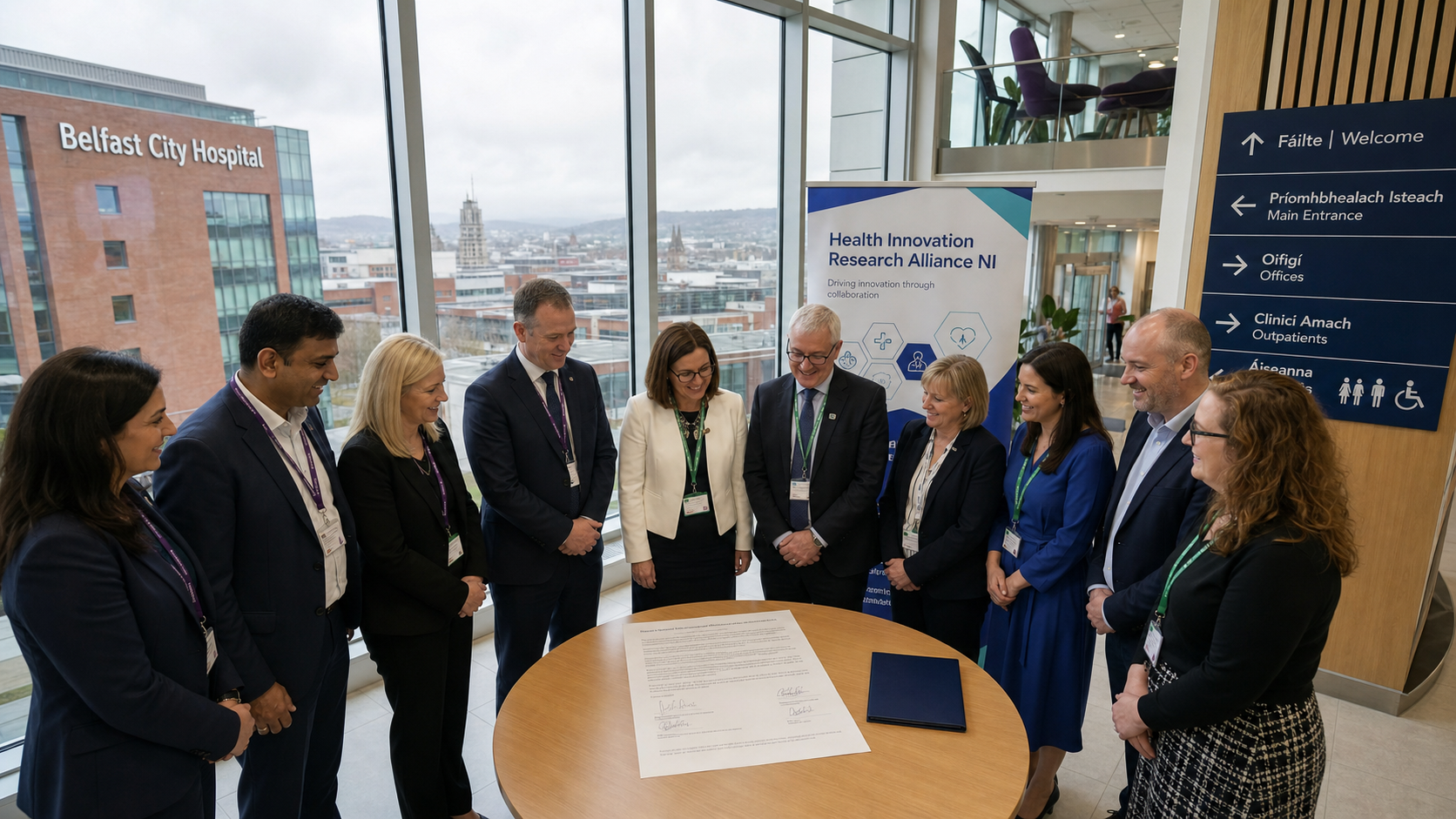
AstraZeneca Signs Landmark Partnership with Northern Ireland to Transform Healthcare and Establish Region as Life Sciences Testbed
Northern Ireland has entered a "first-of-its-kind" strategic partnership with pharmaceutical giant AstraZeneca in a collaboration that aims to transform healthcare delivery in the region and establish Northern Ireland as a global testbed for life sciences and digital health innovation. The partnership, which involves the Department of Health, the Department for the Economy, and the Health Innovation Research Alliance NI, was announced on Wednesday and has been described by government officials as "crucial" to the Executive's Reset Plan for healthcare transformation. The initiative will focus on chronic conditions and on shifting care from acute hospitals into community settings.
Background
AstraZeneca is one of the world's largest pharmaceutical companies, with a particular strength in oncology, cardiovascular disease, and respiratory conditions. The company has a significant presence in Ireland — its global biologics manufacturing facility in Dún Laoghaire is one of the largest pharmaceutical manufacturing sites in the country — and has been expanding its engagement with the Irish and Northern Irish healthcare systems in recent years. The company's interest in Northern Ireland reflects both the region's strengths in life sciences research and the opportunity to work with a relatively small, integrated health system that can serve as a testing ground for new approaches to care delivery.
The Health Innovation Research Alliance NI, known as HIRANI, is a body that brings together the health and social care trusts, universities, and industry partners to support health research and innovation in Northern Ireland. HIRANI has been instrumental in developing Northern Ireland's reputation as a centre for health research, drawing on the region's unique assets including its integrated health and social care system, its strong universities — Queen's University Belfast and Ulster University — and its relatively small and well-defined population, which makes it an attractive location for clinical trials and health services research.
The Northern Ireland health system is facing significant challenges, including long waiting lists, an ageing population, and the need to manage increasing numbers of people with chronic conditions such as diabetes, heart disease, and respiratory illness. The traditional model of care, which relies heavily on acute hospital services, is widely recognised as unsustainable, and there is broad consensus that the future of healthcare lies in shifting more care into community settings and using technology to support people to manage their own health.
Key Developments
The AstraZeneca partnership, reported by the Newsletter on Wednesday, is described as a "first-of-its-kind" collaboration that goes beyond the typical relationship between a pharmaceutical company and a health system. Rather than simply supplying medicines, AstraZeneca will work with the Department of Health, the Department for the Economy, and HIRANI to develop and test new models of care delivery, with a particular focus on chronic conditions and on the use of digital health technologies to support patients in the community.
The partnership is aligned with the Stormont Executive's Reset Plan for healthcare, which sets out a vision for transforming the Northern Ireland health system over the coming decade. The Reset Plan identifies the shift from hospital-based to community-based care as a central priority, and the AstraZeneca partnership is intended to provide both the expertise and the resources to accelerate this transition. Government officials have described the partnership as "crucial" to the delivery of the Reset Plan's ambitions.
The specific projects to be developed under the partnership have not yet been announced, but they are expected to include clinical trials of new treatments for chronic conditions, the development of digital health tools to support patient self-management, and research into the most effective models of community-based care. The partnership is expected to generate significant research activity at Queen's University Belfast and Ulster University, as well as commercial opportunities for Northern Ireland's growing life sciences sector.
Why It Matters
The AstraZeneca partnership is significant for several reasons. First, it represents a major vote of confidence in Northern Ireland as a location for life sciences innovation, from one of the world's leading pharmaceutical companies. Second, it has the potential to accelerate the transformation of the Northern Ireland health system in ways that could benefit patients across the region. Third, it creates opportunities for economic development in the life sciences sector, which is one of the most important and fastest-growing parts of the Northern Ireland economy. The partnership also has implications for the broader debate about Northern Ireland's economic future: the ability to attract major international companies to invest in research and innovation in the region is a key part of the case for Northern Ireland's economic viability, and the AstraZeneca deal strengthens that case considerably.
Local Impact
The impact of the AstraZeneca partnership will be felt across the Northern Ireland health system, from the five health and social care trusts that will be involved in implementing the new models of care to the universities and research institutions that will conduct the associated research. For patients with chronic conditions — who represent a large and growing proportion of the population — the partnership offers the prospect of better, more personalised care delivered closer to home. For the life sciences sector in Northern Ireland, which includes companies based in Belfast, Antrim, and other parts of the region, the partnership creates opportunities for collaboration with AstraZeneca and for the development of new products and services. The Department for the Economy has indicated that it will work with Invest NI to maximise the economic benefits of the partnership for Northern Ireland businesses.
What's Next
The detailed terms of the AstraZeneca partnership are expected to be published in the coming weeks, along with a programme of specific projects and initiatives to be developed under the collaboration. The first projects are expected to begin in the autumn of 2026, with initial results anticipated within twelve to eighteen months. A formal review of the partnership's progress is planned for 2028, which will assess the impact on patient outcomes, research activity, and economic development. The Department of Health has indicated that it will publish regular updates on the partnership's progress, and that the findings of the research conducted under the collaboration will be made publicly available.