Annals of Inisfallen Returns to Ireland After 250 Years as Free UCC Exhibition Opens to Public
One of Ireland's most significant medieval manuscripts, the Annals of Inisfallen, has returned to the island for the first time in over four decades, going on free public display at the Glucksman Gallery in University College Cork in a landmark cultural homecoming that has drawn scholars and history enthusiasts from across the country.
Background
The Annals of Inisfallen is a manuscript of extraordinary historical importance, consisting of 57 vellum leaves that together constitute one of the most comprehensive records of early Irish history in existence. Written in both Latin and Irish, the document was compiled by approximately 30 different scribes over several centuries, with contemporary entries running from the 11th to the 14th century. Its contents span Irish life, conflict, ecclesiastical affairs, and notable events from the pre-Christian era through to the late medieval period.
The manuscript is believed to have been initially copied at the monastery of Lismore in County Waterford, drawing on source materials from Clonmacnoise in County Offaly and Emly in County Tipperary. In the 12th century, it was relocated to the island monastery of Inisfallen on Lough Leane in Killarney, where the records were continued by successive monastic scribes. The manuscript eventually passed into the collection of the historian Sir James Ware and later Richard Rawlinson, whose bequest placed it in the Bodleian Library at the University of Oxford, where it has been housed for more than 250 years.
The exhibition, titled "Recording the Past: The Annals of Inisfallen and the Making of Irish History," is a collaborative effort between UCC and the Bodleian Library, supported by businessman Brian McCarthy of Fexco, the National Parks and Wildlife Service, the National Monuments Service, Kerry County Council, and the Cork University Foundation. It opened on 2 September 2026 and runs until 1 November 2026.
Key Developments
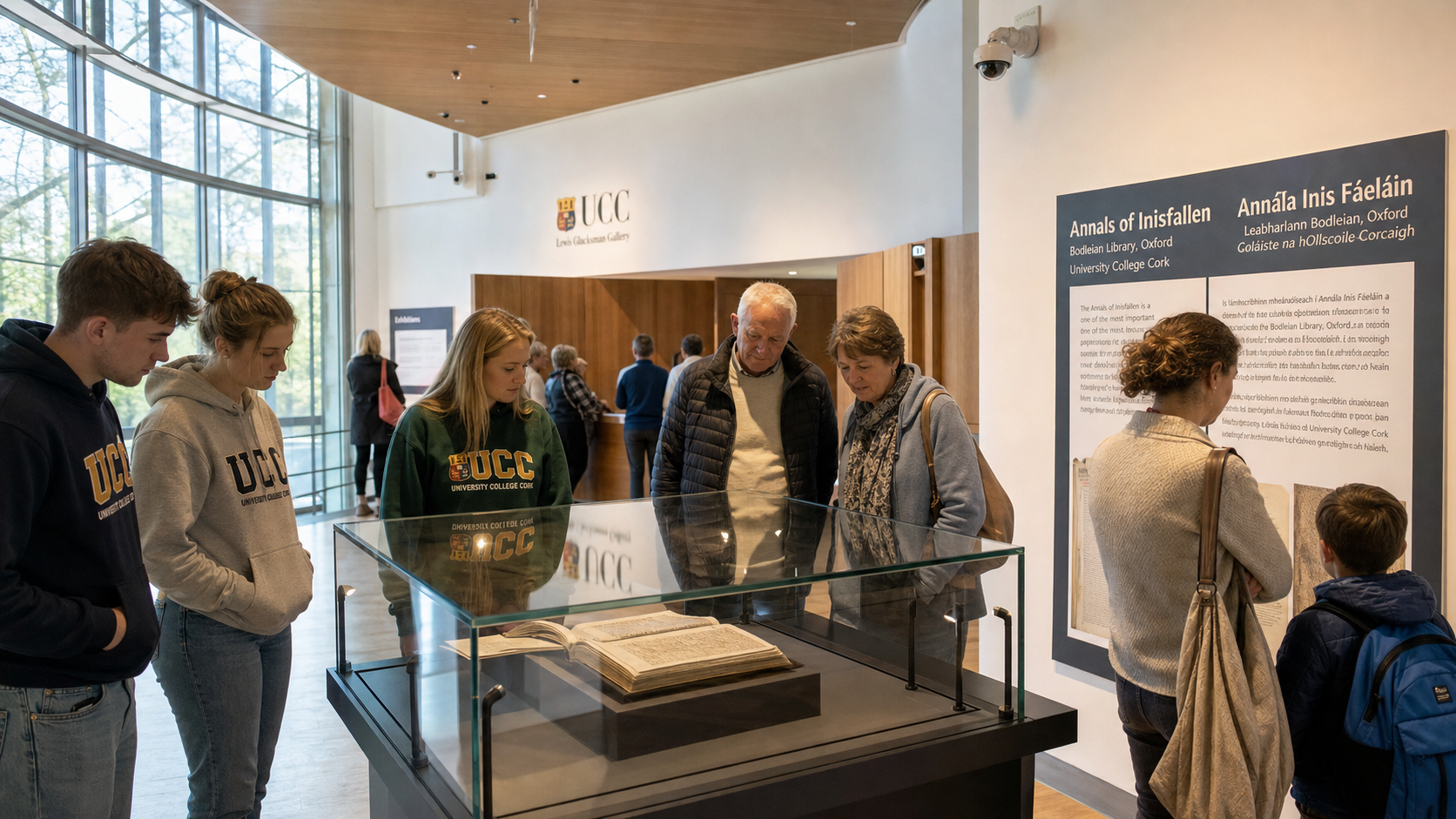
The original manuscript is mounted in a glass case at the Glucksman Gallery, allowing visitors to view the vellum leaves and the distinctive handwriting of the medieval scribes who compiled the record. Alongside the original, visitors have access to a high-resolution digital version of the full text, enabling closer examination of individual entries and annotations. Admission to the exhibition is free, a decision that organisers say reflects a commitment to making the manuscript accessible to as wide an audience as possible.
The return of the Annals to Ireland — even temporarily — has been welcomed by historians and cultural commentators as a significant moment. The manuscript last visited Ireland more than 40 years ago, and its presence at UCC has already attracted considerable interest from schools, universities, and heritage organisations across Munster and beyond. The Glucksman Gallery has reported strong visitor numbers in the opening days of the exhibition.
The exhibition contextualises the manuscript within the broader tradition of Irish annalistic writing, exploring how medieval scribes understood their role as recorders of history and how the Annals of Inisfallen compares with other major Irish chronicles such as the Annals of Ulster and the Annals of the Four Masters.
Why It Matters
The Annals of Inisfallen occupies a unique position in the canon of Irish historical sources. Unlike many medieval manuscripts that deal primarily with ecclesiastical or royal affairs, the Annals contain a rich mixture of local, regional, and national material that gives historians an unusually textured view of life in medieval Ireland. Entries range from accounts of Viking raids and dynastic conflicts to records of unusual weather events and the deaths of local abbots — the kind of granular detail that allows historians to reconstruct the texture of daily life in ways that more formal chronicles do not permit.
The fact that the manuscript has been housed in Oxford for more than two and a half centuries is a reminder of the complex history of Irish cultural patrimony. Unlike some other significant Irish manuscripts — the Book of Kells, for instance, which has been held at Trinity College Dublin since the 17th century — the Annals of Inisfallen has remained largely inaccessible to Irish audiences. The current exhibition represents a rare opportunity for the public to engage directly with a primary source of Irish history that has, for most of its existence, been available only to specialist scholars.
The collaboration between UCC and the Bodleian Library also points toward a model of cultural partnership that could facilitate future loans of significant Irish manuscripts currently held in British and European collections.
Local Impact
For Cork city and the wider Munster region, the exhibition represents a significant cultural draw. The Glucksman Gallery, situated on the UCC campus in the Western Road area of Cork city, is already one of the most visited cultural venues in the south of Ireland, and the Annals exhibition is expected to bring additional visitors to the city over its two-month run. Kerry County Council, which contributed to the exhibition's funding, has highlighted the manuscript's particular resonance for County Kerry, given its long association with the monastery of Inisfallen on Lough Leane. Schools across Cork, Kerry, Tipperary, and Waterford have been invited to arrange group visits, with educational materials prepared by UCC's history department to support curriculum-linked engagement with the manuscript.
What's Next
The exhibition runs until 1 November 2026, after which the manuscript will return to the Bodleian Library in Oxford. UCC has indicated that discussions are ongoing with the Bodleian regarding the possibility of a longer-term loan arrangement or a future return visit. The university is also exploring the development of a permanent digital humanities resource centred on the Annals, which would make the full text and scholarly commentary freely available online to researchers and the general public worldwide.