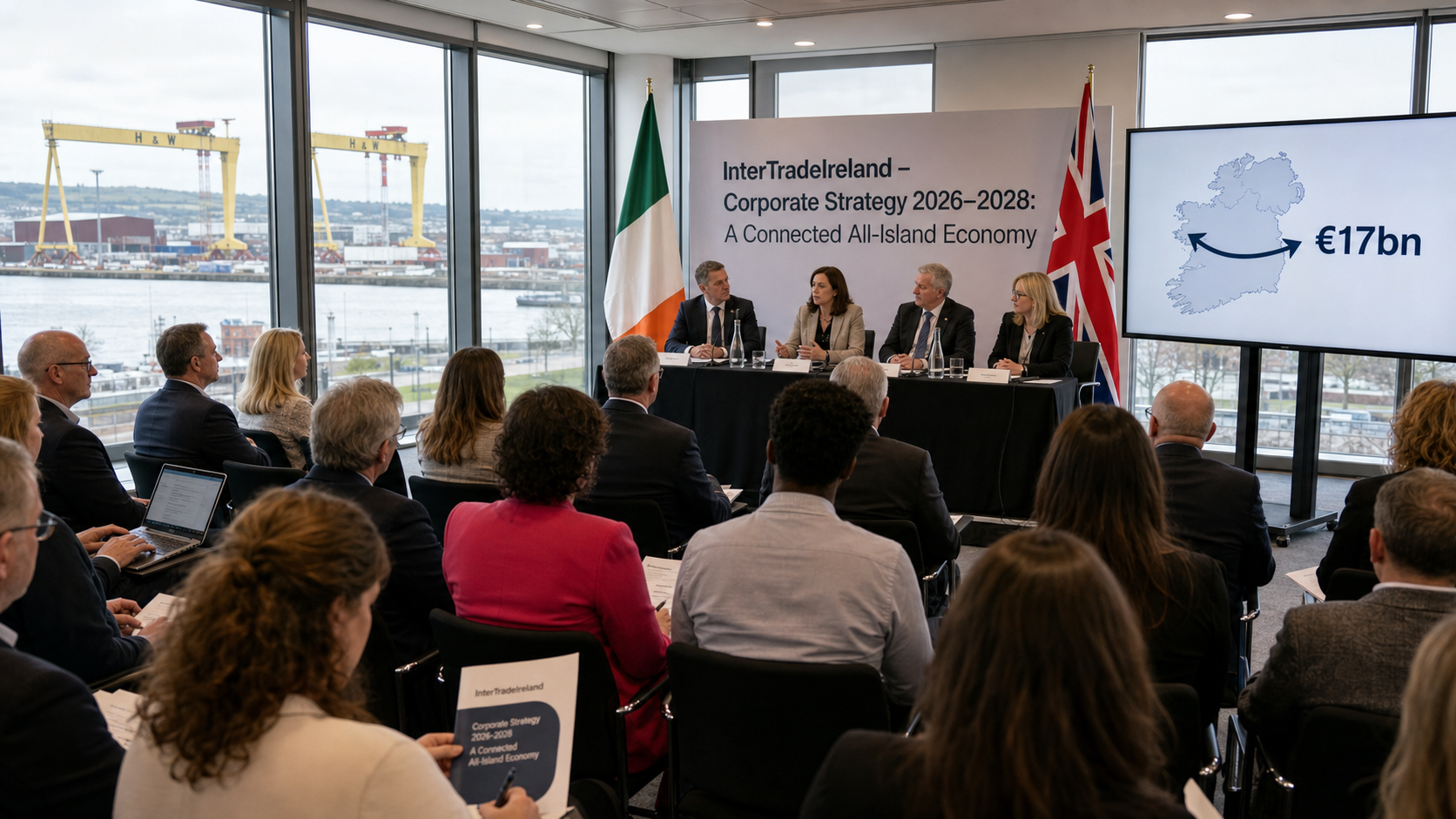
All-Island Trade Hits Record €17 Billion as InterTradeIreland Launches New Strategy for Connected Economy
Trade between Northern Ireland and the Republic of Ireland has reached a record high of €17 billion — equivalent to £14.6 billion — in the latest reporting period, with InterTradeIreland launching a new 2026-2028 corporate strategy designed to deepen economic cooperation across the island and to help businesses on both sides of the border navigate the challenges of a rapidly changing global trading environment.
Background
InterTradeIreland is the cross-border trade and business development body established under the Good Friday Agreement, with a mandate to promote economic cooperation between Northern Ireland and the Republic of Ireland. Funded jointly by the Department of Enterprise, Trade and Employment in Dublin and the Department for the Economy in Belfast, the body has been one of the most consistently effective of the North-South implementation bodies created by the Agreement, providing practical support to businesses on both sides of the border through programmes covering trade development, innovation, and skills.
The all-island economy has grown significantly since the Good Friday Agreement, driven by the removal of trade barriers, the development of cross-border infrastructure, and the increasing integration of supply chains across the island. The Windsor Framework, which resolved the most contentious aspects of the post-Brexit trading arrangements for Northern Ireland, has provided a degree of stability that has allowed businesses to plan with greater confidence, even if the political environment remains complex.
The record trade figure of €17 billion represents a remarkable achievement given the disruptions of recent years — including the Covid-19 pandemic, the post-Brexit adjustment period, and the global supply chain challenges of 2021-2023. It reflects the fundamental economic complementarity of the two jurisdictions, which share a common labour market, a common language, and deep historical and cultural ties that facilitate business relationships in ways that are difficult to quantify but easy to observe.
Key Developments
InterTradeIreland's new 2026-2028 corporate strategy, launched alongside the record trade figures, sets out an ambitious agenda for deepening economic cooperation across the island. The strategy focuses on three main pillars: supporting small and medium-sized enterprises (SMEs) to grow their cross-border trade; fostering innovation and research collaboration between businesses and universities on both sides of the border; and supporting the decarbonisation of the all-island economy, with a particular focus on the agri-food sector, which is the largest single component of cross-border trade.
The strategy has been endorsed by ministers from both jurisdictions, with Economy Minister Conor Murphy in Belfast and Enterprise Minister Peter Burke in Dublin both expressing strong support for the body's work. The joint ministerial endorsement is significant given the political tensions that have characterised North-South relations in recent years, and it reflects a shared recognition that economic cooperation is one of the areas where practical progress can be made even when political differences remain unresolved.
The record trade figure has been welcomed by business organisations on both sides of the border. Ibec, the Republic's main business lobby, described the figure as evidence that the all-island economy is "a genuine economic success story," while the Confederation of British Industry (CBI) in Northern Ireland noted that cross-border trade is a vital component of the Northern Ireland economy and that any measures that disrupt it — including the border security proposals that have emerged in the wake of the recent riots — would have serious economic consequences.
Why It Matters
The record all-island trade figure is significant for several reasons. At the most immediate level, it demonstrates that the economic relationship between Northern Ireland and the Republic is robust and growing, despite the political uncertainties of the post-Brexit period. This is important context for the current debate about border security and the Common Travel Area: any measures that disrupt the free flow of goods and people across the Irish border would have a direct and measurable impact on a trading relationship that is worth €17 billion annually.
The figure also has implications for the broader debate about the economic case for Irish unity. Proponents of unity argue that the all-island economy is already deeply integrated and that formal political unification would remove the remaining barriers to economic cooperation. Opponents argue that the current arrangements — which allow for economic cooperation while maintaining separate political and legal systems — are working well and should not be disrupted. The record trade figure can be cited by both sides of this debate, but it undeniably demonstrates that the economic relationship between the two jurisdictions is one of the most important bilateral trading relationships in these islands.
Local Impact
The practical impact of cross-border trade is felt in communities across the border region, from Derry~Londonderry and Newry in the north to Donegal, Monaghan, and Louth in the south. Businesses in these areas routinely trade across the border, employ workers from both jurisdictions, and rely on cross-border supply chains for their inputs and markets. The InterTradeIreland programmes that support these businesses — including the Acumen programme for cross-border sales development and the Innova programme for cross-border research and development — have a direct impact on employment and economic activity in border communities. The new corporate strategy's focus on SMEs is particularly relevant for these communities, where small and medium-sized businesses are the backbone of the local economy.
What's Next
InterTradeIreland will begin implementing the new 2026-2028 corporate strategy immediately, with the first new programme initiatives expected to be announced before the end of the summer. The body will publish quarterly progress reports against the strategy's targets, with a mid-term review planned for 2027. The North-South Ministerial Council, which provides political oversight of InterTradeIreland and the other North-South implementation bodies, is expected to meet in plenary session in the autumn, at which the new strategy will be formally presented to ministers from both jurisdictions. The next all-island trade figures will be published in early 2027, providing an early indication of whether the record set in the latest reporting period can be sustained or exceeded.