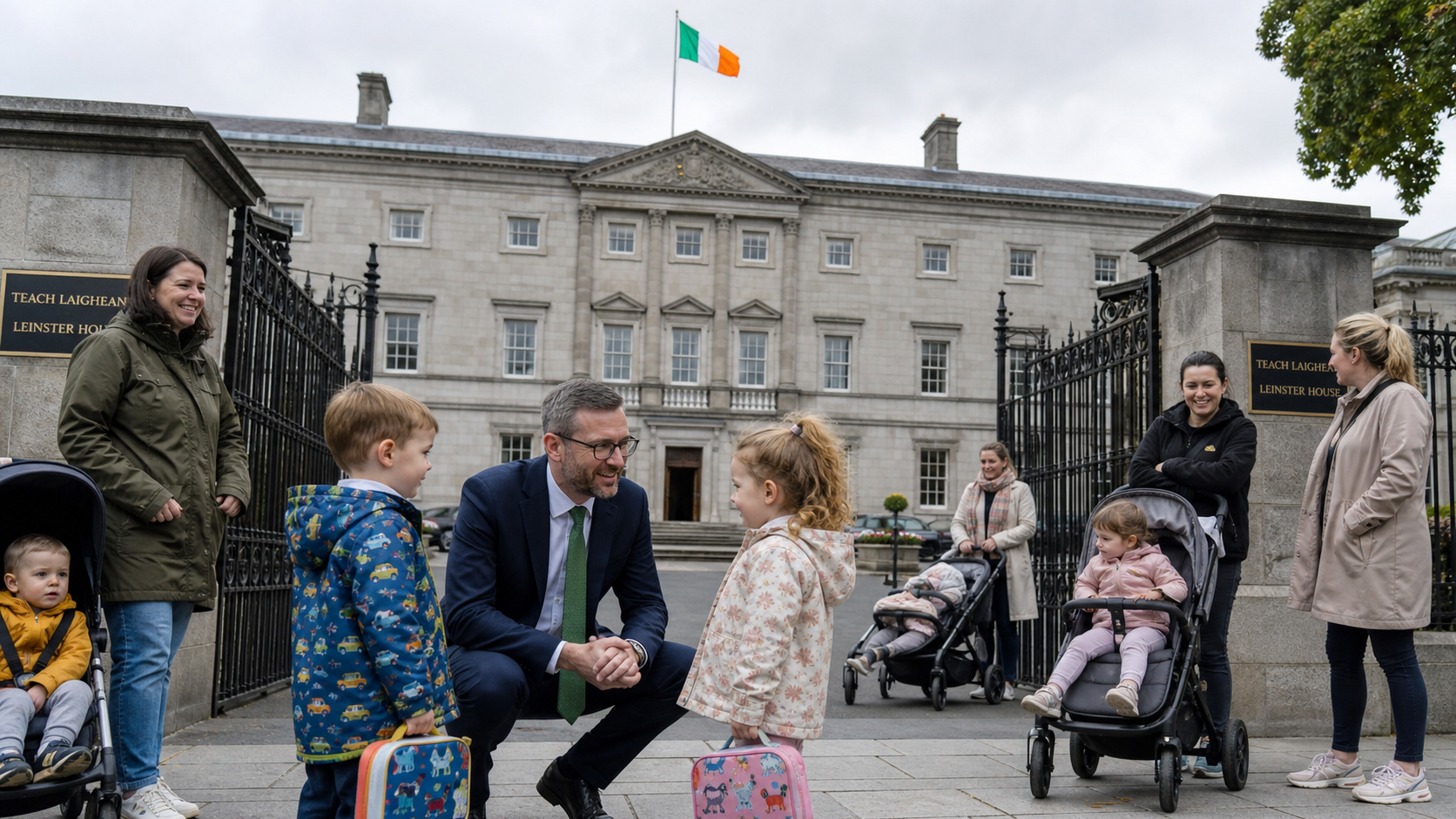
47,000 Children to Benefit from Childcare Subsidy Increase as O'Gorman Announces Expanded NCS Thresholds
Minister for Children, Disability and Equality Roderic O'Gorman has announced significant changes to the income thresholds governing the National Childcare Scheme, a move that will extend subsidised childcare to approximately 47,000 additional children across Ireland and provide meaningful financial relief to thousands of families currently paying full market rates for early years care.
Background
The National Childcare Scheme, introduced in 2019, was designed to replace the patchwork of earlier childcare supports with a single, income-linked subsidy system that would make early years care more accessible and affordable for families across the income spectrum. Under the scheme, families receive a subsidy based on their net income, with those on lower incomes receiving higher rates of support and the subsidy tapering as household earnings increase.
Since its introduction, the NCS has been progressively expanded, with subsidy rates increased and thresholds adjusted in successive budgets. However, childcare costs in Ireland remain among the highest in the European Union, with many families in Dublin and other urban centres paying in excess of €1,200 per month for a full-time childcare place. The gap between what the scheme provides and what families actually pay has remained a persistent source of frustration, particularly for middle-income households who earn too much to qualify for the highest subsidy rates but too little to absorb the full cost of childcare without significant financial strain.
The government's Programme for Government committed to further expanding the NCS as part of a broader strategy to reduce the cost of living for families with young children, and Monday's announcement represents the latest step in that process.
Key Developments
The changes announced by Minister O'Gorman on Monday will raise the income thresholds at which families qualify for NCS subsidies, bringing an estimated 47,000 additional children into the scheme. The minister confirmed that the adjustments are designed to ensure that families who have previously fallen just above the qualifying threshold — and who have therefore received no subsidy despite facing significant childcare costs — will now receive meaningful financial support.
O'Gorman described the announcement as part of the government's commitment to making childcare "genuinely affordable" for Irish families, noting that the cost of early years care has been one of the most significant financial pressures facing households with young children. The changes will take effect from the autumn, with families able to apply through the NCS online portal.
Early years sector representatives welcomed the announcement, though several organisations noted that expanding the number of families receiving subsidies must be accompanied by continued investment in the supply of childcare places and in the wages of early years workers, many of whom remain among the lowest-paid professionals in the country despite the critical nature of their work.
Why It Matters
Ireland's childcare costs are a structural problem with deep roots. Unlike many of its European neighbours, Ireland historically relied on a model of private provision with limited state subsidy, resulting in a market in which costs are driven by the economics of small, independent providers operating in high-cost environments. The NCS was intended to begin addressing this imbalance, but the scale of the challenge means that progress has been incremental rather than transformative.
The expansion announced on Monday is significant in numerical terms — 47,000 additional children is not a marginal adjustment — but it must be understood in the context of a system that still leaves many families paying substantial out-of-pocket costs even after subsidies are applied. For comparison, in countries such as Denmark and Sweden, state-subsidised childcare is available to virtually all families at a fraction of the cost that Irish parents face. The government's stated ambition is to move towards a similar model over the coming years, with the NCS as the primary vehicle for that transition.
Local Impact
The impact of the expanded thresholds will be felt most acutely in urban areas where childcare costs are highest and where the gap between subsidy levels and market rates has been most pronounced. In Dublin, Cork, and Galway, where full-time childcare places regularly cost between €1,000 and €1,400 per month, even a partial subsidy can make a meaningful difference to household budgets. For families in rural areas, where costs tend to be somewhat lower but access to childcare places can be more limited, the changes will also provide welcome relief. The Department of Children has confirmed that the NCS helpline will be staffed with additional advisers in the weeks following the announcement to assist families with applications.
What's Next
The changes to NCS thresholds will be implemented ahead of the autumn childcare term, with the Department of Children confirming that the online application system will be updated to reflect the new eligibility criteria. Budget 2027, due to be presented on 6 October, is expected to include further measures relating to childcare costs, with the government under pressure from opposition parties and advocacy groups to accelerate the pace of reform. Minister O'Gorman has indicated that the government remains committed to the long-term goal of a publicly funded childcare model, though the timeline for achieving that ambition remains subject to ongoing budgetary negotiations.